Friday, June 09, 2006

Blowin' in the Wind

Dear Tillerman,
What is the best kind of wind direction indicator to fit to your boat? A standard burgee or one of the fancy pointy things?
Tim

Dear Tim,
In the immortal words of well-known Minnesota sailor Robert Zimmerman, former owner of the Bequia schooner Water Pearl, "You don't need a weather man to know which way the wind blows."

And after you've been sailing for a while you really won't need a wind indicator, pointy or otherwise, to know which way the wind blows - at least in medium and heavy wind.

But light airs are a different story. When it's one of those hazy, lazy, patchy-wind days of summer and in some places there is a knot or two and in other places there isn't a breath ... Well, then you do need a very sensitive wind indicator to be able to detect the slightest zephyrs so you can trim your sails accordingly.

I favor using cassette tape, one indicator at the top of the mast, and one in front of the mast of my Laser at eye level. I use the lower one most of the time but if that one is hanging straight down I look at the mast-head fly and sometimes it gives me a clue of where the new wind may be coming from.

But here's the real secret. You have to use the right cassette tape.

I tried using a recording of the aforementioned Mr Zimmerman's Idiot Wind. Bad idea. "Idiot wind, blowing like a circle around my skull." Enough said. I also tried using some tape of his Blowin' in the Wind but judging by the results I must have accidentally used a section of Hard Rain's A-Gonna Fall. Easy mistake to make.

Lately I have been having success with tape from Eric Clapton's Unplugged album. The tape is always on top of my sailing toolbox in case I need another piece.


At first I used a piece of Rollin' and Tumblin' but it made the boat very unstable - hate those death rolls. And the time I tried Before You Accuse Me I ended up in the protest room. And using Nobody Knows You When You're Down and Out was a total disaster. All too prophetic, I fear. DFL.

But if you can stay away from those three tracks you will get good results, I promise.

If you can't lay your hands on any of the special light airs go-faster Clapton Unplugged wind-indicator tape, I can supply it at a special reduced rate of $5 per foot. Just send your bank account details to my email address and I will arrange the transfer.

Tillerman

Thursday, June 08, 2006

Pressure

The kids gather for the regatta. For many of them it is their first time. This is a big deal for them. They look around at the other kids. Some of them are bigger, have fancier sailing clothes, have all the latest gizmos on their boats. Everyone is nervous. They don't know what to expect.

The races are run. There are wind shifts and gusts and collisions and capsizes. The scores are tallied and trophies are awarded. There is a winner. And there are the rest. For most of the kids it has been a day full of fun, excitement and laughs, meeting old friends and making new ones, making mistakes and learning something new, small triumphs and minor disappointments ...

But one kid is different. She is over there with her parents screaming and shouting and stamping her feet. For some reason she thought she was going to be the winner of the regatta and she isn't. It wasn't her fault of course. It's not fair. Nothing her parents or her coach can say will calm her down. She's red in the face and tears are streaming down her cheeks. She hates sailing. Sailing stinks. She's never going to sail again.

Maybe she'll get over it and be out sailing again next week. Maybe she won't.

As a (former) parent of junior sailors and organizer of junior regattas I've seen this scenario several times over the years. In my teaching of sailing I worked hard to avoid it. I taught my students about sportsmanship and how to behave whether you win a race or whether you don't. Even after our practice races I made sure that the kids encouraged the losers and congratulated the winners. We discussed how just completing the end-of-season long distance race and entering your first regatta are major achievements to be proud of. You don't have to be first across the finish line to be a winner.

But my efforts haven't always succeeded. For some reason, a kid will get the idea in his or her head that they have to win this race or that regatta and that if they don't it will be the worst thing that has ever happened in their lives and when they don't win they break down and make an embarrassing emotional display in front of all their friends.

Where does this pressure come from? Are the parents pushing them too hard? Or is it something that the parents are doing in a very subtle way, creating a culture of expectation of excellence in their kids in everything they do? Or is it something inherent in some kids' personalities?

This expectation that you always have to win may make some sense in other pursuits. If you really are the smartest kid in your class and you work hard you probably will be the valedictorian. If you are the right body type and you train harder than any of the other kids then you probably will win the cross-country race. But, in sailing, nobody racing in tough competition can expect to win all the time; there's just too much luck involved in our sport.

It must be especially hard for the children of sailing champions. I've no idea how the kids of the Gary Jobsons or Dave Dellenbaugh's of this world cope with trying to live up to the achievements of a famous father. I've seen this problem locally too. The son of our local champion has been sailing with his father since he was 3 or 4 years old. They entered some fun races together. The kid's hand was on the tiller but Dad was calling all the shots ... trim, ease, tack now, duck this boat. They won some races. The kid got the idea that sailing is easy and that he's as smart as his Dad. This year Dad bought the kid his own boat and he started racing on his own. He found out in his first race that sailing isn't as easy as he thought and he didn't realize that it took his Dad 30 years of hard work to become as skilled as he is now. The kid had a meltdown and has vowed to give up sailing.

Somehow my own sons managed to avoid all these pitfalls. They sailed throughout their teenage years and,
now in their twenties, are still sailing. When they were younger they entered some junior regattas; they each won some and lost in others. Sure they enjoyed their victories but I never saw them being too disappointed when they didn't win. How did they learn to cope with losses? In this particular case I think it was through sheer luck rather than conscious effort on my part as a parent.

The luck in this case is that I am no more than a mediocre sailor myself. Yes, I am passionate about sailing and yes, I know a fair amount about it. But in my own racing, through clumsiness, forgetfulness and sheer bloody incompetence, I almost always finish somewhere back in the fleet. I'm sure my sons noticed this. I hope they noticed that even when I finish in the middle of the pack I'm also having a good time. I hope they learned the right lesson from this observation: sailing is fun no matter where you finish in a race.

I know there are some readers of this blog who sailed as kids and became champion sailors in their countries. I wonder whether you felt pressure to perform as kids. How did your parents support, motivate or challenge you? Some of you readers are parents of kids who sail now. What can parents do to avoid putting so much pressure on their kids that sailing isn't fun any more?

Wednesday, June 07, 2006

Mushotoku


Proper Course has no goals.

Blogging is not a game that is played to win.
It is a game that is played just to play.

This blog is not sailing towards a destination.
It is just wandering among the islands.

Each day a new island appears on the horizon. Fresh experiences, sensations, impressions. An unfamiliar thought about sailing occurs spontaneously, naturally. Sometimes it is an isolated island of an idea alone in the ocean. Sometimes it is an archipelago of thoughts and I can hop from island to island. I don't have fixed rules in my mind about what's good, what's bad. A rocky volcanic island, a coral reef, a sandy spit. Each is fascinating in its own way. I just explore the island I'm on at that moment. Sometimes a few friends share it with me.

I pick an idea I like.
I write about it.
Then I move on.

There is no end to the journey.
It is an endless cruise.

Proper Course has no proper course.


Tuesday, June 06, 2006

Learning to Love Light Air

The last couple of weeks of lake sailing in New Jersey have been in light, fluky, patchy winds. Some of my sailing buddies are getting grumpy and are grumbling about the conditions. But, much to my own surprise, I'm actually enjoying the very different challenges of racing in the light stuff. It's as if a light bulb has gone on in my head and I finally "get it". Actually I think the bulb used to be on a few years ago but the circuit was blown by a knottage overload and someone just replaced the fuse.

Perhaps it started when I saw my son's positive attitude to racing in light airs at the Laser regatta a couple of weeks ago. Whatever the reason I went to Wednesday night Sunfish racing last week with a determination to enjoy myself whatever the winds might be. I went out to the course area an hour or so before racing started and checked out the winds. No doubt there was more wind on the left side of the course near the more open part of the reservoir.

So in the first race I pulled off a good start near the pin end of the line and worked the left side of the course. It worked! At the windward mark I was in third place (in a fleet of eighteen boats) just behind the two best sailors in the fleet, Doug and Scott. I hung with them downwind and went out to the left again on the final beat.

Now let's see. What Would Dave Do? I'm now out on the left side with most of the competition to my right. Only Charlie seems to be going further left and he's no threat. Dave would say Evaluate Risk -- if you're happy with your position now is the time to consolidate. So I head back over to the right side, crossing Doug and just ducking Scott. What did Dave say about the finish? Oh yes, make Gains at the Finish if you are close to other boats by finishing on starboard tack. I tack on to starboard. Scott has to tack beneath me. Doug has to tack below him. Ha! I have them pinned -- they can't tack for the line. Just need to sail until I can lay the finish line and I will win my first race in this series this season. Oops - what's this? Here comes good old Charlie on port tack crossing all of us. I guess he rolled the dice, banged the corner and beat us all. Oh well, second is not too shabby in this fleet.

Laser sailing on Sunday was also in light patchy winds with huge holes. In the second race I was leading at the first windward mark but on the reach the wind died and shifted ninety degrees and the whole fleet caught up with me. I was in last place at the leeward mark.

OK, let's see what I can make of this. Do a roll tack and stand up in the process, taking a good look upwind. Hmm - I see a little puff on the left side of the course. Do another tack and try and get in front of it. Yes, definitely extra pressure and I start to gain. Stand up again. I see a wind line over on the right. Tack and start working over there. Oh yes, this is better, now I'm moving. At the windward mark I'm back in first place with a solid lead and hold on to it to the finish.

OK. I admit it. I only wrote about the best races each day. There were other times when I made the wrong choices and saw nearly the whole fleet pass me by heading for the side of the course where I was "sure" there was no wind.

But that's the beauty of light air sailing. It's mainly a mental game rather than a physical one. But also a game of chance. I suppose playing poker might be a near analogy. You have some information to predict what the chances of certain outcomes will be; and you know something about the psychology of your opposition. But your information is incomplete. All you can do is assess the probabilities, make your bet and see what cards turn up.

Maybe that other Tillerman blog could teach me something after all.

Monday, June 05, 2006

Parent Shadows

You had this beautiful baby 15 years ago. He was the apple of your eye. As he grew up you taught him to walk and swim and ride a bike. As soon as he was big enough you shared your passion for sailing with him by taking him for rides on your boat. When he was ready you taught him how to sail. The two of you enjoyed many years sailing together and life was perfect.

Then all of a sudden the kid is as tall as you, he's sprouting a beard and he's into video games, playing the guitar and... girls. Sailing is taking a back seat in his life. Y
our own IQ (at least in his eyes) has dropped to around 70 and if he does deign to go for a sail with his old man he thinks he knows a damn more about sailing than you and isn't shy about letting you know. You love your son and want to spend time with him sharing the joy of sailing. But when you sail together there's no joy in it any more for either of you. What happened?

Sorry to break the news but this is perfectly normal. Your son is growing up. At this stage he is becoming more independent, wants to experiment and try out new things, needs to start making his own choices in life. It can be a stressful time for teenagers and their parents, and the sad news for us sailors is that sailing together can exacerbate the situation. You and your adolescent are thrown together in a small space, dealing with stressful situations. Whether you're racing or dealing with a sudden squall while cruising, sailing demands quick decisions with the skipper calling the shots. Sometimes there's no time for dealing with arguments from an adolescent testing your tolerance.

Look at from his perspective. He wants to make his own decisions, be in control. (Why do you think kids of this age enjoy video games so much?) He craves excitement and challenge. Tootling round the bay for the umpteenth time with Mum and Dad just doesn't turn him on any more.

So you need to rethink what your real objectives for your offspring are. Is the most important thing in the world that he spend every Sunday afternoon for the next three years being your spinnaker trimmer? Or do you want him to grow into a well-adjusted adult capable of taking responsibility, making sound decisions, dealing with challenges.. and maybe, just maybe, having an appreciation for the rewards of sailing? If it's the latter -- and of course it is -- you need to start letting go, giving your son more freedom, more space.

Before any of you feminists complain that I am only talking about boys here, let me explain. Teenage girls were a mystery to me when I was a teenage boy. I never had a daughter so teenage girls are still a mystery to me. Some of what I discuss in this series of posts on teenagers and sailing may apply to girls. Some may not. I haven't a clue.

I mentioned in my first post on this topic that I felt that the main reason that my own sons kept sailing through those teenage years was through luck rather than any particular skill at parenting on my part. The first stroke of luck was that I started off my racing career in a single-hander, the Laser, and when we moved to the USA in 1989 we ended up living close to a sailing club that was also dominated by single-handers, the Sunfish. My kids learned to sail in England in Optimists and so, in our new home, it was natural for them to graduate to Sunfish and Lasers too.

Without thinking about it we had headed off one of the major issues that affects parents who sail with their teenagers. Yes, we went to the same sailing club, sometimes to regattas and clinics together. But we weren't actually sailing in the same boat together. So there was no opportunity to argue about how dumb Dad was for choosing the wrong side of the beat; and no chance that the teenager would become annoyed because Dad was telling him that he was pinching all the time. Sure we had our tensions and arguments. But the very nature of our sailing meant that, for the most part they didn't directly affect our enjoyment of sailing.

The other beauty of sailing single-handers was that it meant the kids had the freedom to sail, or not to sail. The Sunfish fleet I mentioned actually meets on the lake across the road from our house. So if Dad wanted to get up early on Sunday morning and go out sailing at 9 o'clock and one son wanted to lie in bed and show up at noon, that was perfectly practical. If Dad was going to a regatta and one or both sons wanted to sail in it too,we could do that. But if a son had more important (to him) stuff to do that day, that was OK too; he wasn't depriving Dad of a crew by skipping sailing.

If you're not a single-handed sailor this solution may not be practical. At the club where I taught sailing for several years they had a different way of handling the problem. I headed up a junior sailing instruction program in Optimists and Lasers which kids attended until they were about 15. Afterwards if kids wanted to continue sailing their only option really was to crew on one of the club's one design classes - Thistles, Stars, E-Scows. Some kids crewed for their parents; many crewed for someone else - an uncle, a grandfather, a friend. It hadn't really occurred to me before I wrote this post but I see now that this probably was a way that had evolved to deal with the tensions of parents and kids sailing on the same boat.

So that's a couple of ideas on how to put some distance between yourself and your teenage kids but still be able to enjoy sailing together -- well sort of "together". I'm sure there are other ways.

Carol Anne at Five O'Clock Somewhere wrote a very perceptive post a few weeks ago about Man Shadows, the virtual wind shadows that many sailing women feel from the men in their lives. Parents cast shadows too. Make sure you give your teenager some clear air.

The next post in this series on how (not) to motivate your kid to sail is about the pressures of competition.

Sunday, June 04, 2006

Cheat the Nursing Home

I'm not really a morbid person.

Yes, it is true I wrote a post yesterday about eleven different ways to get yourself killed while on or in the water.

And yes, I do have a bumper sticker on my car saying Cheat the Nursing Home. Die on your Laser. It's a joke, OK?

But as we seem to be on the theme this weekend of exiting this life while having a good time on the water, let me draw your attention to this article in the Fairfield County Weekly, in which Alan Abel describes a business that offers elderly people tired of life the opportunity to end it all aboard a luxury cruise ship. The ship aptly name The Last Supper is operated by Euthanasia Cruises.

Saturday, June 03, 2006

Do Not Read This Blog

If you are planning to go out on the water this weekend do NOT read this blog. If you do you will probably end up being so worried about your personal safety that you will cancel your boating plans and curl up at home on a sofa with a good book. On no account click on this link. STOP. Too late. You went and clicked didn't you?

For the 2% of readers who resisted the temptation to follow the link, let me explain that Boating Safety Law and News has been reporting almost every day in the last few weeks about different ways in which you can get yourself killed or critically injured on the water. I assume you are wary of such dangers as your boat capsizing or being struck by a barge, and I know that you are much too careful to drive your jetski into the side of another boat. I'm sure you aware of the risks if you don't wear your lifejacket and of the danger of carbon monoxide poisoning if your cabin is not well ventilated. And we all know that it's not a good idea to drink and drive, whether your vehicle is a car or a motor boat.

But have you ever worried about a fellow boater pulling out a semi-automatic pistol and shooting at you? Have you thought about how dangerous it is not to have your boat properly lit at night? Have you considered that you could be critically injured after being struck by a kayaker? Or that you might meet your end while snorkeling and being struck by a hit-and-run driver?

OK, by now I've probably scared you enough. You're ready to play it safe, stay on the shore and just play with your radio-controlled model boat. Think again. The most bizarre way to get yourself killed while boating occurred when a Florida man used an inflatable to go and rescue his stalled radio-controlled boat and another RC boat punctured his raft.

It's a dangerous world out there kiddies. Play safe on the water this weekend.

Friday, June 02, 2006

Teenagers

"Sailing stinks. I hate sailing. I'm never going sailing again."

On Wednesday night, after sailing, I discovered that the son of one of my best sailing buddies had had a bad sailing experience at the weekend and had emphatically declared that he was retiring from sailing for good. The kid is about 11 years old.

Earlier this week in response to this post, Ward from about.com said ...
I would sincerely like to have answered by anyone whose children are safely past adolescence: How many years' hiatus from sailing with his father does the average teenager require? For the first season ever, mine apparently just wants to play (1) World of Warcraft online and (2) his guitar in his free time. Is the lure of a crew of naked women my only current hope, or is this the part where I am supposed to lean back and not let on that I miss his company?

And Carol Anne from Five O'Clock Somewhere said ...
I'd second Ward's request for a discussion on dealing with teenage offspring as crew. I don't have the problem of mine losing interest in sailing (you don't need naked women; a Dutch track star in a bikini works wonders), but there are some, uh, interesting dynamics at work.

Judging by the record number of comments to my post about Sailing Romance, you guys are somewhat interested in this whole question of sailing and its impact on personal relationships -- or vice versa. So I will write some posts on the topic of being a sailor and parent of teenagers who also sailed.

I won't make these part of the Ask the Tillerman series because that is a spoof agony column where I write pathetic attempts at flippant humor. It seems that this is too important a subject to treat in that way.

Let me first make clear my qualifications, and lack of them, for addressing this topic.

I do meet Ward's criteria of having children past adolescence. More importantly both of my sons learned to sail at the age of 7 or 8; sailed and raced throughout their school years, including those tempestuous teenage years; retained an interest in sailing through their years in college with one of them being an active intercollegiate racer; and now in their twenties with all the typical pressures on people in that age bracket -- building a career, dating, entry-level salaries, graduate school, marriage, mortgage, baby, fixing the leak in the roof -- are both involved to some degree in sailing at an age when many people give up or take a break from the sport.

I have also seen many other kids who weren't as fortunate as mine, both from the perspective of my work as a sailing instructor and as a friend of other sailing parents. Sadly, I've seen numerous kids turned off by the sport or who simply lost interest in sailing.

On the other hand I don't think I have any magic secrets. I count my own sons' continued interest in sailing -- no teenage hiatus there -- as amazingly good fortune rather than any particular parenting prowess on my part. Like most of us I stumbled through the years of being a parent of teenagers without an owner's manual, made a lot of mistakes, yet somehow survived.

But now I look back and realize how lucky I was, how lucky we all were. My kids stayed active in sailing and still enjoy it so we must have been doing something right. I think it's going to take several posts to tell the whole story -- the good, the bad, and the downright ugly -- and to discuss what works and what doesn't so I'll sprinkle them in with other posts over the next few weeks.

Some of the topics I want to discuss are ...


Thursday, June 01, 2006

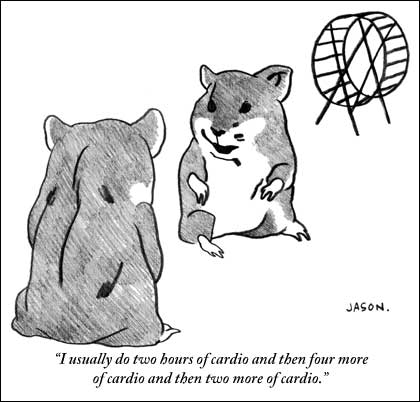
Cardio

Please don't take my previous post on physical conditioning too seriously. You can have too much of a good thing.

On the Value of Physical Conditioning

The June 2006 issue of Sailing World has a superb article by Stuart Streuli on how coach Scott Ikle transformed the college sailing team at Hobart and William Smith Colleges in upstate New York into a national sailing power. According to Sailing World, "Ikle turned a former club team known more for its social prowess than its regatta results into one of the toughest, if not the toughest in the country." Last year the team won the national intercollegiate coed dinghy and team-racing championships in Austin, Texas.

The article describes how Scott emphasizes the importance of goal-setting, planning, mental preparation, mandatory physical workouts, structured practice - and a policy of abstention from alcohol during weekend regattas. Yikes - this program really is serious.

But the quote I liked best was Coach Ikle's thoughts on the value of physical conditioning ...
I see it as positive self-esteem; if you work hard you feel good about yourself. A lot of sailing is mental. If you feel good about yourself and you feel prepared, there is a good chance you can do well.
Do you agree? Is physical fitness important for the sailing that you do?

OK - I'm off to have a run and then lift some weights.