Sit further forward ...
In the six summers I spent teaching kids to sail in Optimists and Sunfish I must have spoken or shouted that phrase (or words to that effect) hundreds of times.
Most kids, when they are learning to sail, seem to want to sit as far back in the boat as they can, even right alongside the tiller in an Optimist, and hang on to the tiller for dear life. I guess it's a natural reaction. It must feel a bit more scary, less in control, to hold the end of the tiller extension instead of the tiller and to sit much closer to the bow of the boat. But being the big bad evil sailing instructor who believes that it's much easier to learn good habits than to break old ones, I always endeavored to teach my kids right from day one to sit well forward in their sailing dinghy. Unless you're planing or taking waves over the bow, it's faster.
Sit further forward...
So it was something of a surprise to hear the same words directed at myself while in the Laser class at Minorca Sailing a few weeks back. We were sailing upwind in a fairly light wind, not hiking conditions, and I was sitting at the front of the cockpit. Honest. But I had forgotten that in such conditions I should have had my weight even further forward in a Laser.
Oh, I know in the really light stuff you need to get your weight forward and lift the transom out of the water. On all those lazy, hazy, crazy days of summer that I've spent racing -- correction: drifting in -- my Laser on New Jersey lakes in 0-2 knots of wind, I'm as adept at anyone at climbing up in front of the mainsheet and squatting in some painful contortion just behind the mast.
But this situation in Menorca was in a somewhat stronger wind. Butt on the side deck kind of wind. And my instructor, Comet, was telling me to move my weight up alongside the centerboard, not just to the front of the cockpit.
On checking Comet's tip in my home sailing library I see that Ben Ainslie offers much the same advice in The Laser Campaign Manual: "Sit as far forward as possible (front leg in front of the mainsheet)." And in Ben Tan's Complete Introduction to Laser Racing, Rod Dawson in the chapter on Straight-line Speed advises us to "keep the bodyweight forward, next to the centreboard, to lift the transom above the water level,thereby reducing drag" when beating in lighter winds.
So how did I develop this bad habit of sitting just behind the centerboard of the Laser when beating in light winds? It's sailing that damn Sunfish, I'm sure. The Sunfish guru of gurus, Derek Fries in his book Successful Sunfish Racing specifically advises the Sunfish skipper to "situate himself even with the forward edge of the cockpit. There is no reason to sit any further forward". Ahah. That's it. All those years of sailing the Sunfish taught me a bad habit for Laser sailing.
So in my practice sessions since returning from Menorca I've been working on developing the correct style for sailing a Laser upwind in lighter winds. On some sessions I've sailed for a while with my weight up by the centerboard and then moved back to my old position. It certainly feels different. Hard to put into words but the correct technique has a more locked-in-the-groove smooth balanced feel to it. Fast. (I hope.)
This was the one of the things I was looking for when I had the chance to observe some top-notch Laser sailors last Sunday. I was admiring the leader of one race who was sailing upwind, sitting well forward, and also leaning his body towards the bow too. He looked smooth and fast, and it was easy to see that the knuckle of his bow was slicing into the water and the transom was lifted clear of the water.
By contrast another very good sailor a couple of places behind him was sitting a little back in the cockpit and leaning backwards. His bow was actually lifted up above the surface of the water. I couldn't understand why such an excellent sailor was using this style. Did this usually work for him? Everyone's different, it seems.
There's a tiny little problem with moving your weight forward of the front of the cockpit on a Laser. The deck cleat for the mainsheet. It is in exactly the wrong place. Sit forward and that cleat is going to be sticking into a part of your anatomy that shouldn't have foreign objects poked into it. Not too bad if you are wearing a couple of layers of neoprene. But definitely disconcerting if you are only wearing a swimsuit. But you have to do it. I know of at least one Laser sailor who has removed his deck cleats to avoid this... ahem... sensitive issue.
Thanks to the three Laser sailors who commented on my previous post about Laser technique. Would like to hear from any other Laser freaks if you agree with this stuff (or even if you don't) or have any other tips on light wind beating.
Saturday, November 11, 2006

Wednesday, November 08, 2006
WD-40 and Duct Tape
Thanks to Garfieldt's Blog for this great advice. It really is all you need to know about maintaining boats ...
- You only need two tools: WD-40 and Duct Tape.
- If it doesn't move and should, use the WD-40.
- If it shouldn't move and does, use the duct tape.
Tuesday, November 07, 2006
Three Ways to Sail a Laser Downwind
Last weekend I was observing the different techniques that the top sailors in our Laser fleet used on a run. The winds were mainly around 5 to 10 knots with smallish waves, not big enough for major surfing but certainly pronounced enough that some gains could be made by using the waves.
Sailor A. Sitting well forward with one knee alongside the centerboard, locked in to the boat. No body movement or steering. Outhaul released so that he had a baggy sail. Boom slightly in front of 90 degrees to centerline of boat. But here's why this guy was going fast and what singled him out from all the boats around him. The leech of his sail was pumping rhythmically every time a tiny wave rocked his boat. He wasn't causing these leech flicks with any conscious movement of his body but they were sure helping him to keep the boat moving fast. You have to get the vang released just the right amount to make this happen. Too tight and the leech won't pump. Too loose and the leech will just be floppy. Totally legal and totally fast.
Sailor B. This guy clearly believed that the way to gain maximum advantage from the waves was to carve big turns up and down across the course to catch the best waves and/or steer through gaps in the waves. He would heel to leeward and trim in aggressively to head up; then flatten the boat; then only a few seconds later he would heel the boat to windward and bear away sharply and release all the sheet he had trimmed in. There was some rudder movement but most of the steering was done by the heeling and trimming. Legal? Probably -- if he had good reasons for all of his radical changes of course then he was certainly entitled to heel and trim to steer the boat.
Sailor C. This guy was sitting in the boat sideways in a knees-up position, not locked in next to the centerboard like Sailor A. He wasn't making major changes in direction like Sailor B but he was rocking a lot. His upper body was moving in and out, and the rig was rocking in response too each of these movements. Occasionally he would even lift his butt off the deck to initiate a major roll to leeward and then sit down again to roll the boat back to windward. There was some discussion on our mark boat as to whether this guy was pushing beyond the limits of Rule 42; my two fellow Laser sailors on RC duty felt that his technique was perfectly legal if he was using it to work the waves. Hmmm -- I wasn't so sure.
So which technique worked best? Search me. Sailors A and C were leading or tied for the lead when I was watching them, and Sailor B is one of the most successful sailors in the fleet over the season. I guess all of these methods will work better or worse depending on wind and wave conditions on any given day. Though I might be cautious about using Sailor C's technique at a regatta where there were on-the-water judges enforcing Rule 42.
Any comments?
Sailor A. Sitting well forward with one knee alongside the centerboard, locked in to the boat. No body movement or steering. Outhaul released so that he had a baggy sail. Boom slightly in front of 90 degrees to centerline of boat. But here's why this guy was going fast and what singled him out from all the boats around him. The leech of his sail was pumping rhythmically every time a tiny wave rocked his boat. He wasn't causing these leech flicks with any conscious movement of his body but they were sure helping him to keep the boat moving fast. You have to get the vang released just the right amount to make this happen. Too tight and the leech won't pump. Too loose and the leech will just be floppy. Totally legal and totally fast.
Sailor B. This guy clearly believed that the way to gain maximum advantage from the waves was to carve big turns up and down across the course to catch the best waves and/or steer through gaps in the waves. He would heel to leeward and trim in aggressively to head up; then flatten the boat; then only a few seconds later he would heel the boat to windward and bear away sharply and release all the sheet he had trimmed in. There was some rudder movement but most of the steering was done by the heeling and trimming. Legal? Probably -- if he had good reasons for all of his radical changes of course then he was certainly entitled to heel and trim to steer the boat.
Sailor C. This guy was sitting in the boat sideways in a knees-up position, not locked in next to the centerboard like Sailor A. He wasn't making major changes in direction like Sailor B but he was rocking a lot. His upper body was moving in and out, and the rig was rocking in response too each of these movements. Occasionally he would even lift his butt off the deck to initiate a major roll to leeward and then sit down again to roll the boat back to windward. There was some discussion on our mark boat as to whether this guy was pushing beyond the limits of Rule 42; my two fellow Laser sailors on RC duty felt that his technique was perfectly legal if he was using it to work the waves. Hmmm -- I wasn't so sure.
So which technique worked best? Search me. Sailors A and C were leading or tied for the lead when I was watching them, and Sailor B is one of the most successful sailors in the fleet over the season. I guess all of these methods will work better or worse depending on wind and wave conditions on any given day. Though I might be cautious about using Sailor C's technique at a regatta where there were on-the-water judges enforcing Rule 42.
Any comments?
Yachting Murders
Before being tied to an anchor and tossed overboard with her husband ... Jackie Hawks also "begged to see her grandchild again," and asked Skylar Deleon, "How could you do this to us? You brought your wife and baby on this boat. We trusted you."Scary allegations in Santa Ana trial concerning the murder of a retired couple who just wanted to sell their yacht and spend more time with their first grandchild.
Monday, November 06, 2006
Watching Boats
This weekend I did my turn on race committee duty for our Laser fleet. With over 60 boats out racing the starts were crowded...
 How many out of the 60 made a start in the front row?
 Want to risk an approach on the port tack layline in this fleet?
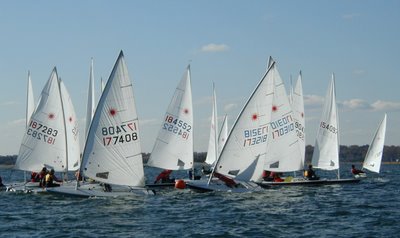 "Don't even think about going in there..."
 How many out of the 60 made a start in the front row?
The windward mark roundings were crowded...
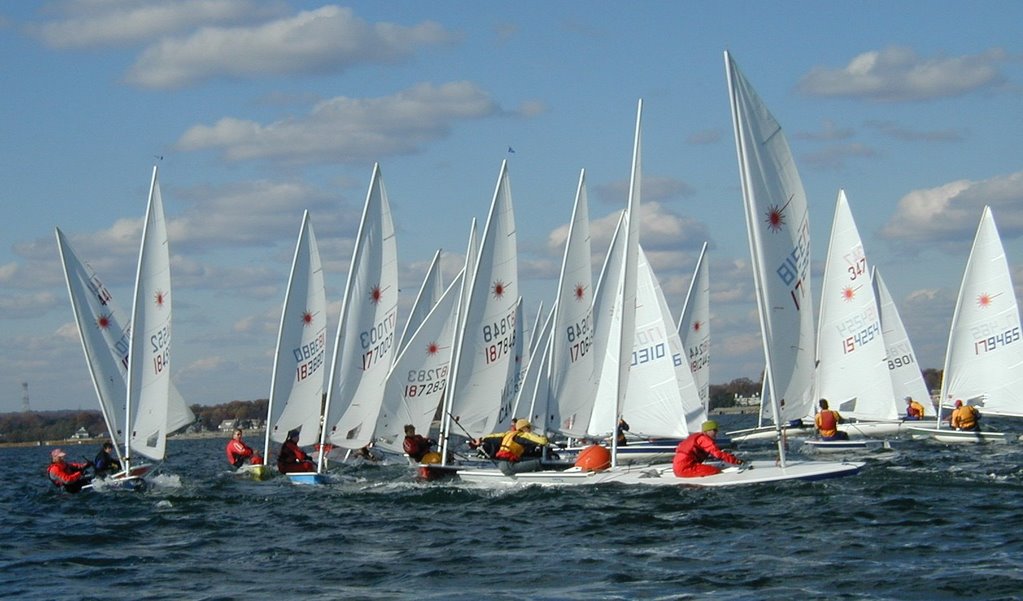 Want to risk an approach on the port tack layline in this fleet?
And the leeward gates were total mayhem...
 "Don't even think about going in there..."
I had plenty of time to observe the techniques of the fleet leaders -- especially in those areas that my instructor in Menorca told me I need to improve. Two things surprised me...
First, it seemed that I learned a lot more from watching other sailors than I normally do when I am on race committee. Perhaps it was because certain boat-handling issues were fresh in my mind having spend a couple of days practicing just those skills a couple of days last week on my own private lake. (OK -- it's not really my lake -- I share it with the other 8,414,349 citizens of the Garden State -- but for some reason my co-owners allowed me total private unfettered sole use of the lake last week.)
Secondly -- and this was even more of a shock -- it was apparent that even the best sailors in the fleet had very different techniques from each other in the areas I was studying.
Hmmm. What does this mean?
a) There is no best way to sail a Laser and everyone develops a technique that works for them.
b) Even the best guys have faults in their technique, or maybe just bad days when they forget how to sail properly.
c) These guys aren't as good as I thought they were.
d) None of the above.
Some guy called "derek" left a comment a few days ago asking for some clues on what I learned in Menorca. So for "derek", and any other Laser freaks out there, there will be at least three posts this week on Lasering technique (which the rest of you can ignore if you wish).
It's about time we had some serious sailing stuff on this blog. After the comments by someone called "mommy" and someone else called "adrift at sea" on Friday's post, I was beginning to worry that this was turning into a relationship blog. "Welcome to the family" indeed.
Watch this space. This is a serious sailing blog. Really...
First, it seemed that I learned a lot more from watching other sailors than I normally do when I am on race committee. Perhaps it was because certain boat-handling issues were fresh in my mind having spend a couple of days practicing just those skills a couple of days last week on my own private lake. (OK -- it's not really my lake -- I share it with the other 8,414,349 citizens of the Garden State -- but for some reason my co-owners allowed me total private unfettered sole use of the lake last week.)
Secondly -- and this was even more of a shock -- it was apparent that even the best sailors in the fleet had very different techniques from each other in the areas I was studying.
Hmmm. What does this mean?
a) There is no best way to sail a Laser and everyone develops a technique that works for them.
b) Even the best guys have faults in their technique, or maybe just bad days when they forget how to sail properly.
c) These guys aren't as good as I thought they were.
d) None of the above.
Some guy called "derek" left a comment a few days ago asking for some clues on what I learned in Menorca. So for "derek", and any other Laser freaks out there, there will be at least three posts this week on Lasering technique (which the rest of you can ignore if you wish).
It's about time we had some serious sailing stuff on this blog. After the comments by someone called "mommy" and someone else called "adrift at sea" on Friday's post, I was beginning to worry that this was turning into a relationship blog. "Welcome to the family" indeed.
Watch this space. This is a serious sailing blog. Really...
Friday, November 03, 2006
Click
Thirty five years ago this evening, two young lady schoolteachers in England were plotting where to go on Saturday night to find some guys.
They saw an advert in the local paper.
They went to a fancy dress party.
One of them met a tall skinny guy.
They clicked.
He introduced her friend to his friend.
Two weddings and some babies came along in due course.
They saw an advert in the local paper.
They went to a fancy dress party.
One of them met a tall skinny guy.
They clicked.
He introduced her friend to his friend.
Two weddings and some babies came along in due course.
Thirty five years later the first couple are still clicking.
They have a grandchild.
She is almost as crazy as they are.
They have a grandchild.
She is almost as crazy as they are.

Thursday, November 02, 2006
Sunday in New England
It sure was a wild windy weekend in New England.
I wasn't able to race on Sunday, and for some reason Scuttlebutt thought that a day of non-sailing for Tillerman was newsworthy enough to tell the world about it.
Litoralis wasn't able to race because it was too windy.
Sherry Fowler from Stay of Execution coached her Bowdoin sailing team from the dock at the MIT Sailing Pavilion at the Schell Trophy and said...
The Cedar Point YC Laser Fleet in Westport, Connecticut didn't race. Andrew Scrivan reported...
The Cottage Park YC Laser Fleet in Boston cancelled racing too...
Meanwhile collegiate regattas around the area were struggling with the conditions. I've already mentioned the Schell Trophy at MIT but here's a more comprehensive report from the NEISA website...
The college freshmen sailors in Vermont competing for the Nickerson Trophy also had an interesting weekend...
Meanwhile up in New Hampshire at the Underdog Trophy another race committee was struggling to run a regatta...
I wasn't able to race on Sunday, and for some reason Scuttlebutt thought that a day of non-sailing for Tillerman was newsworthy enough to tell the world about it.
Litoralis wasn't able to race because it was too windy.
Sherry Fowler from Stay of Execution coached her Bowdoin sailing team from the dock at the MIT Sailing Pavilion at the Schell Trophy and said...
It was the most extreme sailing conditions I've ever witnessed. That was the consensus among all the coaches on the dock. It was wild, and wonderful. The audible "oooooh!s" and "oh my god!"s on the dock was a spectacle in itself. There were moments when I didn't know where on the river to look, because there was such wildness, carnage, and excitement in every direction.
The Cedar Point YC Laser Fleet in Westport, Connecticut didn't race. Andrew Scrivan reported...
Who really wanted to sail in a shifty 40+ knots anyway?
It is not often that our series is blown out, but Sunday was clearly a good day to call off. The club clocked a steady breeze of 25-30kts with westerly gusts up to 50kts. Hope to see everyone next weekend at the regatta.
The Cottage Park YC Laser Fleet in Boston cancelled racing too...
Well... right now at Deer Island it's sustained 31 with gusts well over 40, and the forecast is for more of the same. We're postponing the regatta and BBQ to next weekend. There will be a few of us at the clubhouse today, in case people want to bring their boats down and set up for the season. If, by some miracle, we get a significant break in the weather, we'll try to sail a couple of informal races.
Meanwhile collegiate regattas around the area were struggling with the conditions. I've already mentioned the Schell Trophy at MIT but here's a more comprehensive report from the NEISA website...
Day One - Gnarly forecast but it never seemed to materialize. A Division started in Techs and went to FJs after race 8. B Division sailed FJs with storm jibs and then went to full size jibs and then to Tech dinghies.
Day Two - A west wind of 30-50 knots kept the fleet ashore until noon. Both divisions then sailed two sets in Tech dinghies with storm sails on an X course. Breeze backed off to about 30 knots so A division rigged FJs with storm jibs for their final set. After the starting signal the Rivah Chuck turned white with a 40-50 knot sustained blast for 15 minutes. Hooting, hollering and a few swims followed as the FJs ragged their jibs downwind and the Techs never got off their planes. A division was done at 17 races and B division finished off a matching race as the sun began to set in 40 plus knot puffs.
The college freshmen sailors in Vermont competing for the Nickerson Trophy also had an interesting weekend...
Saturday, New England's freshmen arrived to a 15-18 kt. southerly with 1-2 foot waves. The forecasted 25-35 never came - instead, we raced 4 A division races and 3 B division races in a downright weird 5-10 knot breeze that rotated throughout the afternoon roughly 270 degrees from the morning southerly, ending with an easterly that ultimately died during race 3B.Ouch.
Sunday's forecast did materialize. A 20-30 kt WSW with 4 foot waves outside the breakwater was cranking from about 9:00 am on. The Vermont B boat attempted to test the conditions, and eventually bit it hard downwind, resulting in two stitches in the crew's eyebrow. Racing was called at 11:45.
Meanwhile up in New Hampshire at the Underdog Trophy another race committee was struggling to run a regatta...
Saturday:
Winds from the ESE at approx 8-18 mph and rain to begin the day. At approx: 11:00 A Division sailed 2 races, Windward-Leeward 2 times around. Races took approx. 20-25 minutes each. Very shifty, puffy conditions. B Division sailed two races starting at around 12:15. Shifty, puffy conditions with a number of capsizes. Races took 20-25 minutes each. Velocity in the puffs increased to above 30 mph at end of second B race and the race committee decided to postpone on shore. Conditions worsened on shore with higher velocity puffs in greater consistency and harder rain. At approx. 2:00, racing was postponed for the day based on the current conditions and forecasted weather.
Sunday:
Winds from the WSW at approx. 18 - 20 mph to begin the day. A Division raced one race at approx. 10:15, with building winds and many capsizes. All boats completed the Triangle, once around course without assistance. Velocity in the puffs had increased to 35+ and direction of puffs was very inconsistent direction. High velocity puffs were occurring every couple of minutes. Race committee postponed on shore until 12:30. At 12:30, race committee postponed again to await wind conditions that were suitable for racing. Puffs continued to materialize at least once every 5 minutes with velocities at 35+ mph with some at over 40 mph and direction changes of up to 100 degrees. several teams left the venue leaving 5 teams to sail the B division set. At 2:40, conditions appeared to be settling. Race committee went out to the starting line, observed winds of 18 - 30 mph with 30+ degrees variance for a period of 25 minutes and radioed ashore to send out B Division for a race at 3:05. At approx. 3:30, as B Division was sailing to the racecourse, sustained wind velocity increased to approx. 35+ mph and 4 of 5 boats on the water capsized. Race committee decided conditions were unsuitable to race in, sent the fleet back to shore, and ended the regatta.
Wednesday, November 01, 2006
Schell 2006

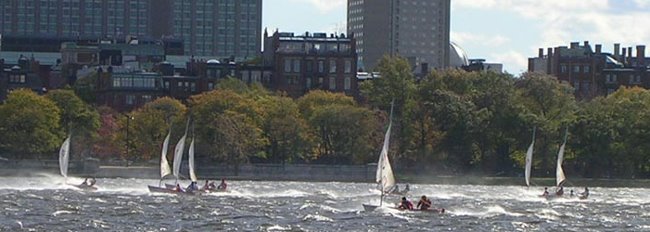
I didn't get to race in New England on Sunday and neither did my son. But some college dinghy sailors went racing in Boston.
Check out the MIT Sailing website for pictures of the Schell Trophy, and links to more photos. According to that site, the regatta was sailed "under extreme conditions both days: on Saturday 28-Oct we had 2+" of rain; even more exciting, on 29-Oct we had constant 25mph winds, with gusts going into the mid 40's!"
The Sailing Lesson
I wrote a post back in May about a famous romance that started on a Sunfish and several readers added comments about their own sailing dates.
On a similar theme check out The Sailing Lesson, a poem by P.B.Adams, part of the collection A Season of Rain. What a writer!!
On a similar theme check out The Sailing Lesson, a poem by P.B.Adams, part of the collection A Season of Rain. What a writer!!
Change of Plan
Hmmm - looks like I might have to rethink my plans to sail in the Laser Masters Worlds in Portugal next summer.
LASER INTERNATIONAL CIRCULAR
31 October 2007
No. 202
2007 Laser World Masters as at 31 October 2006. ILCA have not been able to reach a satisfactory agreement with club Neval de Cascais for the organisation of the Laser World Master in Cascais Portugal. ILCA are now seeking alternative venues.
On the direction of ILCA World Council ILCA is now seeking alternative venues and invites expressions of interest from interested clubs.
The venue should preferably be in Europe available between August and the beginning of November to utilise charter boats used at other events during the year. It has to be possible to service the chosen venue with a minimum of 100 Lasers. The provision of charter Lasers is not the responsibility of the host club although the help in transportation costs could be a positive consideration. The site should have parking and easy launching for at least 250 Lasers, the shore facilities should also provide a site venue for catering for these numbers and a choice of accommodation types near by including pension (bed and breakfast), self catering and hotels. At least 100 competitors are expected to arrive by air so easy access to an international airport is also a consideration as well as convenient travelling for European sailors
The racing program runs from Saturday (practice race) then two races daily from Sunday through the following Saturday with a rest day on the Wednesday. This program may be adjusted slightly to take into account local accommodation booking periods
Racing would take place on a trapezoid course in four fleets. A minimum number of organisation boats in the ratio of one boat for every ten competitors is required.
Expressions of interest should be sent to Jeff Martin Executive Secretary via Email: jcm@laserinternational.org Fax: +44 1326 318968 Tel: +44 1326 315064 by the 30 November 2006.
Questions and request for further information can be addressed to Jeff Martin. It is hoped that the final decision will be made by the 14 December 2006.
Regards
Jeff Martin
Executive Secretary
ic202
International Laser Class Association
LASER INTERNATIONAL CIRCULAR
31 October 2007
No. 202
2007 Laser World Masters as at 31 October 2006. ILCA have not been able to reach a satisfactory agreement with club Neval de Cascais for the organisation of the Laser World Master in Cascais Portugal. ILCA are now seeking alternative venues.
On the direction of ILCA World Council ILCA is now seeking alternative venues and invites expressions of interest from interested clubs.
The venue should preferably be in Europe available between August and the beginning of November to utilise charter boats used at other events during the year. It has to be possible to service the chosen venue with a minimum of 100 Lasers. The provision of charter Lasers is not the responsibility of the host club although the help in transportation costs could be a positive consideration. The site should have parking and easy launching for at least 250 Lasers, the shore facilities should also provide a site venue for catering for these numbers and a choice of accommodation types near by including pension (bed and breakfast), self catering and hotels. At least 100 competitors are expected to arrive by air so easy access to an international airport is also a consideration as well as convenient travelling for European sailors
The racing program runs from Saturday (practice race) then two races daily from Sunday through the following Saturday with a rest day on the Wednesday. This program may be adjusted slightly to take into account local accommodation booking periods
Racing would take place on a trapezoid course in four fleets. A minimum number of organisation boats in the ratio of one boat for every ten competitors is required.
Expressions of interest should be sent to Jeff Martin Executive Secretary via Email: jcm@laserinternational.org Fax: +44 1326 318968 Tel: +44 1326 315064 by the 30 November 2006.
Questions and request for further information can be addressed to Jeff Martin. It is hoped that the final decision will be made by the 14 December 2006.
Regards
Jeff Martin
Executive Secretary
ic202
International Laser Class Association
Subscribe to:
Posts (Atom)