The Sailing Anarchy forums have a thread going about what those of us with less than perfect eyes need to do to be able to see properly when sailing. Prescription goggles, prescription sunglasses, contact lenses, LASIK surgery, PRK surgery, beer goggles, blow-up condoms over your head ...
OK. No more. But you get the picture. Any topic can get a bit wild and woolly over there.
The discussion reminded me of a little piece of wisdom I learned on this topic a few years back. I was sailing my Laser at CORK. In the silver fleet of course. Never have been able to qualify for the gold fleet. Not yet anyway.
It was a crazy windy day. Over 20 knots steady and more in the gusts. We were sailing big trapezoid courses. Coming down the last run on the first race of the day I was hit by a humongous gust. I hung on for a while and tried to avoid the obstacle course of upturned boats in front of me. Bore away to gybe about 100 yards before the leeward mark and then totally lost it. I don't really know what happened but I do remember that one moment I was on the boat and the next I was underwater but the boat was still humming along at a considerable speed dragging me with it.
I had learned the hard way some years ago what you need to do in these circumstances. Basically you have three choices.
1. Let go of everything. Not a good idea. Unless you want to be alone in the middle of Lake Ontario, practically invisible to any other craft, while your boat carries on sailing towards the St. Lawrence River faster than you can swim.
2. Hang on to the tiller extension. Well, at least you are still connected to the boat. Unfortunately tiller extensions bend or break so the advantage is likely to be temporary or expensive or both.
3. Hang on to the mainsheet. Definitely the best option. Unfortunately it has its downside too.
So there I was hanging on to the sheet for dear life while my Laser carried on sailing. (Funny how it sails so much better without me on it.) I was dragged along underwater for what felt like several hundred yards. Quite a thrilling ride under different circumstances. Eventually the boat got tired of the game and capsized. I reeled it in, righted the boat and climbed aboard.
Let's see. Nothing broken on the boat. Nothing broken on me. Still have my hat. Oh no - my glasses had come off. In spite of wearing a croakie the glasses had been pulled off my head by the underwater joyride.
They were expensive prescription sunglasses. Without them the whole world was just a gray blur as I am seriously myopic. But my competitive spirit hadn't totally left me. The boat was now on the correct gybe to round the leeward mark and I wasn't last in the race. So I headed off in the rough direction the mark should be, by luck found the 10 feet high trapezoid buoy, rounded it, and could just see enough to be able to make out the 50 foot yacht that marked the finish line at the end of a short reach.
I finished the race and signaled to the RC that I was heading in to shore. This was a beat for a couple of miles. But I could navigate by staying close to the shore. All I can say, is that it's a good thing that the entrance to the sailing center is marked by a massive prison building about the size of the Pentagon or I would probably have missed it.
After getting ashore I was faced with a quandary. I only had one other pair of prescription glasses with me and I needed those to be able to drive home from Canada. No way was I going to risk losing those in a similar accident. Back at the hotel, a quick perusal of the Yellow Pages identified that Lenscrafters has branches north of the border. So wifey and I headed out to find the Lenscrafters store in a suburban mall north of Kingston.
I explained what had happened to the optician and he smiled. It was obvious that replacing glasses lost to the deeps of Lake Ontario was a major plank of his business. He was able to identify my prescription from measuring my driving glasses and I went off to his display wall to chose some frames.
I chose a stylish pair of aviator glasses and brought them to the counter.
"No. They're not what you want," he counseled. "You need smaller lenses. The reason you lost your glasses is that the other frames were wider than your head so the water could pull them off your head."
I went back to the displays and chose an even smaller pair. They looked a bit strange when I tried them on, but I submitted them for his inspection.
"No. Still not small enough. Try again."
Eventually I chose a pair of Ray-Bans that looked like they would fit a 10-year-old boy. A 10 year-old-boy with a very thin face. I thought they looked ridiculous on me but they met with the optician's approval. And the lenses were manufactured and ready in time for the first race the next day.
So if you go to a Laser regatta and see some old bald guy wearing John Lennon style granny glasses, he's not stuck in some 60's fashion time warp. It's me. And I don't care what you think about my glasses. They work.
Wednesday, November 30, 2005

Tuesday, November 29, 2005
C (3) iv.

International Laser Class By-Law 1 Rule C (3) iv states that one mainsheet clam or cam cleat of any type may be mounted on each side deck in the position shown on the measurement diagram.
Some Lasers have mainsheet cleats; some don't. It all depends on the preference of the owner.
I have cam cleats for the sheet on my current Laser but have rarely used them. Whenever a rookie would ask my advice on mainsheet cleats I would always adopt the macho pose. "Nah. Cleats are for wimps. You need to work the sheet all the time in a Laser. The wind's always changing. You need to be able to ease the sheet instantly in the gusts. You'll capsize if you cleat the sheet. Sure it's hard but if your arms are too weak to hold the sheet in a blow then you need to get to the gym more."
I've now decided that I'm getting too old for that ridiculous assertion. After several hours of sailing a Laser in 15 knots or more my arms start to cramp. The muscle on the inside of my forearms (I'm sure there must be a Latin name for it) tightens up, my thumb locks over my palm in a cramp and I'm unable to release my grip.
Last time I sailed I experimented with cleating the sheet when beating in stronger winds. I'd uncleat it if it looked like I might need to tack such as when approaching a starboard tack boat. Nothing terrible happened. (All right. Two terrible things happened but the humble cleat wasn't to blame. They were the fault of the nut on the end of the tiller.)
I finished all the races without feeling like I'd been hanging by my arms from a hook in an Iraqi prison for a week. So now I'm going to start using the cleats more. Time to start sailing like the grandfather I am.
Emily came home today.
Monday, November 28, 2005
Sunday's Child
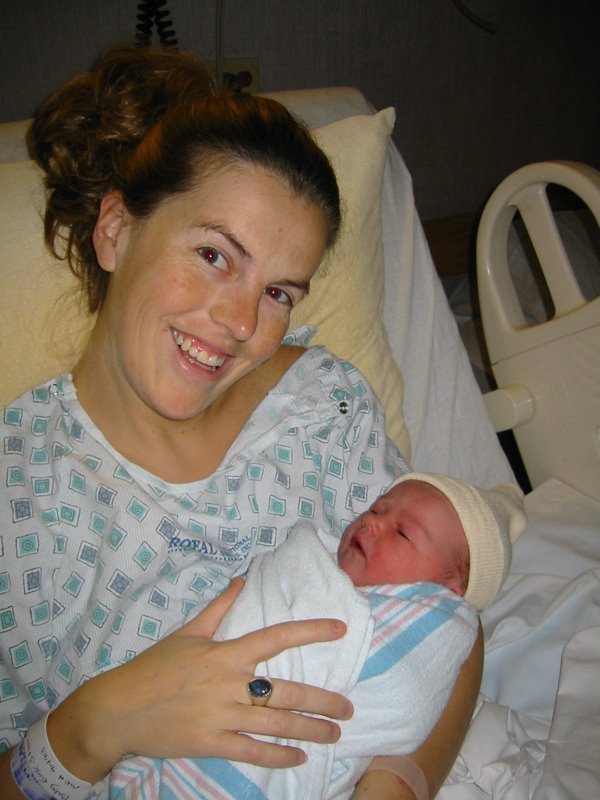 I didn't go sailing yesterday.
Emily, our first grandchild, arrived at 5:11 am on Sunday morning.
Mother and baby are doing well.
Friday, November 25, 2005
No Go
I get a good start, sail on starboard tack for a minute or so then tack into a nice lane going back to the right side of the course. So far, so good.
Halfway up the beat I see a starboard tacker coming towards me about ten boatlengths away. I can probably cross him but am not sure so I give him a hail.
"Tack or Cross?"
For non-racers let me explain. He has right of way so according to the racing rules I am supposed to keep clear of him. To do so I would tack on his lee bow. He would then be in my bad air and would also tack. What just happened? I was going to the right side of the course (presumably because that's where I wanted to be) but now I'm going to the left. He was going to the left side of the course (perhaps he knows something I don't but in any case that's where he wanted to go) but now he's going right. So now we're both going towards what each of us believes is the wrong side of the course.
So that's the reason for the "tack or cross" hail. You won't find it mentioned in the racing rules. It's just a convention that could help both of us. If he really wants to keep going left and thinks that I will easily cross in front of him or that he only needs to bear away a little to let me do so safely, then he will tell me to cross. That way we both keep going the way we want to go.
"Tack or Cross?" I hail again.
"Go!" is the reply.
Fair enough. So I carry on sailing.
As we get closer I see that I'm not going to cross in front of him unless he bears away a bit and he's leaving it very late. Now we're only a few feet apart and he's still coming on fast. Yikes! We're going to collide. I throw a quick tack to avoid a collision and when he's inches away from me so does he.
"No means no!" he screams.
What? No means no? Anyone would think I had tried to rape him. I start to explain that I thought he was saying "go" and that "no" and "go" sound just the same when heard through all the noise of sails and waves. But we are heading in opposite directions now and I doubt he hears much of my complaints.
OK. What do I do now?
Strictly speaking according to the racing rules I should do penalty turns. I was the give-way boat and he definitely had to tack to avoid me. But I start to rationalize why I shouldn't have to take a penalty here.
1. It was really his fault. What did he expect? Shouting "no" that sounds just like "go".
2. We didn't actually collide.
3. If I had heard him properly, I would have lee-bowed him and he would have had to tack, so the outcome is the same.
4. He didn't actually protest me. Maybe he's letting me off because he knows how stupid he has been?
Of course, none of these are actually relevant. According to the rules I was definitely in the wrong. But I finish the race without taking a penalty.
After racing I put the boat away, get changed, and head into the clubhouse. Twelve boxes of steaming pizza arrive and a couple of dozen hungry sailors demolish them in a matter of minutes. In the corner of the room opposite from where I am sitting a few members of the race committee are typing the results into the computer. I am listening in to a conversation between two sailors just to my right. The teenager is about to head off to the Radial Worlds in Brazil and is picking the brains of the gray-haired Master sailor who sailed at the same location in the Masters Worlds last month. The kid really wants advice about the sailing, but the old guy seems to be giving him advice about how to deal with the Brazilian girls. I wonder how he knows so much about this subject?
Someone from the corner of the computer starts to speak up and addresses the room.
"OK. We have a few protests to deal with. Does this sound familiar to anyone here? Fourth race, halfway up first beat, guy with a British accent on port hailed 'tack or cross', starboard boat hails 'starboard'......."
Was that me? I'm not the only sailor in the fleet with that accent. Apparently the protestor didn't remember the sail number of the boat he is protesting. I could just keep quiet and nobody would ever know. But I speak up anyway.
"Describe that incident again. It might have been me."
Basically the same details except he says it went on for quite a while. Hmmm not exactly the way I remember it.
"What actually happened to me was that after the tack or cross hail, I thought he said 'go' but he reckoned he said 'no'."
"It was a yellow boat."
"I wasn't sailing a yellow boat."
"No, the starboard boat was yellow. Was that the incident you were in?"
"I don't recall. Is he protesting me?"
The answer is vague. I'm still not clear what's going on. Did the boat in the incident protest me? Or some third party? Is it even the same incident? Is it even the same race? Whoever has reported the incident they haven't identified the sail number of the boat at fault. And in my incident the starboard boat didn't hail 'protest'. So if he does protest me now it can be thrown out as invalid. So if this does go to an actual protest hearing I can probably win it because of all those reasons.
But I am still feeling some guilt about not doing turns so I tell the scorer to retire me from the race.
One of the fleet leaders pipes up. "And the moral of this tale is........? The question is 'tack or cross?' There are only two answers. 'tack' or 'cross'. Not 'go' or 'no'."
Exactly.
I feel it's a moral victory as I don't really care about my scores in this series anyway. More on clarity of communication in this SailNet Article.
Halfway up the beat I see a starboard tacker coming towards me about ten boatlengths away. I can probably cross him but am not sure so I give him a hail.
"Tack or Cross?"
For non-racers let me explain. He has right of way so according to the racing rules I am supposed to keep clear of him. To do so I would tack on his lee bow. He would then be in my bad air and would also tack. What just happened? I was going to the right side of the course (presumably because that's where I wanted to be) but now I'm going to the left. He was going to the left side of the course (perhaps he knows something I don't but in any case that's where he wanted to go) but now he's going right. So now we're both going towards what each of us believes is the wrong side of the course.
So that's the reason for the "tack or cross" hail. You won't find it mentioned in the racing rules. It's just a convention that could help both of us. If he really wants to keep going left and thinks that I will easily cross in front of him or that he only needs to bear away a little to let me do so safely, then he will tell me to cross. That way we both keep going the way we want to go.
"Tack or Cross?" I hail again.
"Go!" is the reply.
Fair enough. So I carry on sailing.
As we get closer I see that I'm not going to cross in front of him unless he bears away a bit and he's leaving it very late. Now we're only a few feet apart and he's still coming on fast. Yikes! We're going to collide. I throw a quick tack to avoid a collision and when he's inches away from me so does he.
"No means no!" he screams.
What? No means no? Anyone would think I had tried to rape him. I start to explain that I thought he was saying "go" and that "no" and "go" sound just the same when heard through all the noise of sails and waves. But we are heading in opposite directions now and I doubt he hears much of my complaints.
OK. What do I do now?
Strictly speaking according to the racing rules I should do penalty turns. I was the give-way boat and he definitely had to tack to avoid me. But I start to rationalize why I shouldn't have to take a penalty here.
1. It was really his fault. What did he expect? Shouting "no" that sounds just like "go".
2. We didn't actually collide.
3. If I had heard him properly, I would have lee-bowed him and he would have had to tack, so the outcome is the same.
4. He didn't actually protest me. Maybe he's letting me off because he knows how stupid he has been?
Of course, none of these are actually relevant. According to the rules I was definitely in the wrong. But I finish the race without taking a penalty.
After racing I put the boat away, get changed, and head into the clubhouse. Twelve boxes of steaming pizza arrive and a couple of dozen hungry sailors demolish them in a matter of minutes. In the corner of the room opposite from where I am sitting a few members of the race committee are typing the results into the computer. I am listening in to a conversation between two sailors just to my right. The teenager is about to head off to the Radial Worlds in Brazil and is picking the brains of the gray-haired Master sailor who sailed at the same location in the Masters Worlds last month. The kid really wants advice about the sailing, but the old guy seems to be giving him advice about how to deal with the Brazilian girls. I wonder how he knows so much about this subject?
Someone from the corner of the computer starts to speak up and addresses the room.
"OK. We have a few protests to deal with. Does this sound familiar to anyone here? Fourth race, halfway up first beat, guy with a British accent on port hailed 'tack or cross', starboard boat hails 'starboard'......."
Was that me? I'm not the only sailor in the fleet with that accent. Apparently the protestor didn't remember the sail number of the boat he is protesting. I could just keep quiet and nobody would ever know. But I speak up anyway.
"Describe that incident again. It might have been me."
Basically the same details except he says it went on for quite a while. Hmmm not exactly the way I remember it.
"What actually happened to me was that after the tack or cross hail, I thought he said 'go' but he reckoned he said 'no'."
"It was a yellow boat."
"I wasn't sailing a yellow boat."
"No, the starboard boat was yellow. Was that the incident you were in?"
"I don't recall. Is he protesting me?"
The answer is vague. I'm still not clear what's going on. Did the boat in the incident protest me? Or some third party? Is it even the same incident? Is it even the same race? Whoever has reported the incident they haven't identified the sail number of the boat at fault. And in my incident the starboard boat didn't hail 'protest'. So if he does protest me now it can be thrown out as invalid. So if this does go to an actual protest hearing I can probably win it because of all those reasons.
But I am still feeling some guilt about not doing turns so I tell the scorer to retire me from the race.
One of the fleet leaders pipes up. "And the moral of this tale is........? The question is 'tack or cross?' There are only two answers. 'tack' or 'cross'. Not 'go' or 'no'."
Exactly.
I feel it's a moral victory as I don't really care about my scores in this series anyway. More on clarity of communication in this SailNet Article.
Tuesday, November 22, 2005
Would You Like To Dance?
I thought I'd seen about every possible way to teach sailing until I came across skiff blog. In a post entitled What to do with no wind the author describes how on one day with no wind, he and his crew practiced their footwork for gybing their 49er. And he has documented the results with colored diagrams of feet positions that remind me of the way dance steps are often described.
Foxtrot anyone?
Foxtrot anyone?
Shark Attack
This frostbite racing season my main objective is to improve my starts. In the past, I have had a tendency to be too cautious at starts, hanging back for fear of being over the line in any race where I care about the results. The racing this summer in my home fleet did nothing to cure me of this fault. In a small fleet where I had better boatspeed than the other players I could do mediocre starts and still have a great chance to win almost every race.
So I'm going into the Sunday frostbite races with the attitude that I don't care about my overall results, I don't even care about being called OCS occasionally, but I will start every race in the front row in clear air with good speed. I am trying to break myself of the habit of being too cautious and build a new habit of being aggressive at starts. They say it takes 21 days to establish a new habit. If I only race once a week, does that mean it will take 21 weeks of racing? We will see.
When I did the John Kolius racing clinic in Houston a couple of years ago, JK taught starting tactics by saying you basically have two choices. You can hold station on the line trying to stay in position just below the line while protecting the gap to leeward as best you can. Or you can be a "shark". A shark cruises along behind the line of boats holding station until he sees a good gap then scoots into the hole at the last minute. A shark can approach the hole on port tack in which case he has to tack into it. Or he can be a starboard tack shark. In the drills, JK had us practice all three options -- hold station, port tack shark and starboard tack shark.
On Sunday I decided I was going to be a starboard tack shark.
First start it works to perfection. Start cruising down the line with two minutes to go. Find a nice hole. Scoot into it at about fifteen seconds. Luff to slow a little but still have forward momentum. Have room to leeward to bear off. Sheet in and am going fast at the gun. Looking good. Too bad they call a general recall.
Race committee puts up the I flag meaning any boat over the line in the last minute before the start has to go round one end of the line to restart. What do I care? I'm here to practice being aggressive. I'm a shark.
Use the same approach that worked so well for the first start. Cruise down the line slowly on starboard. See a nice gap just below my friend D. Luff up below him and force him up a bit creating a nice big gap to leeward. Bear away just after the 10 second horn and am blasting over the boat to leeward. Sheet in and go. Looking great.
The race committee starts calling sail numbers of boats over the line. Damn. The last of three numbers called is mine. OK. Now I need to go back. Easier said than done. I have boats to the left and right. I have a bunch of second row starters astern. I can't bear away. I can't tack. If I slow down I will screw up the boats behind me. Eventually I see an opportunity, slow down a bit, tack and duck the boats to windward and head off to the right end of the line to round the committee boat and restart.
By the time I'm crossing the line for the second time the fleet is disappearing over the horizon. Oh well -- let's see how many tailenders I can pick off.
I pass one boat halfway up the beat. Pick off a bunch at the windward mark. Get out to one side of the run and cruise past a few more. A couple of boats capsize and let me pass them. Inside rounding at the leeward mark gains me a few more places.
Hike hard up the final beat. Coming towards the finish on starboard tack just below the layline for the port end of the line, I see one of my fellow grandmasters coming in on port tack. No way he can cross me. I start screaming, "Starboard". He keeps coming. What is he thinking? At the last minute we both throw crash tacks. Ha! Got him! It feels good to be mean and to take out a tough competitor. This aggressive behavior could become a habit very fast.
I didn't really care about being OCS. The way I look at it, it proves I'm trying. If the price of learning to make aggressive starts is one OCS per week then so be it.
After racing my friend D. commiserates with me. "That was a tough call," he says. "We were so close that it's amazing they called you but not me. You couldn't have been over by very much."
Thanks D. I needed that.
So I'm going into the Sunday frostbite races with the attitude that I don't care about my overall results, I don't even care about being called OCS occasionally, but I will start every race in the front row in clear air with good speed. I am trying to break myself of the habit of being too cautious and build a new habit of being aggressive at starts. They say it takes 21 days to establish a new habit. If I only race once a week, does that mean it will take 21 weeks of racing? We will see.
When I did the John Kolius racing clinic in Houston a couple of years ago, JK taught starting tactics by saying you basically have two choices. You can hold station on the line trying to stay in position just below the line while protecting the gap to leeward as best you can. Or you can be a "shark". A shark cruises along behind the line of boats holding station until he sees a good gap then scoots into the hole at the last minute. A shark can approach the hole on port tack in which case he has to tack into it. Or he can be a starboard tack shark. In the drills, JK had us practice all three options -- hold station, port tack shark and starboard tack shark.
On Sunday I decided I was going to be a starboard tack shark.
First start it works to perfection. Start cruising down the line with two minutes to go. Find a nice hole. Scoot into it at about fifteen seconds. Luff to slow a little but still have forward momentum. Have room to leeward to bear off. Sheet in and am going fast at the gun. Looking good. Too bad they call a general recall.
Race committee puts up the I flag meaning any boat over the line in the last minute before the start has to go round one end of the line to restart. What do I care? I'm here to practice being aggressive. I'm a shark.
Use the same approach that worked so well for the first start. Cruise down the line slowly on starboard. See a nice gap just below my friend D. Luff up below him and force him up a bit creating a nice big gap to leeward. Bear away just after the 10 second horn and am blasting over the boat to leeward. Sheet in and go. Looking great.
The race committee starts calling sail numbers of boats over the line. Damn. The last of three numbers called is mine. OK. Now I need to go back. Easier said than done. I have boats to the left and right. I have a bunch of second row starters astern. I can't bear away. I can't tack. If I slow down I will screw up the boats behind me. Eventually I see an opportunity, slow down a bit, tack and duck the boats to windward and head off to the right end of the line to round the committee boat and restart.
By the time I'm crossing the line for the second time the fleet is disappearing over the horizon. Oh well -- let's see how many tailenders I can pick off.
I pass one boat halfway up the beat. Pick off a bunch at the windward mark. Get out to one side of the run and cruise past a few more. A couple of boats capsize and let me pass them. Inside rounding at the leeward mark gains me a few more places.
Hike hard up the final beat. Coming towards the finish on starboard tack just below the layline for the port end of the line, I see one of my fellow grandmasters coming in on port tack. No way he can cross me. I start screaming, "Starboard". He keeps coming. What is he thinking? At the last minute we both throw crash tacks. Ha! Got him! It feels good to be mean and to take out a tough competitor. This aggressive behavior could become a habit very fast.
I didn't really care about being OCS. The way I look at it, it proves I'm trying. If the price of learning to make aggressive starts is one OCS per week then so be it.
After racing my friend D. commiserates with me. "That was a tough call," he says. "We were so close that it's amazing they called you but not me. You couldn't have been over by very much."
Thanks D. I needed that.
Monday, November 21, 2005
Only 47
The Laser racing on Sunday once again was simply superb. Sunny day, not a cloud in the sky. About 55 degrees. And a nice solid breeze from the southwest that had us hiking hard upwind and planing on the reaches. 47 sailors with big smiles.
The word "frostbiting" conjures up images of snow and ice and miserably cold weather. But this season (so far) has been absolutely magnificent. Gorgeous sunny fall days and perfect sailing winds.
And did I mention? "Only" 47 boats this week. Down from the 50+ fleets of the last few weeks. Many classes don't attract that many boats for their national championships.
This is the fourth week I've raced this fall and, at last, it feels like I'm getting back in the groove. Not that my results would reflect that. (Yet).
Sailing in a large fleet like this on short courses requires some special skills. It seems to me that there is a huge premium on being able to "read the fleet". Wherever you start on the line at some point you have to get across to the right side of the course. Getting trapped out on, or even above, the port tack layline is not a good recipe for success as you are likely to approach the first mark to face a wall of starboard tackers that you can't get through. Unless of course you are lucky enough to catch a nice lefty shift and get there first. But that's a low percentage play.
Problem is that there always seem to be several boats to weather of you that you won't be able to cross when you tack. So you have to decide whether it is worth ducking them. And you don't want to follow immediately behind the boats to the left of you that are deciding to cross the course as you'll then be in their bad air.
So there's this need to be able to divine what the boats around you are going to do and to decide when to tack across to the right at a time when you will have a clear lane that will get you close to the starboard tack layline without having to take too many transoms and without being pin-balled around the course by starboard tackers.
Then there's that all important approach to the starboard tack layline. Too close to the mark and you'll end up ducking too many boats. Too far away and you can only lose out on headers or lifts. Again a matter of "reading the fleet" and developing a good sense of when and where to make your final approach.
After 3 weeks of racing in this fleet I'm starting to get a better feel for all this and am not screwing up quite so badly as I was earlier in the season.
Downwind the waves weren't quite as good as last week. Not at all easy to get much of a ride. So I concentrated on getting out to one side or other of the fleet and was occasionally able to gain a few places on the runs. Which is definitely progress for me because, being on the heavy end of the weight range for Laser sailors, I always felt at a disadvantage to the lighter sailors off the wind.
The race committee gave us an interesting mix of courses. Some windward-leeward one lap races; one windward-leeward two laps; a triangle; a Harry Anderson; and a triangle/ windward-leeward for the last race.
I particularly enjoyed those two lap races. A chance to stretch my legs on a long beat and exploit my height and weight. Those kids may have the edge on me downwind but I can grind most of 'em down upwind. Ha!
The day was not without incident.....
But I'll write some separate posts about my apparent ability to blow the first race in a unique way each week; a curious rules incident that left me in the wrong through the other guy's stupidity; and my discovery after 20+ years of Lasering of how one little piece of equipment can make a huge difference.
Watch this space.
The word "frostbiting" conjures up images of snow and ice and miserably cold weather. But this season (so far) has been absolutely magnificent. Gorgeous sunny fall days and perfect sailing winds.
And did I mention? "Only" 47 boats this week. Down from the 50+ fleets of the last few weeks. Many classes don't attract that many boats for their national championships.
This is the fourth week I've raced this fall and, at last, it feels like I'm getting back in the groove. Not that my results would reflect that. (Yet).
Sailing in a large fleet like this on short courses requires some special skills. It seems to me that there is a huge premium on being able to "read the fleet". Wherever you start on the line at some point you have to get across to the right side of the course. Getting trapped out on, or even above, the port tack layline is not a good recipe for success as you are likely to approach the first mark to face a wall of starboard tackers that you can't get through. Unless of course you are lucky enough to catch a nice lefty shift and get there first. But that's a low percentage play.
Problem is that there always seem to be several boats to weather of you that you won't be able to cross when you tack. So you have to decide whether it is worth ducking them. And you don't want to follow immediately behind the boats to the left of you that are deciding to cross the course as you'll then be in their bad air.
So there's this need to be able to divine what the boats around you are going to do and to decide when to tack across to the right at a time when you will have a clear lane that will get you close to the starboard tack layline without having to take too many transoms and without being pin-balled around the course by starboard tackers.
Then there's that all important approach to the starboard tack layline. Too close to the mark and you'll end up ducking too many boats. Too far away and you can only lose out on headers or lifts. Again a matter of "reading the fleet" and developing a good sense of when and where to make your final approach.
After 3 weeks of racing in this fleet I'm starting to get a better feel for all this and am not screwing up quite so badly as I was earlier in the season.
Downwind the waves weren't quite as good as last week. Not at all easy to get much of a ride. So I concentrated on getting out to one side or other of the fleet and was occasionally able to gain a few places on the runs. Which is definitely progress for me because, being on the heavy end of the weight range for Laser sailors, I always felt at a disadvantage to the lighter sailors off the wind.
The race committee gave us an interesting mix of courses. Some windward-leeward one lap races; one windward-leeward two laps; a triangle; a Harry Anderson; and a triangle/ windward-leeward for the last race.
I particularly enjoyed those two lap races. A chance to stretch my legs on a long beat and exploit my height and weight. Those kids may have the edge on me downwind but I can grind most of 'em down upwind. Ha!
The day was not without incident.....
But I'll write some separate posts about my apparent ability to blow the first race in a unique way each week; a curious rules incident that left me in the wrong through the other guy's stupidity; and my discovery after 20+ years of Lasering of how one little piece of equipment can make a huge difference.
Watch this space.
Friday, November 18, 2005
26 Miles
On Thursday I ran 26 miles.
No. It wasn't a race. I wasn't running with anyone else. I just went off into the woods and ran 26 miles by myself.
I know what you're thinking. Is this guy nuts? I sometimes think so myself.
But this is all part of the marathon training program that I'm following in preparation for the Disney World Marathon in Florida in January.
Wait a minute. There's something wrong here. This is supposed to be a program to prepare me to run a marathon and I just ran a marathon as part of the preparation? Yes -- it does sound screwy. Hey, my aim is to run a marathon and now I've done it. Can I stop now please?
It's not quite as simple as that. I ran my first marathon, also at Disney World, in January. The last six miles were awful. And my time was just over five hours. My aims for the 2006 event are to finish it in (much) better shape and in a (slightly) faster time.
I'm following Jeff Galloway's training program which basically uses a run-and-walk approach for the long distances, including the marathon itself. This week, week 20 of the program, calls for doing 25 to 26 miles "easy". (I love that "easy" bit). In this context "easy" means running 3 minutes and walking 1 minute for the whole 26 miles. And doing so at a pace that is 2 or 3 minutes a mile slower than I could do on that day.
So that's what I did. I measured out a nice, easy, level trail through the woods that was exactly 3.25 miles. I ran from the car to the end of the trail and then back. Drank some water or Gatorade and sucked an energy gel. Then repeated 4 times in all.
You have a lot of time to think when you're running. Unlike sailing. I find that when sailing a race my mind is occupied 200%. Thinking about strategy, tactics, wind, current, boatspeed, how much my legs are hurting.....
Running is different. Once you've settled into your desired pace there's nothing you have to think about. Except, of course, how much your legs are hurting. Maybe it's not so different from sailing, after all.
So when I'm running my mind wanders. What shall I write in my blog tomorrow? When will my son's baby be born? (It's now week 40 of the pregnancy). Wouldn't it be cool if I ran a marathon and became a grandfather on the same day? How many different kinds of bird song can I hear? How many different kinds of leaf are on the path? How much are my legs hurting? And so on, and so on, for 26 miles.
I started off really slow and relaxed. Then each 3.25 miles I ran very slightly faster than the previous one. Until about 20 miles. Then, wham, it hit me. There really is a wall. The last 6 miles were much slower. I told myself it was actually a cool-down lap. I told myself that by doing the 26 miles now I was somehow storing endurance in a tank that I could use in the real marathon in January. I sincerely hope that's true.
But I finished this "slow and easy" training marathon in only a few minutes more than I ran the race back in January. And I had none of the agonizing cramps that brought me to my knees in Florida.
So I guess I'm making progress.
Just hope my legs recover in time for Laser racing on Sunday.
No. It wasn't a race. I wasn't running with anyone else. I just went off into the woods and ran 26 miles by myself.
I know what you're thinking. Is this guy nuts? I sometimes think so myself.
But this is all part of the marathon training program that I'm following in preparation for the Disney World Marathon in Florida in January.
Wait a minute. There's something wrong here. This is supposed to be a program to prepare me to run a marathon and I just ran a marathon as part of the preparation? Yes -- it does sound screwy. Hey, my aim is to run a marathon and now I've done it. Can I stop now please?
It's not quite as simple as that. I ran my first marathon, also at Disney World, in January. The last six miles were awful. And my time was just over five hours. My aims for the 2006 event are to finish it in (much) better shape and in a (slightly) faster time.
I'm following Jeff Galloway's training program which basically uses a run-and-walk approach for the long distances, including the marathon itself. This week, week 20 of the program, calls for doing 25 to 26 miles "easy". (I love that "easy" bit). In this context "easy" means running 3 minutes and walking 1 minute for the whole 26 miles. And doing so at a pace that is 2 or 3 minutes a mile slower than I could do on that day.
So that's what I did. I measured out a nice, easy, level trail through the woods that was exactly 3.25 miles. I ran from the car to the end of the trail and then back. Drank some water or Gatorade and sucked an energy gel. Then repeated 4 times in all.
You have a lot of time to think when you're running. Unlike sailing. I find that when sailing a race my mind is occupied 200%. Thinking about strategy, tactics, wind, current, boatspeed, how much my legs are hurting.....
Running is different. Once you've settled into your desired pace there's nothing you have to think about. Except, of course, how much your legs are hurting. Maybe it's not so different from sailing, after all.
So when I'm running my mind wanders. What shall I write in my blog tomorrow? When will my son's baby be born? (It's now week 40 of the pregnancy). Wouldn't it be cool if I ran a marathon and became a grandfather on the same day? How many different kinds of bird song can I hear? How many different kinds of leaf are on the path? How much are my legs hurting? And so on, and so on, for 26 miles.
I started off really slow and relaxed. Then each 3.25 miles I ran very slightly faster than the previous one. Until about 20 miles. Then, wham, it hit me. There really is a wall. The last 6 miles were much slower. I told myself it was actually a cool-down lap. I told myself that by doing the 26 miles now I was somehow storing endurance in a tank that I could use in the real marathon in January. I sincerely hope that's true.
But I finished this "slow and easy" training marathon in only a few minutes more than I ran the race back in January. And I had none of the agonizing cramps that brought me to my knees in Florida.
So I guess I'm making progress.
Just hope my legs recover in time for Laser racing on Sunday.
Thank you
Thank you.
Thank you for your supportive comments about my writing but, no, I'm not a novelist in training. It's all real. I'm glad we appreciate the same things such as sailors' support of each other and our vanity about hats.
Thank you for your insightful comments on racing strategy and rules and mental preparation. I admire your dedicated efforts to improve your own and your crew's performance and am learning a lot from you.
Thank you for your different perspective on our sport. When we met you were a recreational keelboat sailor and I was a racing dinghy sailor. I think our exchanges are widening horizons for both of us.
Thank you for your youthful enthusiasm -- well, you sound young. I love your stories of struggling with spinnakers and of sailing in England in the rain. Makes me nostalgic.
Thank you for your youthful enthusiasm -- well, you sound young. I love your stories of struggling with spinnakers and of sailing in England in the rain. Makes me nostalgic.
But especially thank you for making sure that I rarely have to see the dreaded 0 comments.
Thursday, November 17, 2005
Where It All Started
While noodling around the web the other day I came across the website of my first sailing club. Now called Taplow Lake Sailing Club it was called something else back in the early 80's when I was a member. But it's good to see that many of the traditions and quirks of the club have endured.
The club's sailing area was a small L-shaped lake created by gravel extraction. Lettered buoys were distributed around the perimeter of the lake. There was a railway embankment on one side of the lake and trees on other sides. Winds were variable and unpredictable in strength and direction, to say the least.
When I showed up for the skipper's meeting for the first race there I couldn't believe it when they announced the course. The course would be announced as something like L to starboard, B to port, F to port, J to starboard, C to starboard, E to port, K to port, A to starboard. As it was announced, all the sailors would start drawing a wiggly line to represent the course on their forearms and writing down LS BP FP JS CS EP KP AS. There was no way to remember it; it was always too complicated.
When I showed up for the skipper's meeting for the first race there I couldn't believe it when they announced the course. The course would be announced as something like L to starboard, B to port, F to port, J to starboard, C to starboard, E to port, K to port, A to starboard. As it was announced, all the sailors would start drawing a wiggly line to represent the course on their forearms and writing down LS BP FP JS CS EP KP AS. There was no way to remember it; it was always too complicated.
One of the beauties of this almost random zigzag circuit around the lake was that it guaranteed that at least one leg would be a beat on each lap. Maybe not always the same leg. That was half the fun.
The other unusual feature of sailing there was that all regular series races were pursuit races. We sailed 4 one-design classes then: Toppers, Miracles, Enterprises and Lasers. The slowest class would start first followed by the others at predetermined intervals - 90 or 60 seconds apart as I recall. We raced round and round our zigzag course until a certain time interval had passed -- just over an hour I think. This time was designed so that in theory the relative speeds of the different classes had allowed for them all to catch up with each other. The race committee would sound a signal at that time which meant the leading boats had to head for the finish line. If we had all sailed equally well we would all hit the line together.
Of course it never worked out that way. As the Lasers were the fastest class we started last. But it's one thing to catch up with a slower boat in front. It's much harder to overtake it. Especially on a small crowded lake with a buoy to round every few minutes.
But it was fun and an ideal place to get started in racing. Boathandling skills developed quickly in the shifty conditions -- especially when an unstable gusty northwesterly was dumping great shafts of air across the railway embankment and splashing them down on the lake producing random 25 knot gusts at unpredictable intervals.
I've done pursuit racing elsewhere but never been to another club where it was the main form of racing.
The other unusual feature of their program was their Easter Regatta which was a multi-day event based on personal handicaps. Some obscure formula was used to allocate personal handicaps based on previous racing performance. So the races were just like regular Portsmouth Handicap races except each skipper had an individual handicap. In these races all the classes started together and finishing times were adjusted afterwards according to the sailors' handicaps. In fact, personal handicaps were even adjusted during the weekend as I recall. The idea was that a rookie had just as much chance to win the event as the club champion. I think I did place second one year.
We raced all year round, only stopping in the winter if the lake froze which it did some years but not every year. The club was low key and friendly but there were some excellent sailors there including some national champions. It was good to see from their website that not much has changed in 25 years.
Subscribe to:
Posts (Atom)