Is it wise to try and repeat an experience from a different time in your life? If you had a good time doing something special in a certain place will you be disappointed if you go back and try and do the same thing twenty five years later? Things will have changed. People will have changed. You will have changed. Will you enjoy the changes or not? Can you wade in the same river twice?
Twenty five years ago, around this time of year, I learned to sail on the Spanish Mediterranean island of Minorca at a windsurfing and sailing center operated by Minorca Sailing. I remember long afternoons sailing around the bay on my own, making every mistake that a novice can make, capsizing and laughing and recovering, and learning from my mistakes, and slowly getting the hang of this thing called sailing. I remember picnics on an island, sardines grilled on an open fire, gazpacho, lemon ice cream, lobster dinners. I remember my first sail in a Laser there... and my first death roll. I remember sailing a 470 in big ocean swells just outside the protected bay... and a scary capsize in a 470 when I ended up trapped underneath the boat pinned by the tiller through my buoyancy aid. I remember sailing with Tillerwoman in the beginners' race... and winning it.
Those two weeks changed my life. They hooked me on sailing and on racing for good.
Tonight Tillerwoman and I head off to Europe to make some family visits and also to spend another two weeks at Minorca Sailing. I'm excited but also wondering how it will be different. I know most of the boats will be different... but in a good way. They have Lasers and Musto Skiffs and RS 700s and RS 800s and 49ers and 59ers and... the list just goes on and on. More toys than I could ever try in two weeks. They have Laser racing every day. It sounds like dinghy sailor heaven. Hope I'm right.
So this blog is taking another vacation. Normal service will be resumed some time in mid-October.
Monday, September 25, 2006

Sunday, September 24, 2006
Sailing Websites
Why do sailing websites suck so much?
That was the question posed by Adam Turinas at Messing About in Sailboats. Or to be more precise: Why do sailing websites suck so much (blogs excepted)? Adam has been checking out some so-called "professional" sailing websites, mainly the websites of dead-tree US sailing magazines, and has come to the conclusion (as a self-described Internet professional) that most of them are "equally crap".
Adam has also been checking out sailing blogs and has discovered that the stuff on sailing that he finds most interesting is in blogs, not on the sites of sailing magazines. He then comes to the conclusion that "sailing bloggers have the responsibility to make the web a better place for sailors".
I must admit that that last statement put me back on my heels for a while. "Responsibility." "Make the web a better place." Yikes. That's heavy stuff. I don't know about you but I blog for fun, not with any thought of making the web a better place. And as for responsibility, that's the last thing I want when it comes to blogging.
But then I started thinking that maybe Adam has a point. These days most of my reading about sailing is on blogs. If I want to follow what's going on at major Laser championships I can check out US national team member Andrew Campbell's blog CampbellSailing.com, or if I want to see some tips from race winners in local Laser club racing I can find them at Greenwich Laser Racing. I can stay in touch with the training and racing of a fellow Laser master sailor at Split Tacks, or if I feel nostalgic for news of club racing in the old country I can check out Soulsailor or All Day I Dream About Sailing.
If I feel the need to see some superb sailing photography I can feast my eyes at Sailscape, or if my taste today is for some more off-beat pics with a watery theme I can go to The Horse's Mouth. If I feel like a good argument about some sailing controversy I head over to read one of Peter Huston's rants at Sailing As I Sea It, but then if I need something more soothing I settle down to enjoy the latest writings by Judy and Mark Handley at HandleySail.com about their cruise around the world.
The list goes on. I can ogle over marine electronics at Panbo, hear all about the latest news on marine accidents, safety and law at Lawboat, or for something completely different drop in at Grandma's Gone Surfing.
I could go on and on. I think Adam has a point. Some of the most entertaining, informative and provocative writing about sailing on the web these days is to be found in blogs. And the beauty of this medium is that I can tailor what news, stories and opinions I see by continually tuning my feed reader to include those blogs that interest me and to drop those that don't. (I use Bloglines.)
Adam is critical about the website design and quality of grammar and spelling at some of the "professional" sailing websites. To be honest, some bloggers fall a little short in these areas too. But I don't really care. Almost all bloggers are writing from the heart. They are telling us about personal experiences or expressing opinions about which they have a passion. They are not hacks regurgitating some press release written by some other hack in a PR agency for a company promoting some marine product. It's this vivid, personal, direct, honest communication that makes sailing blogs such compelling reading. And by using Bloglines I can compile my own personal sailing magazine full of articles that interest me written by a variety of folk who are passionate about their subjects.
But what do you think about all this? What do you see as the key differences between professional sailing websites and sailing blogs? Which do you prefer to read? And why?
That was the question posed by Adam Turinas at Messing About in Sailboats. Or to be more precise: Why do sailing websites suck so much (blogs excepted)? Adam has been checking out some so-called "professional" sailing websites, mainly the websites of dead-tree US sailing magazines, and has come to the conclusion (as a self-described Internet professional) that most of them are "equally crap".
Adam has also been checking out sailing blogs and has discovered that the stuff on sailing that he finds most interesting is in blogs, not on the sites of sailing magazines. He then comes to the conclusion that "sailing bloggers have the responsibility to make the web a better place for sailors".
I must admit that that last statement put me back on my heels for a while. "Responsibility." "Make the web a better place." Yikes. That's heavy stuff. I don't know about you but I blog for fun, not with any thought of making the web a better place. And as for responsibility, that's the last thing I want when it comes to blogging.
But then I started thinking that maybe Adam has a point. These days most of my reading about sailing is on blogs. If I want to follow what's going on at major Laser championships I can check out US national team member Andrew Campbell's blog CampbellSailing.com, or if I want to see some tips from race winners in local Laser club racing I can find them at Greenwich Laser Racing. I can stay in touch with the training and racing of a fellow Laser master sailor at Split Tacks, or if I feel nostalgic for news of club racing in the old country I can check out Soulsailor or All Day I Dream About Sailing.
If I feel the need to see some superb sailing photography I can feast my eyes at Sailscape, or if my taste today is for some more off-beat pics with a watery theme I can go to The Horse's Mouth. If I feel like a good argument about some sailing controversy I head over to read one of Peter Huston's rants at Sailing As I Sea It, but then if I need something more soothing I settle down to enjoy the latest writings by Judy and Mark Handley at HandleySail.com about their cruise around the world.
The list goes on. I can ogle over marine electronics at Panbo, hear all about the latest news on marine accidents, safety and law at Lawboat, or for something completely different drop in at Grandma's Gone Surfing.
I could go on and on. I think Adam has a point. Some of the most entertaining, informative and provocative writing about sailing on the web these days is to be found in blogs. And the beauty of this medium is that I can tailor what news, stories and opinions I see by continually tuning my feed reader to include those blogs that interest me and to drop those that don't. (I use Bloglines.)
Adam is critical about the website design and quality of grammar and spelling at some of the "professional" sailing websites. To be honest, some bloggers fall a little short in these areas too. But I don't really care. Almost all bloggers are writing from the heart. They are telling us about personal experiences or expressing opinions about which they have a passion. They are not hacks regurgitating some press release written by some other hack in a PR agency for a company promoting some marine product. It's this vivid, personal, direct, honest communication that makes sailing blogs such compelling reading. And by using Bloglines I can compile my own personal sailing magazine full of articles that interest me written by a variety of folk who are passionate about their subjects.
But what do you think about all this? What do you see as the key differences between professional sailing websites and sailing blogs? Which do you prefer to read? And why?
Friday, September 22, 2006
Caribbean Laser Midwinters
I've just booked up for a Laser sailing adventure at the Cabarete Windsurfing and Laser Sailing Centre in the Dominican Republic in January. First there is a four day clinic run by Brett Davis, then a day's rest, and finally the three day Caribbean Midwinters Regatta.

By all accounts there is every chance of big wind and huge waves. The list of other Laser sailors who have already attended Laser training sessions at this site is impressive. On the other hand they do sail out of Bozo Beach. I guess I'll fit in somewhere on that spectrum.

By all accounts there is every chance of big wind and huge waves. The list of other Laser sailors who have already attended Laser training sessions at this site is impressive. On the other hand they do sail out of Bozo Beach. I guess I'll fit in somewhere on that spectrum.
Thursday, September 21, 2006
Relapse
Man, it was good to be sailing again!
On Wednesday I took my Laser down to the reservoir and went for a blast. This is the first time I've sailed since the first weekend of September because of this nagging cold and cough which is finally clearing up.
The wind was blowing around 12-15 knots so it was good weather for stretching my legs on some long all-out hiking beats. I decided to practice sailing a tad higher than I usually do. I'm generally a footer but on occasion there are tactical reasons to want to be able to pinch slightly without losing any significant speed. So I sailed long upwind legs with the windward telltales fluttering and with good speed.
Downwind I tried the knees up style of sailing that Split Tacks has been recommending, and also my conventional style of front knee by the centerboard and aft knee and foot jammed across the cockpit. I still prefer my old style partly because it's much easier to move weight forwards and aft when necessary, not to mention it's easier to balance the boat side to side.
Spent a fair amount of time reaching, practicing keeping the boat on the plane as long as possible, and doing reach to reach gybes going from plane to plane as smoothly and quickly as possible.
After a while I sailed up into the bay where some of the diehard Sunfish sailors from the club were doing some fun racing even though it's long after their official season is over. One of them gestured for me to join them but I shook my head and went off to practice again in the windier part of the lake.
Around 6pm I headed back towards the club and saw the Sunfish starting a race when I was two or three minutes downwind of them. So I joined the race for the hell of it. In the lighter winds I had a chance to practice the roll tacks that had been giving me so much trouble back in August. Now it all seemed a lot easier. Funny how your brain seems to keep on learning between practice sessions. Is it true that we learn in our sleep?
Slowly I passed all the fleet tailenders. The Curmudgeon has recently started showing up at the club again after sulking for almost a year because of this incident. When I first saw him a few weeks back I gave him a friendly greeting but he ignored me. Perhaps he read my post about him? Anyway, he was in second place in the Sunfish race and I just passed him near the finish line using superior tactics and awesome roll tacks. He's still not speaking to me.
Over beer and pizza afterwards conversation turned to the club champion of champions regatta which was sailed last Saturday. Apparently Rule 42 issues surfaced again just as they did last year. I kind of suspected they might which was why, although I was qualified to sail in it as the club Laser champion this year, I found an excuse to avoid it. This year the RC was better prepared and was using Appendix P which allows on-the-water judges from the protest committee to award immediate penalties for illegal propulsion. It turned out that one sailor's choice not to accept such a penalty decided the regatta.
On the drive home I was still high from the experience of being back in the Laser again. I think I had been suffering withdrawal symptoms.
Man, it was good to be sailing again!
On Wednesday I took my Laser down to the reservoir and went for a blast. This is the first time I've sailed since the first weekend of September because of this nagging cold and cough which is finally clearing up.
The wind was blowing around 12-15 knots so it was good weather for stretching my legs on some long all-out hiking beats. I decided to practice sailing a tad higher than I usually do. I'm generally a footer but on occasion there are tactical reasons to want to be able to pinch slightly without losing any significant speed. So I sailed long upwind legs with the windward telltales fluttering and with good speed.
Downwind I tried the knees up style of sailing that Split Tacks has been recommending, and also my conventional style of front knee by the centerboard and aft knee and foot jammed across the cockpit. I still prefer my old style partly because it's much easier to move weight forwards and aft when necessary, not to mention it's easier to balance the boat side to side.
Spent a fair amount of time reaching, practicing keeping the boat on the plane as long as possible, and doing reach to reach gybes going from plane to plane as smoothly and quickly as possible.
After a while I sailed up into the bay where some of the diehard Sunfish sailors from the club were doing some fun racing even though it's long after their official season is over. One of them gestured for me to join them but I shook my head and went off to practice again in the windier part of the lake.
Around 6pm I headed back towards the club and saw the Sunfish starting a race when I was two or three minutes downwind of them. So I joined the race for the hell of it. In the lighter winds I had a chance to practice the roll tacks that had been giving me so much trouble back in August. Now it all seemed a lot easier. Funny how your brain seems to keep on learning between practice sessions. Is it true that we learn in our sleep?
Slowly I passed all the fleet tailenders. The Curmudgeon has recently started showing up at the club again after sulking for almost a year because of this incident. When I first saw him a few weeks back I gave him a friendly greeting but he ignored me. Perhaps he read my post about him? Anyway, he was in second place in the Sunfish race and I just passed him near the finish line using superior tactics and awesome roll tacks. He's still not speaking to me.
Over beer and pizza afterwards conversation turned to the club champion of champions regatta which was sailed last Saturday. Apparently Rule 42 issues surfaced again just as they did last year. I kind of suspected they might which was why, although I was qualified to sail in it as the club Laser champion this year, I found an excuse to avoid it. This year the RC was better prepared and was using Appendix P which allows on-the-water judges from the protest committee to award immediate penalties for illegal propulsion. It turned out that one sailor's choice not to accept such a penalty decided the regatta.
On the drive home I was still high from the experience of being back in the Laser again. I think I had been suffering withdrawal symptoms.
Man, it was good to be sailing again!
Wednesday, September 20, 2006
How to Roll Tack a Laser
You must be joking. You are reading my blog to learn how to roll tack a Laser? You can't be serious.
Anyone who has ever seen me sail knows that my roll tacks are crap. When I try to do a roll tack it either comes out as a rather pathetic wafting around that only serves to make the boat move even more slowly than it already was, or else as a totally uncontrolled near capsize followed by a desperate rapid flattening of the boat that frightens all the waterfowl within a three mile radius.
I am never able to tack like all those incredibly annoying kids who effortlessly perform controlled, graceful, smooth roll tacks that turn the boat efficiently and propel it speedily on to the new tack.
Well, I may not be able to perform killer roll tacks. But I know a man who can. Or rather I own a DVD by a man who can. Steve Cockerill's Boat Whisperer DVDs include some excellent advice on roll tacks supported by some superb video on how the master does it. I have been studying the DVD to try and work out what is wrong with my own technique and how to change it. I have been trying to break down the tack into its individual elements so I can reconstruct my own tacks. So here is my synopsis of how to tack like the Rooster...
Disclaimer: As I wrote before passing on Dave Dellenbaugh's Top Ten Tactical Tips, if the following doesn't make sense to you or you disagree with it, blame me, not Steve. Hey - it's OK to disagree. I like a good argument. Flame me in the comments if you like.
Shoot. Steve's first tip is to start the tack by "cheating the wind" or shooting into the wind. His point is that your aim is not to complete the tack as quickly as possible but to gain as much distance to windward as you can. He has a lot of gobbledygook on the video about the square root of two which will probably go over the heads of folk who have forgotten Pythagoras's Theorem. But the idea is to use your speed to gain distance towards the breeze without slowing down. The shoot is achieved with gradual gentle use of the rudder and continues until the sail starts to back. At the same your weight should be moved towards the centerline of the boat. Note there is no mention of a heel to leeward before the tack which many sailors do use.
Roll. As the sail starts to back, move your body weight by pushing with your feet against the cockpit wall and moving your butt to the edge of the deck. Steve has a long explanation about how this is using the angular momentum of your body to help the boat rotate to the new tack more quickly. The boat is moving in a circle around a vertical axis as it tacks and when you move your body backwards you are moving your weight towards the center of the circle. This is analogous to an ice dancer spinning with her arms out and then pulling her arms in when she wants to spin more quickly.
I have to confess that although I understand the physics of this argument, it doesn't feel to me that this body movement to roll the boat is actually making the boat spin more quickly to the new tack because of this angular momentum effect. Am I alone in this feeling or do you get that sensation when you tack?
Another way that Steve describes this part of the move is to say that it's not so much a matter of sitting on the side deck as that it should feel like you are pulling the boat towards yourself.
Stand up. Once the roll is complete, you should stand up through the gap between the boom and the deck.
Ease. At this point you should ease the sheet a tad so that when you flatten the boat the sail doesn't stall. Steve emphasizes that you shouldn't ease too soon as keeping the sail sheeted in helps the boat to turn.
Flatten. Roll the boat flat and sheet in as the boat gains speed.
I haven't mentioned what is happening with the tiller, the rudder and your hands through all this as I am assuming that this part of the technique is understood. When I studied this video in detail and then went out on the water and tried to emulate Steve, I realized that my technique was wrong in several areas. I was starting the first roll too soon, I was easing the sheet too early, and the way I moved my body across the boat in the middle of the tack was totally wrong. It took me a few practice sessions back in August to correct these errors, and things got a lot worse before they got better. But that's why it's important to practice; you're never going to fix errors like this in the middle of a race. I still have more work to do, but thanks to the Rooster I'm making good progress.
What is your technique to roll tack a dinghy? Do you do it in a different way from what Steve recommends? All input, advice, disagreements and insults gratefully received.
Anyone who has ever seen me sail knows that my roll tacks are crap. When I try to do a roll tack it either comes out as a rather pathetic wafting around that only serves to make the boat move even more slowly than it already was, or else as a totally uncontrolled near capsize followed by a desperate rapid flattening of the boat that frightens all the waterfowl within a three mile radius.
I am never able to tack like all those incredibly annoying kids who effortlessly perform controlled, graceful, smooth roll tacks that turn the boat efficiently and propel it speedily on to the new tack.
Well, I may not be able to perform killer roll tacks. But I know a man who can. Or rather I own a DVD by a man who can. Steve Cockerill's Boat Whisperer DVDs include some excellent advice on roll tacks supported by some superb video on how the master does it. I have been studying the DVD to try and work out what is wrong with my own technique and how to change it. I have been trying to break down the tack into its individual elements so I can reconstruct my own tacks. So here is my synopsis of how to tack like the Rooster...
Disclaimer: As I wrote before passing on Dave Dellenbaugh's Top Ten Tactical Tips, if the following doesn't make sense to you or you disagree with it, blame me, not Steve. Hey - it's OK to disagree. I like a good argument. Flame me in the comments if you like.
Shoot. Steve's first tip is to start the tack by "cheating the wind" or shooting into the wind. His point is that your aim is not to complete the tack as quickly as possible but to gain as much distance to windward as you can. He has a lot of gobbledygook on the video about the square root of two which will probably go over the heads of folk who have forgotten Pythagoras's Theorem. But the idea is to use your speed to gain distance towards the breeze without slowing down. The shoot is achieved with gradual gentle use of the rudder and continues until the sail starts to back. At the same your weight should be moved towards the centerline of the boat. Note there is no mention of a heel to leeward before the tack which many sailors do use.
Roll. As the sail starts to back, move your body weight by pushing with your feet against the cockpit wall and moving your butt to the edge of the deck. Steve has a long explanation about how this is using the angular momentum of your body to help the boat rotate to the new tack more quickly. The boat is moving in a circle around a vertical axis as it tacks and when you move your body backwards you are moving your weight towards the center of the circle. This is analogous to an ice dancer spinning with her arms out and then pulling her arms in when she wants to spin more quickly.
I have to confess that although I understand the physics of this argument, it doesn't feel to me that this body movement to roll the boat is actually making the boat spin more quickly to the new tack because of this angular momentum effect. Am I alone in this feeling or do you get that sensation when you tack?
Another way that Steve describes this part of the move is to say that it's not so much a matter of sitting on the side deck as that it should feel like you are pulling the boat towards yourself.
Stand up. Once the roll is complete, you should stand up through the gap between the boom and the deck.
Ease. At this point you should ease the sheet a tad so that when you flatten the boat the sail doesn't stall. Steve emphasizes that you shouldn't ease too soon as keeping the sail sheeted in helps the boat to turn.
Flatten. Roll the boat flat and sheet in as the boat gains speed.
I haven't mentioned what is happening with the tiller, the rudder and your hands through all this as I am assuming that this part of the technique is understood. When I studied this video in detail and then went out on the water and tried to emulate Steve, I realized that my technique was wrong in several areas. I was starting the first roll too soon, I was easing the sheet too early, and the way I moved my body across the boat in the middle of the tack was totally wrong. It took me a few practice sessions back in August to correct these errors, and things got a lot worse before they got better. But that's why it's important to practice; you're never going to fix errors like this in the middle of a race. I still have more work to do, but thanks to the Rooster I'm making good progress.
What is your technique to roll tack a dinghy? Do you do it in a different way from what Steve recommends? All input, advice, disagreements and insults gratefully received.
Tuesday, September 19, 2006
How to Talk Like a Pirate
Some sailing blogs are pointing out that today is International Talk Like a Pirate Day. So, as a public service, here is a short educational film to help you enjoy the day.
Death of a Sunfish
I was pleased to be able to dispose of my old Sunfish in a way that meant it would still be of some pleasure to another sailor. Thanks to chuck for proving a link to a story of a Sunfish that met a much more unhappy end.

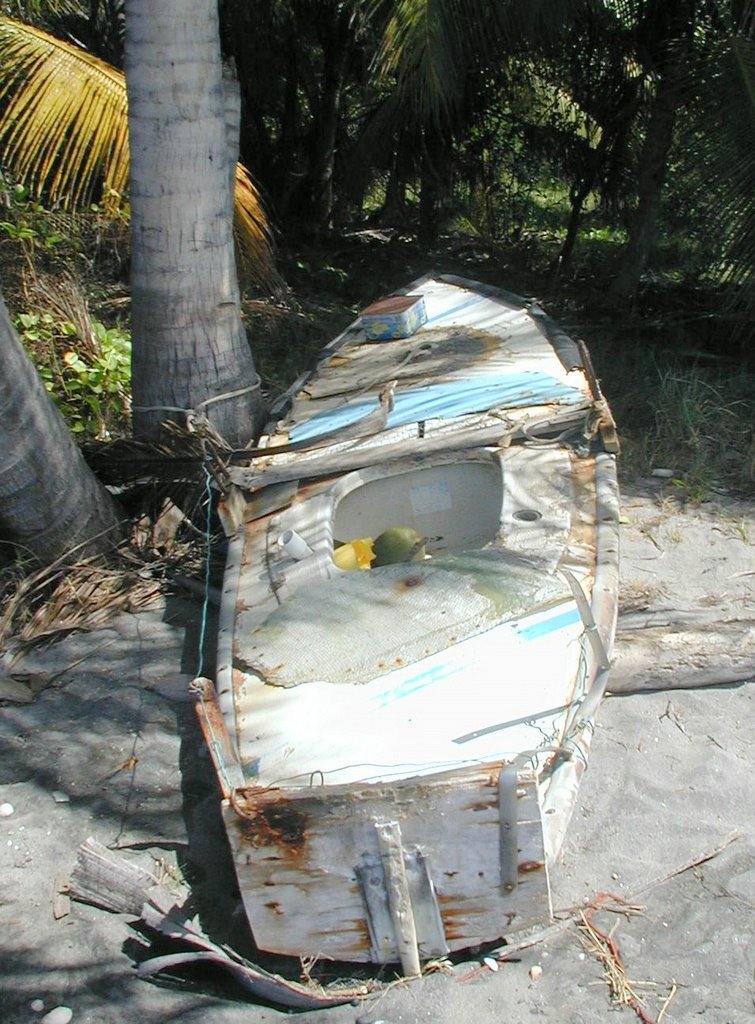
This reminded me of the photo below which I took on the beach of some Caribbean island (Bequia I think) a couple of years ago. It looks as if the hull of some old Sunfish has been recycled into becoming a rowboat for a fisherman by tacking on various timbers. But eventually even this life came to a sad end.
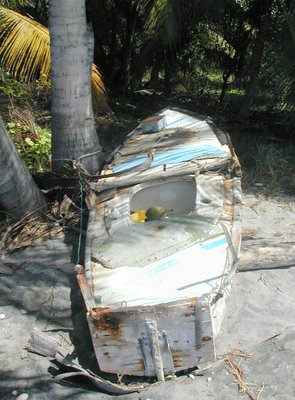

This reminded me of the photo below which I took on the beach of some Caribbean island (Bequia I think) a couple of years ago. It looks as if the hull of some old Sunfish has been recycled into becoming a rowboat for a fisherman by tacking on various timbers. But eventually even this life came to a sad end.
Monday, September 18, 2006
Sailing Pictures
I've long been an admirer of the marvelous sailing photography on display at Sailscape. Tall ships, windsurfers, dinghy racing, sunsets... and every week a few new superb shots.
To truly appreciate the beauty of all these photos hook up your computer to a projector or big screen TV, put on some suitably nautical music, pour yourself a rum drink, sit back and enjoy Willie Waw's photostream on Flickr as a slide show.
To truly appreciate the beauty of all these photos hook up your computer to a projector or big screen TV, put on some suitably nautical music, pour yourself a rum drink, sit back and enjoy Willie Waw's photostream on Flickr as a slide show.
Sunday, September 17, 2006
Sold
Yesterday I sold my Sunfish. It feels like the end of an era. Or at least the end of a major chapter in my sailing life.
I learned to sail and race in a Laser in the UK and my two sons started sailing in Optimists when they were old enough. So when we moved to America in 1989 our plan was to continue sailing these boats. However, the area to which we moved in North Jersey had very little Optimist and Laser activity but it was a hotbed of racing in a weird little boat called the Sunfish. Indeed a Sunfish fleet raced every Sunday morning in the summer on the lake opposite our house.
At first I resisted the obvious draw to sail what the locals sailed. My sons and I raced our Laser and Optimists for a year or two in the lake club's open fleet. But the fleet was small and dwindling, and handicap racing has never been as exciting for me as racing in a large one design fleet. So slowly we were sucked in to the Sunfish world. I bought a second-hand Sunfish, passed it down to one son and bought another. He also inherited my Laser when I bought a new one. Pretty soon the Tillerman family fleet was three Lasers and three Sunfish.
We raced the Sunfish locally and occasionally traveled further afield for Laser regattas. Every Sunday morning we would drift around the lake with the Sunfish fleet. It was usually the highlight of our weekend. It was what I and the kids did together as they were growing up. Pretty soon they were faster than me but that was OK.
I took my sons to the North Jersey Lakes Junior Sunfish Championship and they each won it in turn. I sailed in the senior North Jersey Lakes series against some of the best Sunfish sailors in the region. Once I even won one of those regattas. The high point of our six boat family sailing was the summer of 1995 when all three of us did a Laser clinic in upper New York State one week, and then sailed in the Sunfish North Americans in Delaware the following week.
Around that time I set myself the challenge of qualifying for the Sunfish World Championships. This turned out to be somewhat easier than I expected and I sailed as part of the US team at the Sunfish Worlds three times including memorable championships in the Dominican Republic and Colombia. For reasons I still don't fully understand I woke up after the free rum night at a Sunfish North Americans to find that I had been elected to the board of directors of the US Sunfish Class.
When my sons left for college I turned my attention to encouraging and coaching other young Sunfish sailors. I taught local kids how to race and took them to junior championships. After I retired from real work in 2000 I spent the first three summers teaching sailing in our club's Sunfish program. And I was instrumental in creating a junior championship series sailed at several local clubs. I joined a Wednesday night Sunfish fleet at another nearby club on a reservoir and even won their Sunfish regatta one year.
So I've had a lot of fun and a lot of rewards from the Sunfish over the years. But lately I've been drawn more and more back to the Laser. I've been sailing my Laser on Sundays in the spring and fall at a frostbite fleet in Connecticut. A friend and I started a Laser fleet at that reservoir club I mentioned, so I've been able to sail the Laser every summer weekend locally as well as travel to Laser regattas further away. The more I sail my Laser the less interesting the Sunfish is to me. But I don't want to knock the Sunfish or the people who sail it who are as friendly a crowd as you could ever hope to meet. It's just a personal preference.
Regular readers of this blog may have worked out that I've been heading towards dumping the Sunfish for a while now. When I wrote my third post ever Focus (and by the way the first post to attract any comment) this was in the back of my mind. My growing lack of interest in the Sunfish influenced Tweaks and my frustration with Sunfish racing came out when I wrote about Wednesday Night Racing. It seems like every time I sailed the Laser I enjoyed it so much more that I kept hearing these Voices asking me why I still bothered to sail a Sunfish. But even this year there have been times when the Sunfish has occasionally been a source of pleasure, such as the evening I wrote about in Memories of a Moment.
So finally I pulled the trigger. Placed an ad in our club newsletter, had some interest from a couple of members, and sold the Sunfish yesterday to a young woman who has just learned to sail and wants a boat to race. I explained all the little mods and tweaks I have made to the boat, answered all her newbie questions about the equipment, helped her work out what she needed to be able to tow the boat, and she bought it for the asking price.
Now I can concentrate purely on Laser sailing. Portugal here I come.
I learned to sail and race in a Laser in the UK and my two sons started sailing in Optimists when they were old enough. So when we moved to America in 1989 our plan was to continue sailing these boats. However, the area to which we moved in North Jersey had very little Optimist and Laser activity but it was a hotbed of racing in a weird little boat called the Sunfish. Indeed a Sunfish fleet raced every Sunday morning in the summer on the lake opposite our house.
At first I resisted the obvious draw to sail what the locals sailed. My sons and I raced our Laser and Optimists for a year or two in the lake club's open fleet. But the fleet was small and dwindling, and handicap racing has never been as exciting for me as racing in a large one design fleet. So slowly we were sucked in to the Sunfish world. I bought a second-hand Sunfish, passed it down to one son and bought another. He also inherited my Laser when I bought a new one. Pretty soon the Tillerman family fleet was three Lasers and three Sunfish.
We raced the Sunfish locally and occasionally traveled further afield for Laser regattas. Every Sunday morning we would drift around the lake with the Sunfish fleet. It was usually the highlight of our weekend. It was what I and the kids did together as they were growing up. Pretty soon they were faster than me but that was OK.
I took my sons to the North Jersey Lakes Junior Sunfish Championship and they each won it in turn. I sailed in the senior North Jersey Lakes series against some of the best Sunfish sailors in the region. Once I even won one of those regattas. The high point of our six boat family sailing was the summer of 1995 when all three of us did a Laser clinic in upper New York State one week, and then sailed in the Sunfish North Americans in Delaware the following week.
Around that time I set myself the challenge of qualifying for the Sunfish World Championships. This turned out to be somewhat easier than I expected and I sailed as part of the US team at the Sunfish Worlds three times including memorable championships in the Dominican Republic and Colombia. For reasons I still don't fully understand I woke up after the free rum night at a Sunfish North Americans to find that I had been elected to the board of directors of the US Sunfish Class.
When my sons left for college I turned my attention to encouraging and coaching other young Sunfish sailors. I taught local kids how to race and took them to junior championships. After I retired from real work in 2000 I spent the first three summers teaching sailing in our club's Sunfish program. And I was instrumental in creating a junior championship series sailed at several local clubs. I joined a Wednesday night Sunfish fleet at another nearby club on a reservoir and even won their Sunfish regatta one year.
So I've had a lot of fun and a lot of rewards from the Sunfish over the years. But lately I've been drawn more and more back to the Laser. I've been sailing my Laser on Sundays in the spring and fall at a frostbite fleet in Connecticut. A friend and I started a Laser fleet at that reservoir club I mentioned, so I've been able to sail the Laser every summer weekend locally as well as travel to Laser regattas further away. The more I sail my Laser the less interesting the Sunfish is to me. But I don't want to knock the Sunfish or the people who sail it who are as friendly a crowd as you could ever hope to meet. It's just a personal preference.
Regular readers of this blog may have worked out that I've been heading towards dumping the Sunfish for a while now. When I wrote my third post ever Focus (and by the way the first post to attract any comment) this was in the back of my mind. My growing lack of interest in the Sunfish influenced Tweaks and my frustration with Sunfish racing came out when I wrote about Wednesday Night Racing. It seems like every time I sailed the Laser I enjoyed it so much more that I kept hearing these Voices asking me why I still bothered to sail a Sunfish. But even this year there have been times when the Sunfish has occasionally been a source of pleasure, such as the evening I wrote about in Memories of a Moment.
So finally I pulled the trigger. Placed an ad in our club newsletter, had some interest from a couple of members, and sold the Sunfish yesterday to a young woman who has just learned to sail and wants a boat to race. I explained all the little mods and tweaks I have made to the boat, answered all her newbie questions about the equipment, helped her work out what she needed to be able to tow the boat, and she bought it for the asking price.
Now I can concentrate purely on Laser sailing. Portugal here I come.
Friday, September 15, 2006
Bubble Baba Challenge
I know I relaunched this blog a couple of weeks ago to focus more on Laser sailing and training. But that doesn't mean we can't enjoy other water sports from time to time.
It's not an official sport event and it will probably never be considered for the Olympics, but the growing popularity of Rubber Doll White-Water Rafting in Russia saw the fourth annual contest staged near St.Petersburg.
The event, better known as the 'Bubble Baba Challenge 2006', is the highlight of the novelty watersports season in Russia, and was held over a testing one kilometer course near St.Petersburg. Contestants are required to brave rapids on the river Vuoksa while embracing a blow-up doll, some of whom had their modesty preserved by t-shirts.
The idea to use rubber dolls to race down the rapids was conceived as a joke three years ago during a long rafting trip involving only men. Since then the popularity of this new watersport has grown rapidly.
It's not an official sport event and it will probably never be considered for the Olympics, but the growing popularity of Rubber Doll White-Water Rafting in Russia saw the fourth annual contest staged near St.Petersburg.
The event, better known as the 'Bubble Baba Challenge 2006', is the highlight of the novelty watersports season in Russia, and was held over a testing one kilometer course near St.Petersburg. Contestants are required to brave rapids on the river Vuoksa while embracing a blow-up doll, some of whom had their modesty preserved by t-shirts.
The idea to use rubber dolls to race down the rapids was conceived as a joke three years ago during a long rafting trip involving only men. Since then the popularity of this new watersport has grown rapidly.
Subscribe to:
Posts (Atom)