 Ummm Sis .. have you seen this dude with the camera?
Sunday, February 05, 2006

Onne
So there you are screaming down a reach in 20 knots of wind towards the gybe mark. You're trying to keep track of where all the other boats in the race are, where the next mark is, where the next wave is coming from, what the hell that idiot in the boat to leeward is going to do next, whether your crew has any clue of what he's doing ...
And then you start to approach the mark and you see THIS in front of your bow.

Do you
a) scream WTF ...
b) panic ...
c) put the helm down and do a crash tack ...
d) think, "Oh great. It's Onne van der Wal and he'll have some cool pictures of us on his website tonight"?
And then you start to approach the mark and you see THIS in front of your bow.
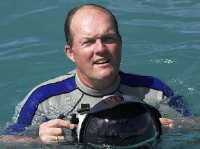
Do you
a) scream WTF ...
b) panic ...
c) put the helm down and do a crash tack ...
d) think, "Oh great. It's Onne van der Wal and he'll have some cool pictures of us on his website tonight"?
Hoot
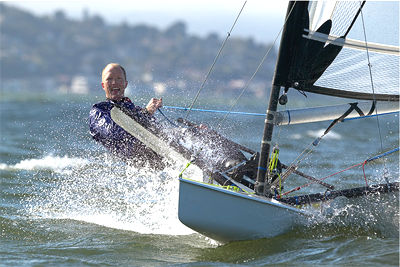
Every few years a new small single-handed sailing boat is launched on the market and the hype starts. This will be the one. The one that displaces the Laser from its position as the gold standard in single-handed one design sailing. A few years ago it was the MX-Ray but it never really took off in a big way. This year there is the Hoot.
I must admit it looks pretty cool. I especially like the picture of the self-described petite brunette carrying the hull under her arm.

Who knows? This might be the one. The boat I mean -- not the brunette.
Saturday, February 04, 2006
Be Prepared
Hey can I borrow a screwdriver?
Sure - take your pick.
Anybody got a knife?
Yeah - over here.
Who are these people? They come to the club without the most basic tools and then go cadging around the boat park until they find some sucker like me. Yeah, I'm that one guy that everyone seems to go to when they need to borrow something. My little box of tools lives in my car during the sailing season and I kinda hope that it contains everything that I might conceivably need to fix stuff on my Laser.
Let's see what I have ...
Pop riveter
Pop rivets
Corrosion eliminator
I don't ever recall actually replacing any riveted fittings in the middle of a regatta, but hey, you never know.
Wet and dry paper
Gotta keep your bottom smooth.
Can of McLube
Actually I have a bigger can too in the car. Spray it everywhere you can think. Could write a whole other post on the uses for this stuff. Probably will one day.
3 straight edge screwdrivers
2 Phillips screwdrivers
3 wrenches
Pair pliers
Tool that looks like a pair of pliers but is actually a gizmo for undoing Sunfish sailclips. No idea why I still carry it, except to be nice to Sunfish sailors that like to borrow it.
File
Hammer
I feel bad about this. Always seems like an admission of failure if I actually have to whack something on my precious boat with a hammer. But there are some times when you just have to do it.
Eric Clapton cassette tape
My car doesn't even have a cassette player. But cassette tape is great stuff for a light air wind indicator.
Sail repair tape
Telltales various colors
Marine-tex
Spatulas for applying marine-tex
Epoxy stick
This thing is supposed to be able to fix holes underwater. I've never actually needed to fix a hole underwater while Laser sailing but it sounded like a cool thing to have.
5200 silicone sealant
Tube of gelcoat repair stuff
Tape measure
Don't use it very often but this was my secret weapon for eliminating those heavy air death rolls. Another story for another day.
Scissors
2 knives
Cigarette lighter
I don't smoke. This is for sealing the ends of synthetic lines.
Pens and pencils
Assorted rolls of tape
My big role of duct tape is elsewhere in the car. Which reminds me, must write a post about the sailor's best friend one day.
Spare light bulbs for the trailer
Circuit tester
Aaagh trailer electrics. Hate 'em. That's another subject ripe for further discussion.
Tire levers
Tire repair kit
Mainly for those damned dolly tires that are always flat just when you're in a hurry to launch.
Sunscreen
This is just a backup in case I forget to throw the big bottle of sunscreen into my sailing bag.
Bag of Laser parts
Bailer, O rings, fairleads, centerboard stops ... Almost everything small on a Laser that can break. I have accumulated this mainly through a process of buying two replacements whenever anything breaks on the boat. One to replace the broken one; one for the bag for next time. Of course next time it's usually something else but over the years I've been sailing Lasers I seem to have accumulated one spare part for most bits. Could write a whole other post on "The Day I Broke My ..." and probably will one day.
So what am I missing. Comments please?
Sure - take your pick.
Anybody got a knife?
Yeah - over here.
Who are these people? They come to the club without the most basic tools and then go cadging around the boat park until they find some sucker like me. Yeah, I'm that one guy that everyone seems to go to when they need to borrow something. My little box of tools lives in my car during the sailing season and I kinda hope that it contains everything that I might conceivably need to fix stuff on my Laser.
Let's see what I have ...
Pop riveter
Pop rivets
Corrosion eliminator
I don't ever recall actually replacing any riveted fittings in the middle of a regatta, but hey, you never know.
Wet and dry paper
Gotta keep your bottom smooth.
Can of McLube
Actually I have a bigger can too in the car. Spray it everywhere you can think. Could write a whole other post on the uses for this stuff. Probably will one day.
3 straight edge screwdrivers
2 Phillips screwdrivers
3 wrenches
Pair pliers
Tool that looks like a pair of pliers but is actually a gizmo for undoing Sunfish sailclips. No idea why I still carry it, except to be nice to Sunfish sailors that like to borrow it.
File
Hammer
I feel bad about this. Always seems like an admission of failure if I actually have to whack something on my precious boat with a hammer. But there are some times when you just have to do it.
Eric Clapton cassette tape
My car doesn't even have a cassette player. But cassette tape is great stuff for a light air wind indicator.
Sail repair tape
Telltales various colors
Marine-tex
Spatulas for applying marine-tex
Epoxy stick
This thing is supposed to be able to fix holes underwater. I've never actually needed to fix a hole underwater while Laser sailing but it sounded like a cool thing to have.
5200 silicone sealant
Tube of gelcoat repair stuff
Tape measure
Don't use it very often but this was my secret weapon for eliminating those heavy air death rolls. Another story for another day.
Scissors
2 knives
Cigarette lighter
I don't smoke. This is for sealing the ends of synthetic lines.
Pens and pencils
Assorted rolls of tape
My big role of duct tape is elsewhere in the car. Which reminds me, must write a post about the sailor's best friend one day.
Spare light bulbs for the trailer
Circuit tester
Aaagh trailer electrics. Hate 'em. That's another subject ripe for further discussion.
Tire levers
Tire repair kit
Mainly for those damned dolly tires that are always flat just when you're in a hurry to launch.
Sunscreen
This is just a backup in case I forget to throw the big bottle of sunscreen into my sailing bag.
Bag of Laser parts
Bailer, O rings, fairleads, centerboard stops ... Almost everything small on a Laser that can break. I have accumulated this mainly through a process of buying two replacements whenever anything breaks on the boat. One to replace the broken one; one for the bag for next time. Of course next time it's usually something else but over the years I've been sailing Lasers I seem to have accumulated one spare part for most bits. Could write a whole other post on "The Day I Broke My ..." and probably will one day.
So what am I missing. Comments please?
Friday, February 03, 2006
Yacht Club Websites
Peter Huston at Buffalo Niagara Sailing had an interesting post a few days ago about Club Communications. The gist of what he was saying was that yacht clubs, in his area at least, do a poor job of using the web to communicate with their members. He was in fact arguing for clubs to use the web to have a dialog with their members and, in particular, for officers to use blogs to achieve this end.
His article started me thinking about yacht club websites and their quality. What do I want from a sailing club website? Well, it depends on what my relationship with that club is. If I'm a prospective member I want current information about their range of activities, some details about membership, and an easy way to contact the club. If I'm planning to attend a regatta at the club I basically want directions or a map, and perhaps a way to contact them to ask questions. And if I'm a member of the club then I probably want to see a calendar of upcoming activities, up-to-date postings of racing results and maybe photos of recent sailing (perhaps even showing myself). Whatever my relationship with the club I will be more impressed with the club if the design and maintenance of the website look professional. After all if they can't run a simple thing like a website properly, then I will start to wonder if their approach to race management is equally sloppy.
So I decided to check out a few websites of clubs that sailed at last year.
First up was the Carolina Yacht Club at Wrightsville Beach, NC where I sailed in the Laser US Nationals in April. I wrote about the experience here. Well, their home page is pretty minimalistic but they do have links to their 2006 social and racing schedules and some notices of upcoming activities such as a tactical seminar in February and an ocean race in April. They even have a forum which should make Peter Huston happy. The forum has some recent for sale ads but only two posts on the general bulletin board since the end of September. Not exactly a hive of member/officer interaction. But there are directions to the club and a map; the list of officers is the 2006 slate and I can send them emails by clicking on their titles; and the club newsletters are online - hey there's even some pictures of us Laserites at the Nationals in the May issue. No obvious information on membership but I guess I could always email the commodore and ask. All in all, not a bad site. I'd give it 7 out of 10.
In June I was racing in our Laser district championships at Island Heights Yacht Club and waffling on about it here. Let's see. Their website home page has a cool picture of the club from the river and some news from December about a fire destroying some members' homes. So far so good. But then a link to some racing results (actually to their local YRA site) gives me the dreaded 410 error; the calendar page takes me to last year's calendar; the photos link takes me to some photos of sailing in 2000 and a golf tournament in 2003; and the sailing link on the home page leads me to an archive of results from 1999 to 2001. There is a contacts page with the ability to send emails to officers but by now I'm wondering if the information there is any more current than the photos or results; and I see no obvious way to get directions to the club or apply for membership. Lucky I already know my way. Not good. Not good at all. Let's be generous and give them 2 out of 10.
For my last site today I checked out Severn Sailing Association in Annapolis where I sailed in the Laser US Masters at the beginning of October and of which I burbled here and here. First impressions of the site are excellent: a clean, smart professional looking design. There's a prominent link to the 2006 racing schedule and notices of upcoming events such as a rules seminar by Dave Perry in February. On the "About SSA" page there are links to a lot of the stuff anyone would be looking for: directions to the club, how to join, names of fleet captains, phone numbers and emails. About the only thing missing from the website is that element of two way dialog that Peter Huston was looking for, but apart from that they're doing a superb job. 9 out of 10 I would say.
So what do you think? How does your yacht club's use of the web measure up? Know any sites that are a model for all clubs? Or any real lemons? Comments please.
His article started me thinking about yacht club websites and their quality. What do I want from a sailing club website? Well, it depends on what my relationship with that club is. If I'm a prospective member I want current information about their range of activities, some details about membership, and an easy way to contact the club. If I'm planning to attend a regatta at the club I basically want directions or a map, and perhaps a way to contact them to ask questions. And if I'm a member of the club then I probably want to see a calendar of upcoming activities, up-to-date postings of racing results and maybe photos of recent sailing (perhaps even showing myself). Whatever my relationship with the club I will be more impressed with the club if the design and maintenance of the website look professional. After all if they can't run a simple thing like a website properly, then I will start to wonder if their approach to race management is equally sloppy.
So I decided to check out a few websites of clubs that sailed at last year.
First up was the Carolina Yacht Club at Wrightsville Beach, NC where I sailed in the Laser US Nationals in April. I wrote about the experience here. Well, their home page is pretty minimalistic but they do have links to their 2006 social and racing schedules and some notices of upcoming activities such as a tactical seminar in February and an ocean race in April. They even have a forum which should make Peter Huston happy. The forum has some recent for sale ads but only two posts on the general bulletin board since the end of September. Not exactly a hive of member/officer interaction. But there are directions to the club and a map; the list of officers is the 2006 slate and I can send them emails by clicking on their titles; and the club newsletters are online - hey there's even some pictures of us Laserites at the Nationals in the May issue. No obvious information on membership but I guess I could always email the commodore and ask. All in all, not a bad site. I'd give it 7 out of 10.
In June I was racing in our Laser district championships at Island Heights Yacht Club and waffling on about it here. Let's see. Their website home page has a cool picture of the club from the river and some news from December about a fire destroying some members' homes. So far so good. But then a link to some racing results (actually to their local YRA site) gives me the dreaded 410 error; the calendar page takes me to last year's calendar; the photos link takes me to some photos of sailing in 2000 and a golf tournament in 2003; and the sailing link on the home page leads me to an archive of results from 1999 to 2001. There is a contacts page with the ability to send emails to officers but by now I'm wondering if the information there is any more current than the photos or results; and I see no obvious way to get directions to the club or apply for membership. Lucky I already know my way. Not good. Not good at all. Let's be generous and give them 2 out of 10.
For my last site today I checked out Severn Sailing Association in Annapolis where I sailed in the Laser US Masters at the beginning of October and of which I burbled here and here. First impressions of the site are excellent: a clean, smart professional looking design. There's a prominent link to the 2006 racing schedule and notices of upcoming events such as a rules seminar by Dave Perry in February. On the "About SSA" page there are links to a lot of the stuff anyone would be looking for: directions to the club, how to join, names of fleet captains, phone numbers and emails. About the only thing missing from the website is that element of two way dialog that Peter Huston was looking for, but apart from that they're doing a superb job. 9 out of 10 I would say.
So what do you think? How does your yacht club's use of the web measure up? Know any sites that are a model for all clubs? Or any real lemons? Comments please.
Thursday, February 02, 2006
More on the Wattle
Oops. I was wrong. A commenter on today's post about Australia Day asked if there are wattle jokes. I replied that I doubted that Aussies take the wattle seriously and that there would probably be some good jokes out there.
I was wrong. Seems like Australians take the wattle as seriously as Americans do their flag, the French their wine, and the British ...
Scrub that thought, we Brits don't take anything that seriously.
Yup. It seems that there are patriotic songs about the wattle with such stirring lines as ...
And here's another that I really like ...
Apparently, during World War 1 it was customary to send soldiers serving overseas a sprig of wattle with each letter to remind them of home. And, more recently, after the Bali bombings the Australian prime minister suggested that Australians wear sprigs of wattle and plant wattle seeds as a "quiet personal gesture of remembrance and reflection".
So apologies to my Australian readers. I didn't mean to treat your national symbol so lightly. In mitigation I can only point out that I do have an Australian mother-in-law ... and there ought to be a joke there but I can't think of the punch line.
What's all this got to do with sailing, you may ask?
Good question.
I was wrong. Seems like Australians take the wattle as seriously as Americans do their flag, the French their wine, and the British ...
Scrub that thought, we Brits don't take anything that seriously.
Yup. It seems that there are patriotic songs about the wattle with such stirring lines as ...
But whatever the quarrel, whoever her foes,
Let them come! Let them come when they will!
Though the struggle be grim, 'tis Australia that knows,
That her children shall fight while the Waratah grows,
And the Wattle blooms out on the hill.
And we must sing a rebel song
And join in rebel chorus.
We'll make the tyrants feel the sting
O' those that they would throttle;
They needn't say the fault is ours
If blood should stain the wattle!
So apologies to my Australian readers. I didn't mean to treat your national symbol so lightly. In mitigation I can only point out that I do have an Australian mother-in-law ... and there ought to be a joke there but I can't think of the punch line.
What's all this got to do with sailing, you may ask?
Good question.
Australia Day
 Damn it.
You didn't remind me.
Once again Australia Day came and went and I didn't get a chance to celebrate it.
So here's a picture of Australia's floral emblem, the golden wattle.
You knew that, didn't you?
Product Endorsement
 When I wrote a post some months ago mentioning a certain body part it generated way too many google hits from weirdos who were almost certainly not looking for my personal accounts of running and sailing. So I will simply say that this product BODYGLIDE has provided the necessary lubrication to enable me to complete two marathons in comfort.
Wednesday, February 01, 2006
Unfit
This classic from Mike Belkin's comic strip Unfit (actually published on January 3) reminded me of all that talk last month of new year resolutions, and goals, and establishing new habits like getting fit for sailing.
So, dear reader, how are you doing with your resolutions? Comments please.
So, dear reader, how are you doing with your resolutions? Comments please.
Living Slow
I see that one reader arrived at my blog by doing a google search on "live slow". I guess that's not surprising -- the phrase is up there in my title bar. I must admit that I didn't give that choice of words a great deal of thought when I started the blog. "Live slow, sail fast" after all is just a slogan on a T-shirt.
I knew that one of the major themes of the blog would be "sail fast", my often futile attempts to improve my sailboat racing skills; and as a relatively recent retiree the "live slow" slogan resonated with me after a half a century of hustle and hassle to get good grades, to get into the right college, to get the right job, to get promotions ... a hectic life of schedules and work and meetings and deadlines and business travel. "Live slow" was just a statement of rejection of that life style, a commitment to take it easier in retirement.
But following up on that google search I see that "living slow" is much, much more serious than I had imagined. It's a whole philosophy, a movement even. It seems to have got started with the Slow Food movement which was founded in 1986 as a response to the opening of a McDonald's restaurant on the Spanish Steps in Rome. Slow Food, now an international organization with over 80,000 members, has an aim to "protect the pleasures of the table from the homogenization of modern fast food and life". They promote gastronomic culture, develop taste education, and work to protect agricultural biodiversity and traditional foods.
Mmmm... sounds tasty.
The Slow Food movement in turn gave rise to a network of Slow Cities "where living is easy". These are towns "where men are still curious of the old times, towns rich of theatres, squares, cafes, workshops, restaurants and spiritual places, towns with untouched landscapes and charming craftsman where people are still able to recognize the slow course of the Seasons and their genuine products respecting tastes, health and spontaneous customs."
Hmmm - that sounds good. However, I notice that their website doesn't seem to award the "slow city" accolade to any towns in the USA. Perhaps they have just been a bit slow updating the website?
Some take it even further and argue for the virtues of slowness in almost every aspect of life. In his book In Praise of Slowness, Carl Honore reports that he sees everywhere evidence of "a great hunger for slowness". He writes not only of enjoying a four hour slow food dinner in Italy but also of a "slow school" in Japan founded by parents as an alternative to high stress classes. He tells of a group that plays music such as Mozart slowly (sounds a bit like my guitar playing), the superslow weightlifting movement (I can relate to that) and Honore even enrolls, with his wife, in a class on slow sex (no comment).
The common themes running through most of these ideas seem to be an emphasis on quality over quantity; a commitment to take the time to appreciate the finer things in life; an emphasis on paying attention to the details of each experience. It's more than a rejection of speed; it's a celebration of life by electing to live it a pace that allows one to enjoy each of its adventures to the utmost.
Then there is a blog called Slow Leadership with posts on such topics as What's So Good About the Work Ethic? and Slow Leadership in Practice which is about a company that "trusts its employees to set their own salaries and working times... (who) go to meetings only if they think they need to... The company has no official structure, no organizational chart, no business plan and no corporate strategy." Not sure how some of that would have gone down with my old employer but it sounds like a cool place to work.
Slow living is even a subject for serious academic research. Wendy Parkins of Murdoch University in Western Australia (a splendid place to live slow, by the way) has published an article in a learned journal on Fast Subjects and Slow Living. Here is the abstract.
As you can see some of these folk in the slow movement are very earnest in their arguments for the merits of slowness. They can seem a little too purposeful for my taste. Do we really have to work so hard at the slow life?
I think I need a break.
I knew that one of the major themes of the blog would be "sail fast", my often futile attempts to improve my sailboat racing skills; and as a relatively recent retiree the "live slow" slogan resonated with me after a half a century of hustle and hassle to get good grades, to get into the right college, to get the right job, to get promotions ... a hectic life of schedules and work and meetings and deadlines and business travel. "Live slow" was just a statement of rejection of that life style, a commitment to take it easier in retirement.
But following up on that google search I see that "living slow" is much, much more serious than I had imagined. It's a whole philosophy, a movement even. It seems to have got started with the Slow Food movement which was founded in 1986 as a response to the opening of a McDonald's restaurant on the Spanish Steps in Rome. Slow Food, now an international organization with over 80,000 members, has an aim to "protect the pleasures of the table from the homogenization of modern fast food and life". They promote gastronomic culture, develop taste education, and work to protect agricultural biodiversity and traditional foods.
Mmmm... sounds tasty.
The Slow Food movement in turn gave rise to a network of Slow Cities "where living is easy". These are towns "where men are still curious of the old times, towns rich of theatres, squares, cafes, workshops, restaurants and spiritual places, towns with untouched landscapes and charming craftsman where people are still able to recognize the slow course of the Seasons and their genuine products respecting tastes, health and spontaneous customs."
Hmmm - that sounds good. However, I notice that their website doesn't seem to award the "slow city" accolade to any towns in the USA. Perhaps they have just been a bit slow updating the website?
Some take it even further and argue for the virtues of slowness in almost every aspect of life. In his book In Praise of Slowness, Carl Honore reports that he sees everywhere evidence of "a great hunger for slowness". He writes not only of enjoying a four hour slow food dinner in Italy but also of a "slow school" in Japan founded by parents as an alternative to high stress classes. He tells of a group that plays music such as Mozart slowly (sounds a bit like my guitar playing), the superslow weightlifting movement (I can relate to that) and Honore even enrolls, with his wife, in a class on slow sex (no comment).
The common themes running through most of these ideas seem to be an emphasis on quality over quantity; a commitment to take the time to appreciate the finer things in life; an emphasis on paying attention to the details of each experience. It's more than a rejection of speed; it's a celebration of life by electing to live it a pace that allows one to enjoy each of its adventures to the utmost.
Then there is a blog called Slow Leadership with posts on such topics as What's So Good About the Work Ethic? and Slow Leadership in Practice which is about a company that "trusts its employees to set their own salaries and working times... (who) go to meetings only if they think they need to... The company has no official structure, no organizational chart, no business plan and no corporate strategy." Not sure how some of that would have gone down with my old employer but it sounds like a cool place to work.
Slow living is even a subject for serious academic research. Wendy Parkins of Murdoch University in Western Australia (a splendid place to live slow, by the way) has published an article in a learned journal on Fast Subjects and Slow Living. Here is the abstract.
Imbrication? Sociality? Geeze this is getting heavy.
Slow living involves the conscious negotiation of the different temporalities which make up our everyday lives, deriving from a commitment to occupy time more attentively. This article considers the significance of time in practices of slow living and the imbrication of time and speed in notions of 'slowness' where slowness is constructed as a deliberate subversion of the dominance of speed. By purposely adopting slowness, subjects seek to generate alternative practices of work and leisure, family and sociality.
As you can see some of these folk in the slow movement are very earnest in their arguments for the merits of slowness. They can seem a little too purposeful for my taste. Do we really have to work so hard at the slow life?
I think I need a break.
Subscribe to:
Posts (Atom)