Here are the links to all five posts in my series on how to stay alive when Laser sailing...
Wednesday, November 25, 2009

Tuesday, November 24, 2009
World's Smallest Schooner?
None of my many hundreds of highly knowledgeable and attentive readers seem to have picked up on what I thought was a glaring error of nautical terminology in Sunday's post which included the lyrics to Mr. Kenny Chesney's song "The Life".
Mr. Chesney claims that he met a gentleman called José who had a "12 foot Schooner".
Hmmm. I'm no expert on boats but according to Wikipedia (which is never wrong) a schooner is "a type of sailing vessel characterized by the use of fore-and-aft sails on two or more masts with the forward mast being shorter or the same height as the rear masts."
A 12 foot boat with at least two masts and fore-and-aft sails? Seems unlikely to me.
Was Mr. Chesney just groping for a word that sorta kinda rhymes with "cooler"?
Or do Mexican fisherman really use 12 foot boats with two masts? Or is the word "schooner" used to describe some other kind of boat in Playa del Carmen?
So how small could a schooner be? What is the world's smallest schooner?
According to the The Google (which contains all the knowledge in the universe) this photo on Flickr may be of the world's smallest schooner.
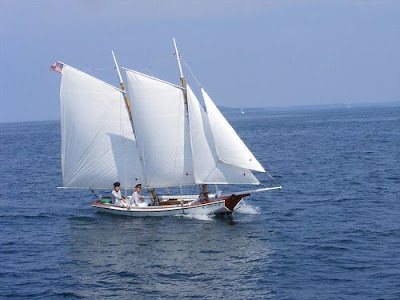
How long is that? 30 foot including the bowsprit? Certainly more than 12 foot. I haven't been able to discover any more information about this boat. Can anyone help? Or does anyone know of an even smaller schooner?
What about this boat?

I stumbled upon this picture on 70.8% yesterday, in a post in which Thomas Armstrong reviews A VOYAGE OF PLEASURE: the Log of Bernard Gilboy’s Transpacific Cruise in the Boat, “Pacific” 1882-1883. Armstrong describes the Pacific as an 18 foot schooner.
Hmmm. At first I was going to argue whether this strange looking craft (with only one mast apparently) was really a schooner, but then I read the text of the post and learned that Gilby was capsized by a wave 90 days out of San Francisco and that in this accident he lost "a mast". He subsequently contrived a jury rig which is shown in the "lead photograph" in the book. So now I'm confused. Is the drawing on the cover of the boat as built, or of the jury rig? Did the boat have one or two masts originally? And if only one, was it really a schooner? I have no compunction about challenging Mr. Chesney's nautical credentials but am very reluctant to second guess Mr. Armstrong on such a subject.
Can someone please help me to find a way out of this fog?
Mr. Chesney claims that he met a gentleman called José who had a "12 foot Schooner".
Hmmm. I'm no expert on boats but according to Wikipedia (which is never wrong) a schooner is "a type of sailing vessel characterized by the use of fore-and-aft sails on two or more masts with the forward mast being shorter or the same height as the rear masts."
A 12 foot boat with at least two masts and fore-and-aft sails? Seems unlikely to me.
Was Mr. Chesney just groping for a word that sorta kinda rhymes with "cooler"?
Or do Mexican fisherman really use 12 foot boats with two masts? Or is the word "schooner" used to describe some other kind of boat in Playa del Carmen?
So how small could a schooner be? What is the world's smallest schooner?
According to the The Google (which contains all the knowledge in the universe) this photo on Flickr may be of the world's smallest schooner.

How long is that? 30 foot including the bowsprit? Certainly more than 12 foot. I haven't been able to discover any more information about this boat. Can anyone help? Or does anyone know of an even smaller schooner?
What about this boat?

I stumbled upon this picture on 70.8% yesterday, in a post in which Thomas Armstrong reviews A VOYAGE OF PLEASURE: the Log of Bernard Gilboy’s Transpacific Cruise in the Boat, “Pacific” 1882-1883. Armstrong describes the Pacific as an 18 foot schooner.
Hmmm. At first I was going to argue whether this strange looking craft (with only one mast apparently) was really a schooner, but then I read the text of the post and learned that Gilby was capsized by a wave 90 days out of San Francisco and that in this accident he lost "a mast". He subsequently contrived a jury rig which is shown in the "lead photograph" in the book. So now I'm confused. Is the drawing on the cover of the boat as built, or of the jury rig? Did the boat have one or two masts originally? And if only one, was it really a schooner? I have no compunction about challenging Mr. Chesney's nautical credentials but am very reluctant to second guess Mr. Armstrong on such a subject.
Can someone please help me to find a way out of this fog?
Monday, November 23, 2009
Sail With a Friend

It's not that I'm paranoid, but there really are people out there trying to read my mind...
First of all it was the Wizard of Berkeley twice trying to guess the subjects of my group writing projects before I announced them...
Now the Old Man of Lake Eustis has attempted to guess the subject of the final instalment of my series on How Not to Die on Your Laser.
And the spooky thing is that both of them did accurately read my mind! Am I that predictable? Or do these two old geezers have supernatural powers?
So, yes, the fifth of Tillerman's Tips on How Not to Die on Your Laser is Sail With a Friend.
What? What's that he said? Tillerman said you should always sail in company, sail with other Lasers, sail with a friend? Is this the same Tillerman who actually boasted in Anti-Social Bastard that he sailed 50 times on his own last year? The same Tillerman who wrote posts about sailing alone early in the season on the Sakonnet River such as So Where the Bloody Hell Are You? and who also wrote about sailing alone in the dark days of December in posts such as Paint it Black? What a hypocrite.
You are right. I am a hypocrite. But it is true that if you want to play it really safe you should never go off Lasering on the sea on your own. Shit happens. Bad shit sometimes happens. Here are just a few of the things that could happen when you go Lasering. If any one of these things happened while you are on your own a mile from shore you might never get home...
- injure yourself
- break the mast
- break the boom
- break the rudder
- break the mast-step
- break the gooseneck
- rip a fitting off the boom
- have a heart-attack or a stroke
- get run over by a ferry or powerboat
- fall off the boat and lose contact with it
- hit a rock and knock a huge hole in the hull...
My son and I had a conversation about sailing a Laser alone on the day that the two of us went for a blast in the waves at the mouth of the Sakonnet River. I wrote about it in Fat Boy and Little Man.
"So is it really any safer with two of us? If one of us breaks a mast or a boom, say, in waves and wind like this, there's no way that the other one is going to be able to tow the damaged boat back to shore."
"True. We may have to abandon the broken boat. But with one good Laser we can make sure that the two of us make it alive back to the beach."
"Right."
And that's the point. If you are sailing with at least one other friend in a Laser, he can help you in all sorts of ways. If you get separated from your boat, he can pick you up and sail you back to it. (Been there, done that.) If your boat breaks he can perhaps help you do some kind of jury-rig repair. Worst case, he can pick you up and take you back to safety even if you have to abandon your boat.
So, yes, it's a good rule never to sail alone.
Is that going to stop me from sailing alone? No. Absolutely not. I discovered last year that some of the most rewarding experiences on the water come from solitary sails. And there are things you can do to make sailing on your own somewhat less risky...
Oh no! I feel another series coming on. Tillerman's Top X Tips on How to Stay Safe When Sailing Alone on Your Laser.
Watch this space.
Sunday, November 22, 2009
Wouldn't That Be The Life?
It was early one morning
Playa del Carmen
That’s when I first met José.
He had a 12 foot Schooner
A 3 foot cooler
Full of the catch of the day
And he was wrinkled from grinning
From all of the sun he had been in.
He was barefoot, cerveza in hand.
He said, “Gracias Señor," when I paid him too much for
All of the snapper he had.
Now I told him, "My friend it ain’t nothing,"
In the best broken Spanish I knew.
I said, "I make a good living
Back home where I’m from."
He smiled and said, "Amigo, me too."
He said, "I fish and I play my guitar
I laugh at the bar with my friends
I go home to my wife
I pray every night
I can do it all over again."
Somewhere over Texas
I thought of my Lexus
And all the stuff I work so hard for
And all the things that I’ve gathered
From climbing that ladder
Didn’t make much sense anymore.
They say my nest egg ain’t ready to hatch yet.
They keep holding my feet to the fire.
They call it paying the price
So that one day in life
I’ll have what I need to retire
And just fish
And play my guitar
And laugh at the bar with my friends
And go home to my wife
And pray every night
I can do it all over again.
And to think that I thought for a while there
That I had it made
When the truth is I’m really just dying
To live like José
And just fish
Play my guitar
Laugh at the bar with my friends
Go home to my wife
Pray every night
I can do it all over again.
Wouldn’t that be the life?
Wouldn’t that be the life?
Love and Sailing: First Three Entries
I am frequently amazed by the inventiveness and creativity of the readers of this blog...
When I suggested Love and Sailing as a topic for another group writing project, I expected that I would see stories along the lines of the book that inspired the subject, The Motion of the Ocean, real life confessions of how sailing has impacted your relationships with your significant others and/or vice versa.
To be sure, O Docker in his premature contribution Who Do You Trust? did follow this model.
But Joe Rouse went off in a completely direction with Con La Vela He Encontrado El Amor Verdadero! which includes a very helpful link for lonely single sailors in our community.
And Carol Anne gave us A spat which she says is, "Purely fiction. Purely. Well, almost purely." Hmmm. Is it a dream? A fantasy? Or can you read between the lines of other posts in Carol Anne's blog to find the seeds of inspiration for this delightfully titillating bodice ripper?
So now it's your turn. What can you do with this topic? Full details of how to participate at Love and Sailing.
Friday, November 20, 2009
Make Sure You Can Get Back in the Boat

It's time for #4 in Tillerman's Top Five Tips For Making Sure You Don't Die on Your Laser. In case you've forgotten, the first three tips were...
Tip #4 is Make Sure You Can Get Back in the Boat.
Actually for any boat that can capsize, like a Laser, the tip should really read Make Sure You Can Do a Capsize Recovery AND Get Back in the Boat but today I'm going to provide a public service for sailors of all kinds of boats, big and small, by having a bit of a rant on the general issue of getting back in the boat.
Start of rant...
As I am sure you recall, the incident that triggered me to start writing this series of posts was when Thorsten Cook fell off his boat during the Star North Americans. One of the factors that contributed to the seriousness of the situation was that, although Mr. Cook's crew did manage to sail the boat back to him, the two of them were unable to get him back into the boat.
How often do we hear of stories like this? Sometimes it's the classic "man and wife go for a day cruise in their yacht... man falls overboard... wife either cannot sail the boat back to man on her own or even if she does they cannot get him back on board." (Sorry to sound sexist but it's usually that way round.) It happened on the waters right in front of my house a year or two ago in weather conditions that weren't at all extreme. The husband fell overboard. The wife was unable to recover him. She called out the Coastguard but he drowned and his body was washed up in front of our favorite local restaurant a few days later.
I'm sorry but I can't understand the mentality of people who go sailing without any kind of clue as to how they are going to get back on board if they fall off. I know it's not as easy on many kinds of boat as it would be on a Laser but I think you should have a plan for getting back on board... and practice it.
There's a great Yachting Magazine article on this issue, Man Overboard, which discusses what equipment to use to retrieve a crew member in the water, and why a swim platform is worse than useless in anything except calm conditions.
And, while I'm ranting, let me have a go at those sailing schools that purport to teach "man overboard" drills. A few years ago, my son and I did one of those fully certificated Bareboat Chartering Level courses with intensive three-hour emphasis on man-overboard recovery. We had a lot of fun learning how to turn a 40-foot yacht around in wind and waves and find our way back to the "man" in the water. Except it wasn't a man. It was a life jacket which we picked up with a boat hook. The instructor didn't even explain to us how one of us could magically pluck a 200 lb real person out of the water in heavy seas.
So do yourself a favor. Think it through. Worst case. If the most experienced member of your crew goes overboard, how will the rest of the crew (your wife, your kids, whatever) recover him or her? Then practice it. Make Sure You Can Get Back in the Boat.
End of rant...
So is this an issue on a little boat like a Laser or a Sunfish? It can be.
In my experience there are three reasons why a sailor of a small single-handed dinghy may be unable to do a capsize recovery and/or get back in the boat.
- The sailor is too light to do a capsize recovery. It takes a certain minimum weight of person on the daggerboard to right any given capsized boat. If the sailor (usually a child) is too light to achieve this they will not be able to do a capsize recovery. Simple physics. I've lost count of the times I've had to jump in the water and help some kid who has got themselves into this situation. That's one of the reasons why, when I was teaching sailing, I usually had the kids do capsize recoveries relatively early in the syllabus. I'm sorry but if you're too light for the boat, then find a more suitable boat.
- The sailor does not have the arm strength to pull themselves up on to the daggerboard to do a capsize recovery. Sorry to sound sexist again, but it's usually women who have this problem.
- The sailor is too heavy to be able to pull themselves on to the daggerboard and/or into the boat. I guess this is really the inverse of #2 but I have seen overweight people of all ages and both sexes who have had this problem. I remember one friend, a Sunfish sailor, who capsized during racing one day. He was unable to climb back into his own boat. When the safety boat, a small whaler, came over to help him he was unable to climb into that and the crew of the rescue boat couldn't pull him in either. There was much discussion afterwards as to what kind of rope tricks might have been employed to get this dude back into his own boat or the safety boat.
Speaking for myself, I am not yet so old, so weak, or so fat that I can't usually do a capsize recovery and scramble back into my Laser. But I do confess that each such event does drain some of my strength and energy away. There have been some windy race days when, after doing way too many capsizes, my arms became so tired that I felt that I wouldn't have had the strength left to do even one more recovery. That's when it's time to head for the beach, the showers and the bar. You can always win the race to the bar!
Comments please. Want to pass on any tips or techniques for getting back in the boat? Are you sure you can do it on your boat?
Wednesday, November 18, 2009
Love and Sailing

Your challenge for this month's group writing project is to write a story on the topic of Love and Sailing. The idea is to tell your readers something about how your love life and your sailing life interact. (You do have both a love life and a sailing life, I hope? If you don't, I guess you could always write a fictional story on this theme.) You don't have to have a blog of your own to enter. And there will be a prize for the best entry!
I was inspired to choose this subject after writing my review of Janna Cawrse Esarey's book the Motion of the Ocean in which Janna writes about how she and her new husband Graeme came to terms with each other's strengths and weaknesses and forged a strong marriage while sailing across the Pacific on their honeymoon. They drove each other crazy in many ways but love conquered all in the end.
I suspect all of us with a passion for sailing have tales to tell of how our sailing has impacted our relationship with our significant other, or vice versa. Perhaps, like Janna and Graeme, you worked out how to love, live and sail together on a long voyage with your loved one. Or maybe sailing introduced you to the love of your life. Or sadly tore you apart from them. Perhaps you and your beloved fight like cats and dogs every time you go sailing together. Or it could be that you fell for someone who hates sailing and have had to adapt your sailing lifestyle to cope with that. We all have different tales to tell. Write about wherever love and sailing come together (or don't) in your life.
Over on the west coast of our great nation there is a wizard who can read my mind. O Docker actually entered this competition two weeks before I announced it, with a story about how he learned to build his wife's confidence in his sailing skills: Who Do You Trust? an excellent example of the Love and Sailing genre.
So now it's your turn. Here is how to participate...
1. Write a post on the theme Love and Sailing (or Love and Some Other Kind of Boating if you prefer) on your blog. Please publish it before Tuesday December 1st.
2. Let me know about your post by sending an email to tillermeister@gmail.com including a link to your post. If you don't have a blog of your own just email me your article and I will post it here.
3. Oh, do me a favor... please choose some title other than Love and Sailing for your post; I don't want to have to link to 20+ stories all with the same title. (If you don't select a unique title, I reserve the right to choose a new title for your post and you may not like my choice!)
4. Please put a link to this post in yours.
5. I will post here two links to your post. Every day or so I will write a post listing any new entries in the project. Then at the end of the project I will publish the complete list of Love and Sailing stories.
6. I will then allow a period for all my readers to comment on the Love and Sailing stories, and at the end of that I will choose a winner who will receive... a copy of Janna's book on our theme: the Motion of the Ocean, 1 Small Boat, 2 Average Lovers, and a Woman's Search for the Meaning of Wife.
Look forward to hearing from you...
It's Pottery Wednesday

The UPS guy always drives by our house as the sun is setting. Most days he just swings around the circle at the end of the cul-de-sac in front of our house and doesn't stop. I'm never quite sure whether he does this because he wants to turn round, or because he absolutely needs to see one our spectacular bay sunsets at the end of his working day. Maybe both.
But yesterday evening the UPS guy stopped at our house. And he delivered a beautiful gift for me from Antolin Rivera, the sailing potter. Antolin has been leaving comments here for a while; he was the author of that moving entry Hanging in our Less is More group writing project; and he sent me the Night Race picture.
Antolin's gift is a mug which he made himself. It is decorated with a scene of sand, dunes, wave, wind... and there are two small sailboats and a running man. How appropriate for me! What a wonderful gift.
Thank you my friend.
Tuesday, November 17, 2009
Two Amazing Facts About The Racing Rules Of Sailing That You Could Have Learned From Reading Sailing Blogs Last Week
For all you Racing Rules Wonks, here are two amazing facts about the Racing Rules of Sailing that you may not know...
1. The Rules don't specify exactly where the starting line is. It's up to the whim of the Race Committee. And often they don't tell you what they've decided.
 Photo: College Singlehanded Nationals 2009 shamelessly stolen from GTSphotos.com
What's that you say? The starting line is always defined in the Sailing Instructions.
You are right. But often the SI's say something like "the starting line will be between a staff with an orange flag on the committee boat and an orange pin buoy". But what if the pin buoy is a 5-foot wide tetrahedron? Does the start line run through the back, the center, or the front of that buoy? Because if you think it's the front and the race committee are sighting the back, then every time you "win the pin" you are going to be called OCS.
Think it can't happen at a serious, major championship?
Think again. It did happen. At the US collegiate single-handed national championships no less. Check out Andrew Campbell's account at The Starting Line - Can you show me where it is? Is it even there? And read the comments which pretty well beat the subject to death. But I'm sure the creative commenters of this blog will find something new to say...
2. The Rules allow a boat you are following closely to force you into committing a foul by quickly slowing down so that you hit its transom.
 Photo: Laser Masters Worlds 2009 - shamelessly stolen from capizzano.com
Most of us have some vague idea that the Racing Rules help prevent collisions by not allowing a boat to take a sudden action which causes a collision, or that if a boat does take such an action then it will be the one penalized.
There is Rule 15 which says that if a boat takes some action to acquire right of way she shall initially give the other boat room to keep clear.
And there is Rule 16 which says if a right-of-way boat changes course, she shall give the other boat room to clear.
But if you think about it, neither of these Rules apply to a situation where two boats on the same tack are sailing along with the trailing boat's bow a few inches behind the leading boat's transom. When the leading boat eases sheets and slows down she is not changing course so Rule 16 doesn't apply. And the action of slowing down does not make the lead boat acquire right of way (she already had it.) So Rule 15 doesn't apply. So when you plow into the back of the sneaky guy that eased his sheets, it's you, the boat that's clear astern, that has broken Rule 12.
Ahah, you say. What about Rule 14: A boat shall avoid contact with another boat if reasonably possible? Surely the boat clear ahead that slowed down thereby causing contact has infringed Rule 14?
Well, yes. But Rule 14 also says that a right-of-way boat shall not be penalized under this rule unless there is damage or injury. And, in most cases, a little bow to transom bump between two boats sailing at almost the same speed is not going to cause any damage. So our sneaky sheet-easer gets off scot-free and you in the following boat have to do penalty turns!
It doesn't seem fair to me but that's how the Rules work according to International Judge Jos Spijkerman. The issue first came up in a question I posed in the comments to a very similar situation Rapid Response Match Race Call 2009-10. Jos answered my question and discussed this example and some similar ones in Non-Actions?
What do you think? Would you pull this trick in a race if another boat was following close to your transom? Would you feel good about it? How about if someone did it to you?
I suspect your reaction to this post will depend on whether you are a SNOP or an RRF. Which are you?
- The Rules don't specify exactly where the starting line is. It's up to the whim of the Race Committee. And often they don't tell you what they've decided.
- The Rules allow a boat you are following closely to force you into committing a foul by quickly slowing down so that you hit its transom.
1. The Rules don't specify exactly where the starting line is. It's up to the whim of the Race Committee. And often they don't tell you what they've decided.
 Photo: College Singlehanded Nationals 2009 shamelessly stolen from GTSphotos.com
What's that you say? The starting line is always defined in the Sailing Instructions.
You are right. But often the SI's say something like "the starting line will be between a staff with an orange flag on the committee boat and an orange pin buoy". But what if the pin buoy is a 5-foot wide tetrahedron? Does the start line run through the back, the center, or the front of that buoy? Because if you think it's the front and the race committee are sighting the back, then every time you "win the pin" you are going to be called OCS.
Think it can't happen at a serious, major championship?
Think again. It did happen. At the US collegiate single-handed national championships no less. Check out Andrew Campbell's account at The Starting Line - Can you show me where it is? Is it even there? And read the comments which pretty well beat the subject to death. But I'm sure the creative commenters of this blog will find something new to say...
2. The Rules allow a boat you are following closely to force you into committing a foul by quickly slowing down so that you hit its transom.
 Photo: Laser Masters Worlds 2009 - shamelessly stolen from capizzano.com
Most of us have some vague idea that the Racing Rules help prevent collisions by not allowing a boat to take a sudden action which causes a collision, or that if a boat does take such an action then it will be the one penalized.
There is Rule 15 which says that if a boat takes some action to acquire right of way she shall initially give the other boat room to keep clear.
And there is Rule 16 which says if a right-of-way boat changes course, she shall give the other boat room to clear.
But if you think about it, neither of these Rules apply to a situation where two boats on the same tack are sailing along with the trailing boat's bow a few inches behind the leading boat's transom. When the leading boat eases sheets and slows down she is not changing course so Rule 16 doesn't apply. And the action of slowing down does not make the lead boat acquire right of way (she already had it.) So Rule 15 doesn't apply. So when you plow into the back of the sneaky guy that eased his sheets, it's you, the boat that's clear astern, that has broken Rule 12.
Ahah, you say. What about Rule 14: A boat shall avoid contact with another boat if reasonably possible? Surely the boat clear ahead that slowed down thereby causing contact has infringed Rule 14?
Well, yes. But Rule 14 also says that a right-of-way boat shall not be penalized under this rule unless there is damage or injury. And, in most cases, a little bow to transom bump between two boats sailing at almost the same speed is not going to cause any damage. So our sneaky sheet-easer gets off scot-free and you in the following boat have to do penalty turns!
It doesn't seem fair to me but that's how the Rules work according to International Judge Jos Spijkerman. The issue first came up in a question I posed in the comments to a very similar situation Rapid Response Match Race Call 2009-10. Jos answered my question and discussed this example and some similar ones in Non-Actions?
What do you think? Would you pull this trick in a race if another boat was following close to your transom? Would you feel good about it? How about if someone did it to you?
I suspect your reaction to this post will depend on whether you are a SNOP or an RRF. Which are you?
Monday, November 16, 2009
Where You Can Learn to Sail in a Laser

Ooops. I screwed up again.
A few weeks ago I wrote in Where Can I Learn to Sail in a Laser? that I didn't know of any sailing schools that teach total beginners in Lasers.
Duh.
I should have know that Sailfit in Clearwater, Florida (which I have attended twice) does teach beginners in Lasers. Because I had attended a couple of clinics there to work on refining my racing skills I had somehow got the idea that that was all they do. But it says perfectly clearly on their website, "We are very pleased to continue to teach Laser sailors from beginner through advanced." (My emphasis.)
Kurt Taulbee, the guy who runs Sailfit, wrote an email to me at the weekend to point out to me the error of my ways...
I have had several clients with no Laser experience come to Clearwater to learn how to sail. I have boats for them to use during the lessons. I show them how to rig their boat and give them pictures of the rigging. I show them how to launch their boat and then I sail alongside them in my own boat. I tell them to steer left or right to help them feel the flow over the sail. I show them how to sit in the boat and hold the tiller properly. I show them how to sheet the sail in properly. Then tacking and jibing, etc. This method works quite well. If they capsize and can’t bring it back up I jump in and help them. If it is windy we downsize the sail to radial or 4.7. I have also had a bunch of beginner sailors attend our seminars. Even if they can’t do all the drills they progress very well over the seminar and understand what they need to practice.
Anyway, SAILFIT does provide instruction for sailors that are just starting out.
To make things worse when I found Kurt's email early yesterday morning and hastily dashed off an email to apologize for my oversight I called him "Karl". In mitigation I will say that I had just got out of bed, was somewhat bleery-eyed, and was still waiting for my first cup of coffee of the day to brew.
Anyway. I strongly recommend that you should check out Sailfit if you want some superb instruction on how to sail a Laser whatever your level of experience. I wrote about my time there this year at Sailfit Revisited.
Sorry Karl. I mean Kurt.
Subscribe to:
Posts (Atom)