Tacticat the online sailing tactical simulator just keeps improving. In the last week or so tides have been added to the program introducing all sorts of fun new realistic effects such as being swept on to the windward mark by the current.
There's also an action replay feature which I suggest you try if you want to gain a feel for the simulator. Go to the American Gold regatta from last night and click on where it says #6 REPLAY [SKIFF]. (You will see why I suggest this race shortly.)
I hope this works on your computer. For some reasons I have to click on the link, wait a few seconds, and then click on it again to get the Java applet to load properly. (Hey, I never said it was perfect.)
Once the applet starts you can click on F1 to see the full list of commands some of which you will need to control the view in the replay. Z and X zoom in and out. W controls different displays of wind. U controls display of current. You can left-click on the display to re-center what part of the race course you are viewing.
The race countdown clock is in the top left-hand corner. There are controls at top center to pause or slow the action, and a slide to fast forward at top right.
You will see the sailors chatting to each other before the start and during the race. The exchanges about ICISC relate to my Small World post from a few days ago. You will see some dude called Litoralis foul himself on my transom just before the start and then see him complaining at other boats that he thought were too slow at the start.
But note how that yellow boat aces the start, picks the correct side of the course, nails the layline (well almost) and leaves the fleet in his wake. As they say, "Even a blind nut can find a squirrel occasionally." Or something like that.
Tuesday, November 27, 2007

Mermaids, Hot Tubs, Spiders, Urinals and Wildebeest
It seems that I misjudged you my dear readers. I had thought that you would like nothing better at Thanksgiving than to spend a few happy minutes browsing around boating blogs to find the answers to such deliciously salacious questions as "who recently lost their New Jersey virginity?" and "who has been taking photos of urinals in China?"
But no. There was hardly any response to my Boating Blog Trivia Quiz. Clearly you were all much too busy following other Thanksgiving traditions such as pretending to enjoy eating a plateful of your mother-in-law's special yams in raspberry syrup, and laughing for the seventeenth year at Uncle Joe's joke about the time he lost his dentures while stuffing the turkey.
Actually there were two answers in the comments. But they were both from Adam. And the second one was only correcting the first one. What were you drinking man?
Anyone, I am not one to be deterred by your apathy. Whatever the reason for your giving me the cold shoulder, I forgive you. So for your blog browsing pleasure here are the answers to the quiz. Knock yourself out.
1. The dude who recently achieved a speed of 21.8 knots in a foiler Moth is Simon Nelson from another mid life crisis.

2. And the other dude who recommends warming your feet in a hot tub before you go windsurfing is Windsurf Woody.
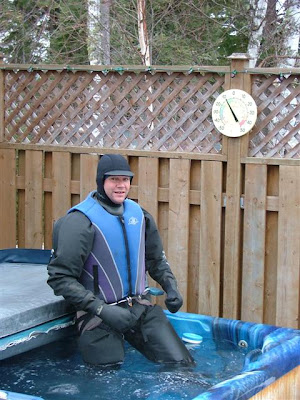
3. Edward from EVK4 SuperBlog is the superhero who has just launched an official Laser Olympic Campaign with the motto "Velox Ocius Pango".

4. As Adam correctly answered, this picture of a monster spider ready to devour London is from Captain JP's log.

5. No Litoralis, it wasn't frogma who wrote about losing her "New Jersey virginity". It was Grandma.

6. And it was Soulsailor's kids who persuade him to name his new boat "Miracle or Jedi Mind Trick".

7. The author of South West Sea Kayaking is apparently a fellow Fawlty Towers fan. Hey, the post was about kayaking in Torbay so this quote does kind of fit.

8. Step forward for civilization. Danish windsurfer Moses Lovstad was the fellow who was training in China and felt compelled to share with us this sample of Chinese culture.

9. Christy from Central Air was in the Fish on Friday mood when she posted this photo.

10. And finally, (do I hear a huge sigh of relief) David who writes Never Sea Land has something of a mermaid fixation and was responsible for ruining your appetite for Thanksgiving dinner with this anatomically correct picture of the mermaidian reproductive tract.

But no. There was hardly any response to my Boating Blog Trivia Quiz. Clearly you were all much too busy following other Thanksgiving traditions such as pretending to enjoy eating a plateful of your mother-in-law's special yams in raspberry syrup, and laughing for the seventeenth year at Uncle Joe's joke about the time he lost his dentures while stuffing the turkey.
Actually there were two answers in the comments. But they were both from Adam. And the second one was only correcting the first one. What were you drinking man?
Anyone, I am not one to be deterred by your apathy. Whatever the reason for your giving me the cold shoulder, I forgive you. So for your blog browsing pleasure here are the answers to the quiz. Knock yourself out.
1. The dude who recently achieved a speed of 21.8 knots in a foiler Moth is Simon Nelson from another mid life crisis.

2. And the other dude who recommends warming your feet in a hot tub before you go windsurfing is Windsurf Woody.

3. Edward from EVK4 SuperBlog is the superhero who has just launched an official Laser Olympic Campaign with the motto "Velox Ocius Pango".

4. As Adam correctly answered, this picture of a monster spider ready to devour London is from Captain JP's log.

5. No Litoralis, it wasn't frogma who wrote about losing her "New Jersey virginity". It was Grandma.

6. And it was Soulsailor's kids who persuade him to name his new boat "Miracle or Jedi Mind Trick".

7. The author of South West Sea Kayaking is apparently a fellow Fawlty Towers fan. Hey, the post was about kayaking in Torbay so this quote does kind of fit.
Well, may I ask what you expected to see out of a Torquay hotel bedroom window?
Sydney Opera House perhaps?
The Hanging Gardens of Babylon?
Herds of wildebeest sweeping majestically across the plain…”- Basil Fawlty

8. Step forward for civilization. Danish windsurfer Moses Lovstad was the fellow who was training in China and felt compelled to share with us this sample of Chinese culture.

9. Christy from Central Air was in the Fish on Friday mood when she posted this photo.

10. And finally, (do I hear a huge sigh of relief) David who writes Never Sea Land has something of a mermaid fixation and was responsible for ruining your appetite for Thanksgiving dinner with this anatomically correct picture of the mermaidian reproductive tract.

Monday, November 26, 2007
Check the Scales Before You Buy
So you've read on some blog or other about Laser sailing and decided it sounds like fun. You went down to watch your local Laser fleet racing and saw people of all ages, sizes and genders out racing Lasers, and now you're certain that Laser sailing is for you. But you're nor sure whether you need to buy a Standard Rig or a Radial Rig... or even something called a 4.7 whatever that is.
Well let me try and explain. Basically it all depends on your weight.
When the Laser was first launched over 35 years ago it came with one size of sail. It quickly became very popular, but over the years it became apparent that for lighter people, especially smaller women and younger teenagers, it was more than they could handle in a real blow. It was clear that a smaller, less powerful rig was needed for the boat to become popular with lighter people.
One attempt to solve this problem was called the M-rig. It never really caught on. If you see one for sale I don't recommend you buy it. There are very few of them around and you won't find any other M-rigs to race against.
The real breakthrough in solving the issue of making the boat more manageable for lightweight sailors was the Laser Radial. This uses a shorter more flexible bottom mast section and a radial cut sail with 18% less area than the standard rig. The Radial is now immensely popular for youth and women's racing. Indeed the Radial is the single-handed boat for women in the Olympic games.
It was then discovered that many kids who learned to sail in Optimists and aspired to sail Lasers had a problem. There was a weight range when they were really too heavy for an Optimist but not quite heavy enough for a Laser Radial. So the Laser 4.7 Rig was introduced. This uses a shorter pre-bent mast section and a sail with an area of 4.7 square meters, smaller again than the Radial sail.
So now we have the Laser range....
The Laser 4.7 which suits sailors who weigh roughly 75 to 120 lbs.
The Laser Radial for sailors who weigh 120 to 155 lbs.
The Standard Laser for sailors who weigh over 150 lbs.
Of course these are not hard and fast rules. Any sailor, however light they are, can sail a Standard Rig Laser in very light winds. But as the wind picks up a lightweight will find it harder to keep the boat flat and when it gets very windy they will be so overpowered that they will be capsizing way too often for it to be fun any more.
Also skill level and fitness make a huge difference. A young fit expert sailor of 130 lbs would probably be faster than a heavy, clumsy old doofus like me in a Standard Rig, even in heavy weather.
Some sailors own Radial and Standard Rigs and switch according to the conditions. In light winds they sail the Standard Rig; then on a day with a real blow they sail the Radial. The hull and almost all the equipment is the same. All you need to change is the sail and the bottom half of the mast.
One caveat. At least in North America, the 4.7 rig has been positioned as being for kids transitioning from Optimists to the Laser. The major regattas for 4.7 rigs are for juniors only. So if you are an adult weighing 110 or 115 lbs say, I would advise going with the Radial, not the 4.7. You won't find other adults to race against in the 4.7. (Of course you could always buy a 4.7 rig as well so you can go out and practice and have fun when it's blowing dogs off chains if you want.)
Sunday, November 25, 2007
Small World
Sailing is a small world. It's amazing how you run into the same people at different times in different parts of the world. There's probably one of those weird "degrees of connection" rules in sailing. And I would hazard a guess that, in sailing, we're all connected to each other by three or fewer degrees of separation.
I've written once or twice here already about running into people I knew at sailing clubs or regattas that I never expected to meet in that context. But last night I had the most unusual "small world" moment yet.
I was sitting at home in Rhode Island feeling sorry for myself (still no sailing as my back injury heals slowly) and playing Tacticat. I like to check the profiles of my fellow competitors to see who they are and where they are from. I noticed that a couple of the other sailors in the race had the same last name, a rather unusual name, and I remembered that some guy in my first sailing club in England whom I hadn't seen for about 25 years had the same last name. A quick instant message (being careful not to be typing at the same time that I might need to make a sudden steering change in the race) as to whether there was some connection to the guy from last century, and I received the reply, "Yes, that's the old man."
So I'm playing a virtual sailing game with two young guys who are the sons of the ace from my first sailing club. A connection that spans three thousand miles and a quarter of a century. Small world indeed.
Do you have any "It's a Small World" sailing stories?
Saturday, November 24, 2007
Spanish Lessons
"I split with the leaders, find a little booster shot on the left, and nip Bethwaite at the finish line for the bullet. Life is good."
No, I didn't write that. It's a quote from Spanish Lessons, an account of the 2007 Laser Masters Worlds in Roses written by Bill Symes. Bill was sailing in the same fleet as me at Roses, but he's a much better sailor than me, and a much better writer.
So enjoy his story, the story I wish I could have written about the regatta I wish I could have had.
Friday, November 23, 2007
Fish Heads on Friday

Why are fish heads so unappreciated? After all, the whole American agricultural industry started when the colonists off the Mayflower learned from their Native American friend Squanto how to fertilize their corn seeds with fish heads. Every little American kid learns the story at school.
But do we have a National Fish Head Day? is there a Fish Head postage stamp? Does the President pardon two fish named May and Flower, and then send them to Disney World instead of getting their heads chopped off?
Instead we have this national obsession with giving thanks for turkeys. What's so special about turkeys?
I am starting a campaign to earn due recognition for the contribution of fish heads to the history and continued success of our great nation. As a first step every American family will celebrate today, the Friday of Thanksgiving weekend, by eating a delicious feast of fish heads. If you don't have a recipe for fish heads try this one from chinesefood-recipes.com.
Fish-head, tofu and mushrooms
Ingredients :
* 1 big fish head
* 2 slabs tofu
* 151g mushrooms
* 19g vermicelli
* 151g lean pork
* Napa cabbage (as desired; approximately 2 cups).
Directions:
1. Chop big fish head (salmon, tuna, or carp preferred) into 4 to 6 chunks, remove gills. Wash and set aside.
2. Wash lean pork and tofu. Dice or cut into slices. Cut Napa cabbage into shreds. Soak vermicelli till soft. Slit open the sides of mushrooms.
3. Sauté 2 slices of ginger with oil on wok. Put in fish head to fry until slightly browned. Add in appropriate amount of water right away. Boil at high heat for 10 minutes.
4. Add in tofu, mushrooms, vermicelli, lean pork, and Napa cabbage and boil for 10 minutes. Add salt to taste.
Mmmm. Finger-lickin' good.
Thursday, November 22, 2007
Boating Blog Trivia Holiday Quiz
Today is Thanksgiving Day here in the State of Rhode Island and Providence Plantations, and for that matter everywhere else in the other twelve former British colonies, three independent republics, and sundry other territories acquired by war, treaty or purchase that now make up the 3.79 million square miles of the fifty United States of America. You may have heard of them.
Anyway, to celebrate American Thanksgiving Day, here is a Boating Blog Trivia Holiday Quiz. The answer to each question is the name of a boating blog or blogger. Clue: somewhere in the sidebar of this blog there are links to all the blogs referenced in the questions.
1. Which blog is written by a sailor who recently achieved a speed of 21.8 knots in a foiler Moth?
2. Which blog included this picture in a post about safety procedures?
3. Which blog is written by a sailor who has just launched an official Laser Olympic Campaign with the motto "Velox Ocius Pango"?
4. Which sailing blog posted this picture of a monster spider ready to devour London?
5. Who wrote earlier this month about losing her "New Jersey virginity"?
6. What's the name of the blog whose writer owns a boat named "Miracle or Jedi Mind Trick"?

7. Which boating blogger recently used this quote from the classic British TV series "Fawlty Towers"?
8. Step forward for civilization. The writer of this blog has recently been training in China where he took this picture and posted it on his blog. Who is he?
9. Which sailing blog posted this vintage picture of Fish on Friday?
10. And finally, which sailing blog recently posted this anatomically correct picture as a public service to folk who ponder the mermaid problem?
If you know all the answers please don't ruin everyone else's fun by posting all the answers to the quiz in the comments. One answer per person please.
Happy Thanksgiving Day everyone.
Anyway, to celebrate American Thanksgiving Day, here is a Boating Blog Trivia Holiday Quiz. The answer to each question is the name of a boating blog or blogger. Clue: somewhere in the sidebar of this blog there are links to all the blogs referenced in the questions.
1. Which blog is written by a sailor who recently achieved a speed of 21.8 knots in a foiler Moth?
2. Which blog included this picture in a post about safety procedures?
3. Which blog is written by a sailor who has just launched an official Laser Olympic Campaign with the motto "Velox Ocius Pango"?
4. Which sailing blog posted this picture of a monster spider ready to devour London?
5. Who wrote earlier this month about losing her "New Jersey virginity"?
6. What's the name of the blog whose writer owns a boat named "Miracle or Jedi Mind Trick"?

7. Which boating blogger recently used this quote from the classic British TV series "Fawlty Towers"?
Well, may I ask what you expected to see out of a Torquay hotel bedroom window?
Sydney Opera House perhaps?
The Hanging Gardens of Babylon?
Herds of wildebeest sweeping majestically across the plain…”- Basil Fawlty
8. Step forward for civilization. The writer of this blog has recently been training in China where he took this picture and posted it on his blog. Who is he?
9. Which sailing blog posted this vintage picture of Fish on Friday?
10. And finally, which sailing blog recently posted this anatomically correct picture as a public service to folk who ponder the mermaid problem?
If you know all the answers please don't ruin everyone else's fun by posting all the answers to the quiz in the comments. One answer per person please.
Happy Thanksgiving Day everyone.
Wednesday, November 21, 2007
Comments On
A few days ago I asked my readers whether a "real" blog ought to allow comments. In particular I asked whether a blog should allow such reader participation before being considered as a candidate for my list of Top Ten Sailing Blogs of 2007.
Today, Scuttleblog, incidentally one of the Top Ten Sailing Blogs of 2006, decided to turn comments on.
Hmmm. Coincidence?
Whatever the reason I think it's a good move.
Wonder if any of the other "sailing web sites that look like blogs but don't want to hear from their readers" will follow suit. You know who you are.
Lake Winds
I accepted the challenge from TK. I promised I would explain in more simple language what Stuart Walker was trying to communicate in his Sailing World article Unlocking the Mysterious Lake Winds.
Since accepting the challenge last Wednesday I've studied the article. I've puzzled over the meaning of many of the statements in it. I've tried to make sense of them by referring to Stuart Walker's book Sailor's Wind. But that left me even more confused.
And then, out of the blue, came an email from Tom Donlan, a J-22 sailor from Annapolis, who is also a professional writer and a great fan of Dr. Walker's thinking and writing. To my huge relief Tom had taken it upon himself to "translate" the first few paragraphs of Walker's article. Magic!
So here we go. Walker as translated by Donlan. With a few random jottings from Tillerman along the way...
Walker wrote...
Believe it or not, even this introductory paragraph left my feeble mind confused. I got stuck on that phrase, "gradient winds, always offshore". Whaaaat? Last Wednesday I took my almost-two-years-old granddaughter down to the local lake to indulge in one of her favorite games, throwing rocks into what she calls the "ocean". There was a big low pressure area over Hudson Bay creating a strong southerly "gradient wind" over southern New England. (Don't worry if you don't know that term "gradient wind". Tom will explain it soon.)
Emily and I stood on the northern shore of Lake Whippersnapper with that wind blasting into our faces. And I kept thinking about Walker's words. Gradient wind always offshore? Sure feels like it's blowing onshore to me.
So here is Tom Donlan's opening sentence...
Oh, now I get it. Of course the wind over a lake has been blowing over land before it reaches the lake, even though in different parts of the lake it will be blowing offshore, onshore and even parallel. to the shore. That's all the good doctor was trying to say. My bad.
But wait. Walker used two technical terms in that first paragraph. "Gradient" and "thermal" winds. I think I know what they mean, but other readers might not. If you don't, then the rest of the article might not make much sense to you. So Donlan explains these terms ...
Fair enough.
In the first sentence of his second paragraph Walker says...
Donlan's version is...
(Tom confesses that he added the sentence "The smaller the lake, the more true this is". And the last sentence about several different thermal winds is really a lead-in to the next thought where Walker gets into discussing those different winds.)
But wait. I've sailed on some pretty small lakes, probably the smallest lakes that anyone in their right mind would even consider organizing sailboat racing. And I agree that such lakes are shielded to some extent from gradient winds by the higher land around them. And though it's less intuitively obvious I could even accept Walker's point that the lake is protected from gradient winds by a pool of cool marine air trapped above its surface. But I'm not sure I accept the implication that small lake sailing is dominated by thermal winds rather than gradient winds.
I remember many summer Sunday mornings on a small lake in New Jersey waiting for the wind to come in. And if there was a gradient wind of any strength at all it almost always reached the lake surface at some point during the day and was the dominant wind for sailing that day.
What's your experience on this question? Perhaps my New Jersey lake had some geographical factors that made it unusual?
Anyway, thanks to Ton Donlan for helping us out in understanding the insights of Dr Walker. There is lots more to come from both of them next Wednesday in our series on Walker's Words of Wisdom.
Since accepting the challenge last Wednesday I've studied the article. I've puzzled over the meaning of many of the statements in it. I've tried to make sense of them by referring to Stuart Walker's book Sailor's Wind. But that left me even more confused.
And then, out of the blue, came an email from Tom Donlan, a J-22 sailor from Annapolis, who is also a professional writer and a great fan of Dr. Walker's thinking and writing. To my huge relief Tom had taken it upon himself to "translate" the first few paragraphs of Walker's article. Magic!
So here we go. Walker as translated by Donlan. With a few random jottings from Tillerman along the way...
Walker wrote...
Lake sailing is more complex than sailing on the open sea, but more predictable. A lake, like any body of water enclosed by land, is subject to gradient winds, always offshore, and by thermal winds -- the lake breeze itself as well as winds generated by the surrounding terrain.
Believe it or not, even this introductory paragraph left my feeble mind confused. I got stuck on that phrase, "gradient winds, always offshore". Whaaaat? Last Wednesday I took my almost-two-years-old granddaughter down to the local lake to indulge in one of her favorite games, throwing rocks into what she calls the "ocean". There was a big low pressure area over Hudson Bay creating a strong southerly "gradient wind" over southern New England. (Don't worry if you don't know that term "gradient wind". Tom will explain it soon.)
Emily and I stood on the northern shore of Lake Whippersnapper with that wind blasting into our faces. And I kept thinking about Walker's words. Gradient wind always offshore? Sure feels like it's blowing onshore to me.
So here is Tom Donlan's opening sentence...
Lake sailing is more complex than sailing on the open sea because the wind is always coming from the land and is therefore more shifty and puffy.
Oh, now I get it. Of course the wind over a lake has been blowing over land before it reaches the lake, even though in different parts of the lake it will be blowing offshore, onshore and even parallel. to the shore. That's all the good doctor was trying to say. My bad.
But wait. Walker used two technical terms in that first paragraph. "Gradient" and "thermal" winds. I think I know what they mean, but other readers might not. If you don't, then the rest of the article might not make much sense to you. So Donlan explains these terms ...
No matter where you sail, there are two kinds of winds: "Gradient" winds are the winds from a weather system; "thermal" winds are those generated by local temperature differences between land and water.
Fair enough.
In the first sentence of his second paragraph Walker says...
A lake is an oasis of calm in the surrounding land; a pool of cool marine air trapped above its surface protects it from the gradient winds and facilitates the development of thermal winds confined to the lake surface and its surroundings.
Donlan's version is...
A lake, surrounded by higher land, is less likely to be affected by gradient winds, which blow across the lake higher up than our masts. The smaller the lake, the more true this is. On the lake surface, the dominant winds are likely to be local thermal winds. There may be several different thermal winds in the course of a day.
(Tom confesses that he added the sentence "The smaller the lake, the more true this is". And the last sentence about several different thermal winds is really a lead-in to the next thought where Walker gets into discussing those different winds.)
But wait. I've sailed on some pretty small lakes, probably the smallest lakes that anyone in their right mind would even consider organizing sailboat racing. And I agree that such lakes are shielded to some extent from gradient winds by the higher land around them. And though it's less intuitively obvious I could even accept Walker's point that the lake is protected from gradient winds by a pool of cool marine air trapped above its surface. But I'm not sure I accept the implication that small lake sailing is dominated by thermal winds rather than gradient winds.
I remember many summer Sunday mornings on a small lake in New Jersey waiting for the wind to come in. And if there was a gradient wind of any strength at all it almost always reached the lake surface at some point during the day and was the dominant wind for sailing that day.
What's your experience on this question? Perhaps my New Jersey lake had some geographical factors that made it unusual?
Anyway, thanks to Ton Donlan for helping us out in understanding the insights of Dr Walker. There is lots more to come from both of them next Wednesday in our series on Walker's Words of Wisdom.
Tuesday, November 20, 2007
Yardstick

I've always been a one-design guy myself. I've raced Lasers against Lasers, and Sunfish against Sunfish mainly. First boat across the line wins.
But in many yacht clubs where they have a variety of classes they have some kind of handicap racing. Someone works out a conversion factor for every boat and they do some mathematical jiggery pokery to convert all the times it takes every boat to sail around the course to some common base. The bigger faster boats cross the line first but some guy in a slow boat at the back of the fleet might win on corrected time if he is a better sailor than the guys with the big boats.
The Portsmouth Yardstick is one of these handicapping systems. The tables in the link are calculated from elapsed times of actual races sent in by yacht clubs all over the country to US Sailing. So the handicaps are based on the performance of real boats of each class raced by real people in real races.
Of course no system is perfect. And if you are always being beaten by the same boat it is natural to believe that the fault lies in the handicapping system. Today I received this email from one of my readers...
I own a Choate Cf 27. The Yacht club where I race the boat uses the Portsmouth Rating system. I have to race an E Scow. In the Portsmouth system my boat is rated 75.3 and the E Scow is rated 75. Where did Portsmouth get these numbers? There is no way this right. I have written Portsmouth to try to get the rating changed and the say they have the number to prove the rating is right.
Hmmm. I don't know why he thinks I can help him. As I mentioned before I'm more of a one-design kind of guy. I have done some handicap racing and even won my old club's multi-class championship in a regatta scored using the Portsmouth Yardstick system.
Why is it a "yardstick" by the way? I've no idea.
Anyway I did do a bit of googling around about Choate Cf 27 and handicapping methods, and discovered an interesting story about a Cf 27. Apparently back in 1996 some guy bought a rather tired, 18-year-old Cf 27, slapped on a coat of paint, and picked up a few new sails. He entered it in a 116 boat handicap regatta in San Diego and on a 7 mile course won his class by over 9 minutes.
So don't blame the boat, my friend. Don't blame the handicap system. Prepare the boat well and you may well do as well as the San Diego guy. The full story is at Dennis's Menace.
Oh yeah, I forget to mention, the skipper of the Cf 27 in the San Diego race was Dennis Conner.
Any comments, observations or advice from readers who are into handicap racing?
Subscribe to:
Posts (Atom)