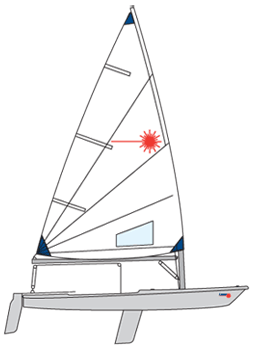
Thanks to Chris Partridge of Rowing for Pleasure for sending in this picture in response to yesterday's question about Furniture and Sailing. It's not a sailboat but it is a boat... I guess.
Wednesday, October 20, 2010
Outboard on Table
Thanks to Chris Partridge of Rowing for Pleasure for sending in this picture in response to yesterday's question about Furniture and Sailing. It's not a sailboat but it is a boat... I guess.
Tuesday, October 19, 2010
Furniture and Sailing

I was wondering... could you make a boat out of a piece of furniture? A bookshelf? A chair? A table, for example?
If it's made of wood and it floats, could you jury rig a sail and some kind of steering oar and actually sail the thing?
Has anybody ever done this? To rescue themselves after a shipwreck, perhaps? Or as part of some crazy fun challenge at a sailing club?
Vice versa, can you convert a boat into a piece of furniture? An Optimist into a coffee table? A Sunfish into a settee?
Just wondering....
What do you think?
Monday, October 18, 2010
Bright Spots

I've recently been reading a book called Switch. The authors, Chip and Dan Heath, didn't know they had written a book about sailing. But I think they have...
The subtitle of the book is How to Change Things When Change is Hard. Personal change, family change, business change. Change is often hard. How can we make it happen? It's one of those easy-to-read books you pick up at airports to read on a long journey, full of fascinating anecdotes and a framework of pop psychology.
Of course, the major theme of this blog is the delusion that I can change to become a better sailor. So it's not surprising that as I read the book I was wondering if I could pick up any good ideas from Switch to help with my own personal quest for change.
One suggestion that Mr. and Mr. Heath (they are brothers I think) make early in the book is Find the Bright Spots. When faced with an apparently intractable problem, some situation that isn't going the way you want it to, ask the question, "Where are the bright spots? Are there any examples where things are going right? What's different about them? What can we learn from them?"
Mr. and Mr. Heath tell stories about how this technique was used to create desirable change in such diverse areas as solving the problem of childhood malnutrition in Vietnam, turning round a ninth-grader with serious behavioral problems at school, and helping a drug company find a way to market a supposed miracle drug that just wasn't selling well.
In every case the successful change agent went looking for the bright spots...
Are there any very, very poor kids who are bigger and healthier than the average Vietnamese child? What are these kids' mothers doing differently from the other mothers?
Is there even one class where that problem ninth-grader isn't always getting into trouble? What is the teacher of that class doing differently?
Are there are any sales staff who are selling more of that miracle drug than their peers? Turns out there were two saleswomen selling twenty times more. What on earth were they doing differently?
Powerful stuff. We don't always approach a problem in that way.
For example what is the normal advice on how to improve as a racing sailor? Find your weaknesses and then find ways to work on them and eliminate them. It's what Eric Twiname teaches in his classic book Sail, Race and Win. Just the opposite of Find the Bright Spots.
So, I thought, how can I apply this principle to my disappointing performance at the recent Laser Masters World Championships in England? Should I analyze how to deal with my general unfitness, and overall wimpiness, not to mention also being a crap sailor? No, no, no. That's the old way. That's focusing on the weaknesses, the supposed causes of the problem. Where are the bright spots?
Ummm. The beer in England was good.
Hmmm. Not very helpful.
What about my previous performances at Laser Masters Worlds? Did I do much better in one year than all the others? That would be a bright spot.
As it happens there was one such year. 2007. The Masters Worlds at Roses in Spain. I finished in the top half of the fleet instead of thrashing around with the tail-enders like I usually do. As I wrote in Semi-Respectable Mediocrity I just felt right from the first day that I had better boat speed than most of my opposition. Definitely a "bright spot".
So what was different about my preparation for the Worlds in 2007?
I moved house? Not likely to be the cause. In any case I'm not moving house every year just to do well in sailing regattas.
I ran a marathon in April? Hmmm. May have been a factor. But that was five months before the Worlds and I didn't run much during that summer, so I suspect that any residual fitness advantage had worn off by September.
I sailed more Laser regattas that year than in any other year in my life? I sailed major regattas and little regattas. In January I went to Cabarete in the Dominican Republic for a clinic and the Caribbean Midwinters. In June I sailed the Laser North Americans in Hyannis. I sailed the Newport Regatta and the Hyannis Regatta and the Buzzards Bay Regatta. I sailed the Championship of Buzzards Bay and the Leukemia Cup. I sailed the New England Laser Masters and in the Ponce de Leon Series. In other words I sailed pretty much every Laser regatta on the local calendar against all the best local sailors and some top national sailors.
As opposed to this year where I sailed the Wickford Regatta and the Buzzards Bay Regatta and precious little else.
Geeze, do you think that could be it? Is it possible that racing a lot improves your racing ability, that sailing lots of regattas for a few months improves sailing fitness and boatspeed and strategy and tactics and all those other skills you need to do well in sailing races?
Duh!
Sometimes I amaze myself.
I think I'll go to bed now.
Friday, October 15, 2010
Racing vs Fun

Some of the comments to my recent posts about how I had only managed to sail half the races in the recent Laser Masters World Championships on account of my general unfitness and overall wimpiness, not to mention also being a crap sailor, were of the general sentiment, "it's not about winning... sailing is meant to be about having fun."
I don't know whether these people have read my blog for very long because, if they had, they would have noticed that I rarely ever win. I wasn't ticked off that I didn't win my division at the Masters Worlds. I never had any prospect of winning. I was ticked off that I didn't have as much fun as I usually do. On the first day I capsized a lot in the first race and was too exhausted to do the second race. In the middle of the week I got sick and missed three races. And on the final day, in spite of a good first race, I was just mentally too tired to do the final race. I was not having fun because I was missing too many races, not because I wasn't winning.
For me, racing is fun. (Usually.) I ought to write a post called Ten Reasons Why Sailboat Racing is Fun. I don't need to win to have fun. I think my feeling on the rare occasion when I win a regatta must be a bit like the one a golfer has when he scores a hole in one. He might have given himself a chance to do it. But he didn't expect to do it. He wouldn't have been disappointed if he didn't do it. He's mightily surprised that he did do it. And he's so happy that he did do it that he buys everyone a drink in the bar afterwards.
If the only way to have fun when racing were to win, then most of us would be miserable most of the time we are racing. Statistically most of us are not going to win most of the time. If we didn't have fun not winning, then we would soon give up.
A very wise man called Stuart Walker once wrote, "Winning is the object of the game, but it is not the object of playing the game."
Think about it.
Play the game.
Have fun.
Thursday, October 14, 2010
Random Radial Ramblings

Among the many helpful and supportive comments to my self-pitying post Half a World about how I had only managed to sail half the races in the recent Laser Masters World Championships on account of my general unfitness and overall wimpiness, not to mention also being a crap sailor, was one from Tony...
I feel a little dirty for suggesting this, but have you thought about swapping to a Radial for the next Worlds? San Fran then Fremantle, both will be a battle in the full rig but much more fun with a smaller sail. Might be a good way to rediscover the fun.
I need to go and wash my mouth out now.
Hmmm. What is a Radial, some of my readers may be asking themselves? And why does Tony feel dirty for suggesting this?
The Laser Radial is just a Laser with a slightly smaller rig. It has a shorter mast bottom section than a standard Laser and a radially cut sail with an area of 5.76 square meters as opposed to the 7.06 square meters of the standard rig. I've never sailed a Radial but I suspect Tony is suggesting it because the Radial would likely to be somewhat easier to handle than the standard rig in heavy weather. I wouldn't need to hike as hard to keep the boat flat upwind and it's reputed to be somewhat more stable downwind. I guess. But what do I know? I've never sailed one.
But why does Tony feel dirty for suggesting that I sail a Radial?
I'm only guessing because Tony comes from Australia and I'm more familiar with American and European attitudes to the Radial. You see the Radial is really intended for sailors in the 130-165 lbs weight range. Not surprisingly it's very popular with youth sailors and women sailors. It is, after all, the women's singlehanded class at the Olympics. As a result, there's a bit of a macho attitude, at least in America, that "Real Men Don't Sail Radials." However not every adult male weighs over 165 lbs. One of my English sailing friends, who has also lived in the USA, tells me that there isn't the same negative macho attitude to Radials in Europe; if you are a smaller adult man you will quite sensibly sail a Laser Radial there instead of beating yourself up trying to handle a full rig in heavy weather.
So I will try not to feel dirty like Tony and ask myself honestly, should I be sailing a Radial? Well, one factor is that I'm not a little guy by any means. I'm 6'2" tall and usually in the 195-200 lb range, in spite of my constant efforts to get closer to the optimum 180 lbs for full rig Laser sailors. Aren't I way too heavy for a Radial?
Maybe not. You see, there is another factor. Age. At the Laser Master Worlds competitors sail in age group divisions and you can choose to sail in Radials or Standards (full rigs). So there are Radial Rig fleets for the age groups 35-44, 45-54, 55-64, and 65+, and Standard Rig fleets for age groups 35-44, 45-54, and 55-64.
See anything strange about this arrangement?
Yup. The International Laser Class in all its wisdom assumes that the top Laser sailors in the world, those aspiring to win or who may already have won masters world championships, will all sail Laser Radials as soon as they turn 65. There is no division at the Master Worlds for full rig sailors over 65.
Why should this be? Why would they want fat old dudes like me (who may well be even fatter after another three years of my wife's superb cooking) weighing over 200 lbs perhaps, to sail a boat designed for people 40 to 70 lbs lighter? Do they assume that we will all be so weak and decrepit by the time we turn 65 that we won't be able to handle a full rig in 25+ knots in big waves on the open ocean? I'm shocked.
But wait. Isn't this where we came in? Didn't this 62-year-old sailor demonstrate a few weeks ago at Hayling Island that age does matter and that sooner or later, perhaps around the mid 60's for the average bloke, you're better off trading down to a Radial? Maybe. Maybe not.
Not everyone agrees with the ILCA's assumption that you should be sailing a Radial once you turn 65. Some macho dudes want to keep sailing full rigs at the Masters Worlds after they turn 65. And, in truth, they still can. There's actually nothing to stop some old geezer of 80 sailing in the Laser Grandmasters Standard fleet. It's intended for sailors aged 55-64 but, as long as you are over 55, they seem to let anyone sail there. There was at least one sailor over 65 sailing in the Grandmasters Standard fleet at Hayling Island. He may have regretted it though. On that first windy day, he even finished behind me in the first race in spite of my many capsizes (what a disgrace) and he also (like me) chose not to compete in the second race. Would he have been happier sailing against his contemporaries in the Great Grandmasters Radial fleet? I don't know. Only he can say.
(I warned you this would be a random ramble... And it's not finished yet. This might be a good time to take a pee break if you need one.)
It is also true that some sailors under 65 like me who normally sail full rig Lasers on the local circuit, do chose to enter in the appropriate Radial fleet at the Masters Worlds, especially if it is a location rumored to have strong winds (like most of the locations chosen for the Worlds, it seems.) I guess they reason that they will have more fun sailing every race in a Radial than thrashing about, struggling to complete even half the races in a full rig like proud, stubborn idiots like me. But, to be fair, the guys I know who do this are not 6'2" and 200 lbs like me either.
At the Masters Worlds, it's all or nothing. You either sail in a Radial fleet all week, or in a Standard fleet all week. But at Masters regattas in North America they allow a practice called "rig-swapping." (Tony would probably think this is very dirty!) On any given day of the regatta you can choose to sail in a Radial or a Standard Rig (assuming you have both.) Some folk think this is unfair because supposedly it gives lighter sailors an advantage. But the powers-that-be like the policy because it maximizes participation. On very windy days when some sailors might stay ashore, they will still race if they are allowed to use the smaller Radial rig.
The same is true in many local fleets for sailors of all ages, my local Laser frostbite fleet for example. Many of the sailors there (albeit not usually ones that are 6'2" tall and who weigh 200 lbs) will sail full rigs on light wind days and Radials on heavy wind days. Like rig-swapping at Masters events, it maximizes participation.
So am I at the point where I too should become a rig-swapper? That is the question.
Should I assume that I will still want to be sailing in Masters Worlds Championships after I am 65 and at that point I will choose do the sensible thing and sail in the Great Grandmasters Radial fleet with my contemporaries, rather than do the macho thing and sail in the Grandmasters Standard Fleet against mere kids of 55? And, if so, should I buy a Radial rig now and start getting used to the different sail? Should I become a rig-swapper at North American Masters events and when frostbiting, and follow Tony's suggestion of sailing a Radial in San Francisco in 2011 and Fremantle in 2012? That is the question.
Will I be ridiculed by my American friends for sailing a Radial when I weigh 200 lbs (plus any subsequent increments caused by my wife's superb cooking)? Would I feel less guilty about sailing a Radial if I actually lost some weight so I was somewhat closer to the ideal range for a Radial sailor? Or should I just work harder on becoming fitter, fit enough to sail a full rig Laser properly in heavy air without getting exhausted after one race? That is the question. Actually that's another question. Really several questions. But they are related to to the first question.
Should I stop this post now or just keep rambling on? That is the question. No, wait, that really is a different question.
Saturday, October 09, 2010
Friday, October 08, 2010
Delusions

This blog has always been about a delusion. It says so over there >>>> in the sidebar. The delusion that it is not too late to discover how to sail smarter and faster. The delusion that if if I read all the right books and watch all the right videos and practice hard and pick the brains of good sailors and work with good coaches and race a lot... that I will become a better Laser sailor.
I realize now that I was deluded about my delusion.
My experience at the Laser Masters Worlds last month brought it home to me. It's not only a delusion that I can become a better Laser sailor; it's also a delusion that I can even maintain my own (already mediocre) level of sailing ability as I get older.
I thought my delusion was that I was on an uphill slope. Now it turns out that my real delusion was that I even on level ground. In reality I'm on a slippery downhill slope trying harder and harder not to slide down too fast.
Or am I?
You, my wonderfully supportive readers, gave me all kinds of advice on how to deal with my disappointing performance at the Worlds, especially my failure to sail in half the races.
There's the "results don't really matter, you're only doing it for fun anyway" advice. There's a lot of truth in that. But if you spend all that money and travel 3,000 miles and only sail half the races, it doesn't feel like a hell of a lot of fun either.
There's the "switch to a Laser Radial at the next Worlds" suggestion. Some of my contemporaries have already gone down that path. It's worth considering.
There's the "face your failure and learn from it" argument. It's a good point. Every competitor goes through bad patches. The real measure of the athlete is how he deals with disappointing results and what he learns from them. I've been thinking a lot about that in the last couple of weeks.
The good news is that my random thoughts about where I go next with my Laser sailing, what my ambitions should be, how I should train, what kind of races I should enter etc. etc. will provide fodder for a few more blog posts over the next couple of weeks...
Watch this space (if you can bear it.)
Wednesday, October 06, 2010
Dumped: A Parable

Tim thought of himself as a bit of a ladies' man. He thought he new all about women and how to please them. He played the field. He got his share. He was enjoying the free and easy life style of a bachelor and man about town... until he met Hailey.
He fell hard for Hailey. She was exciting. She was special. She was cool. She was hot. She was everything he had been looking for. He was more than pleasantly surprised when, after dating for only two or three weeks, she suggested that he move in with her.
That first week at Hailey's place was mind-blowing for young Tim. They did it every night. Hailey certainly seemed to have plenty of experience in that department. He was in seventh heaven.
Until Sunday. Over breakfast on Sunday morning Hailey dropped the hammer. "I'm sorry Tim, but you're just not much good in bed. You don't have much stamina and you have no idea how to handle the rough stuff. And your technique is just awful. Last night was the last time. I need you to move out. I'm going for a walk now. Please be gone when I get back."
Tim was devastated. Where had he gone wrong? He packed his stuff and headed home to his lonely bachelor quarters.
He called Hailey on Monday evening. "Hailey darling, please give me a second chance. I'm sure I just need more practice. We can practice in the morning, we can practice in the evening, we can practice all night long. I'm sure I'll get better."
Hailey wasn't interested. "I'm sorry Tim. You're not practicing on me."
Before he knew what he was saying, Tim blurted out, "Well, I'll practice on my own then. I used to do that a lot."
Oops.
Click.
Hailey had rung off.
Tim called her again on Tuesday evening. "Hey Hailey, I have another idea. I went to this... umm... shop at lunch-time and bought these books and videos. There's a book by a British guy called Paul with lots of glossy pictures of his technique. And a couple of videos of how to do the rough stuff you like, one by some Argentinian fellow. I can bring them round and we can look at them together and try some of the things in them."
Hailey was unmoved. "I don't want to look at your porn videos, you pervert. Go forth and multiply. And don't call me again."
Click.
Tim was at his wits' end. He talked to one of his friends and called Hailey again on Wednesday evening. "Hailey, just listen, I have some ideas. Tony from Australia says we should try a smaller bed. What do you think?"
"You can tell Tony from Australia that I think he has a dirty mind. Now just leave me alone. I don't want to talk to you any more."
Tim was desolate, heartbroken. He didn't know where to turn. He was desperate...
He called Hailey again on Thursday evening. "Please listen to me dear. I have the answer. I met this woman on the Internet. At least I think she's a woman. She lives near San Francisco. She says she can fix my problem. She says I should go out to San Francisco and practice with her and her friends for a few weeks. She says everyone there does it in neoprene and are experts at the rough stuff. And she told me about a couple of variations they do in San Francisco called the Irish Coffee and the Flemish Coil. Sounds like fun. What do you think?
....
"Hailey? Are you still there?"
....
Click.
Tuesday, October 05, 2010
Subscribe to:
Posts (Atom)


