Thursday, June 18, 2015

Embrace the Boredom


Boredom is good?

I don't know what to think of this.

I would appreciate your opinion.

There appears to be a whole series of posts and articles lately on the general theme of how boredom is good for you and why you should "embrace the boredom."


For example, James Clear had a chance to talk to a top Olympic coach and ask him the thing we all want to know...

“What’s the difference between the best athletes and everyone else. What do the really successful people do that most people don’t?”  
He briefly mentioned the things that you might expect. Genetics. Luck. Talent.  
But then he said something I wasn’t expecting. “At some point,” he said, “it comes down to who can handle the boredom of training every day and doing the same lifts over and over and over again.”

Hmmm! The boredom of training.

It sounds right, If you are going to be good at anything - running, sailing, playing the guitar - you are going to have to do lots and lots of practice and training.

And sometimes that gets boring. The ones who succeed learn how to "embrace the boredom."

I can see that. The people who rise to the top are mentally tough enough to stick at the training plan and keep working at it even when they are bored with it. They "fall in love with boredom."


But is that really the only way?


When I was training to run marathons I had to do a number of really, really long runs. Longer than the marathon distance itself in some cases. And what's more boring than running? Put one foot in front of the other. Repeat for 30 miles.

I solved it - to an extent - by exploring different places to run. Trails through unfamiliar woods (until the time I got lost and had to run even further than planned to find my way home.) A trail alongside an historic canal in another part of the state. Actually it was still pretty boring at times.


It's much the same with sailing.

The top Olympic sailors are sailing on at least 100 days every year. I think even sailing would quickly become boring if you were doing the same drills with the same people in the same boat at the same place day after day after day.

Of course, we sailors are lucky in that the winds are rarely the same from one day to the next so that introduces some variety into the program.

But we can also avoid boredom and burnout by mixing it up. Sail in different places. Sail on the sea and on lakes and on rivers. Sail on flat water and in waves. Do solo practice. Tune up with one training partner. Attend a group clinic. Sail small regattas. Sail large regattas. Travel to other countries to sail. Sail in different boats.

But surely most of us sail for fun. Why do it at all if it's boring?


What do you think?

Do you have to "embrace boredom" to succeed.

If so, how do you make yourself do that?

Are there other tricks if you want to put in the time to hone your skills to a high level without getting bored out of your mind in the process?

Is embracing boredom the new mindfulness?

Does embracing boredom make you more creative?

Or is boredom just a bore?


Surfing a bore

Wednesday, June 17, 2015

Stellar!

Why are some days on the water kind of blah - and then just when you least expect it you have a day that brings a huge smile to your face?

Yesterday afternoon was one of those special sailing sessions that make you glad to be alive, glad you sail a Laser, and glad you have such good friends to go Laser sailing with.

The only word to describe it is… stellar.


Stellar - definition:
exceptionally good, outstanding, 
marvelous, outstanding, superb, 
first-rate, out of this world.

The omens were not good at first.

On Monday I had floated the idea to a few friends of sailing Lasers in Bristol on Tuesday afternoon 

We agreed to check the weather forecast on Tuesday morning.

One of my friends was concerned the winds would be too light.

I had seen some forecasts that suggested we would get showers and even thunderstorms.

Tuesday morning was very foggy with no wind.


In the end we decided to go sailing anyway.

At lunch time the fog cleared and a southerly breeze started to build up the bay.

When we launched in Bristol around 2:30pm there was a juicy 10-12 knot breeze from the south that was stirring up some interesting crunchy waves.


We raced WL courses with rabbit starts around a couple of government marks.

Somehow I had got it in my head over the winter that this is about the most boring way imaginable to spend a couple of hours on the water.

I was wrong. We all had a blast.


It was one of those days that repaid hiking hard, sailing the boat flat, and working the boat through the bigger waves upwind. In spite of my sore back on Monday after sailing on Sunday, I threw myself 100% into the fray and worked as hard as I could.

It felt fast upwind and my back wasn't hurting. Is adrenaline a painkiller?

Downwind it was possible to catch rides on some of better waves and I played around with different angles until I found out what seemed fast. I felt loose and relaxed in the boat.


I can't remember the last time I had so much fun in a Laser.


And so to Redlefsens for some pasta and a couple of glasses of Warsteiner Dunkel, and the usual exchange of information about why A was faster than B today and the usual trash talking about all our sailing friends who weren't there. (Only joking people.)

Stellar!


Monday, June 15, 2015

Back to the Laser

I have been neglecting her.

No, it's worse that that. Ever since I took delivery of my RS Aero, I have been totally ignoring her.

We have had so many good times together - and helped each other through a few bad times - for so many years and yet I just put her aside.

Yes it is true. Until Friday I hadn't sailed my Laser at all since that memorable day when my Laser and I crushed my friends in their Aeros on the last race of the day on May 17. Crushed!


Michael O'Brien from Seattle who has also been committing boat bigamy with a Laser and an RS Aero warned me. He said in a comment on A Tale of Two Boats
"When you switch back to the Laser after sailing the Aero for a while, you will feel like you are driving a truck. The momentum and weight difference is dramatic."
So I took my faithful but neglected old Laser over to Bristol last Friday to give here some attention and renew my relationship with her.

I wasn't sure what to expect.

But it felt good.

It felt familiar

It was fun, even exciting at times.

It wasn't like driving a truck at all.

A truck

Phew! I was seriously worried that sailing an RS Aero for a few weeks might have killed my passion for  Laser sailing. Far from it. In fact it felt so good to be back in the Laser, almost as if my time in the Aero had re-energized my enthusiasm for the Laser. I guess I really am going to be a two boat sailor.


The next thing I was interested to explore was an initial answer to the question I asked myself in A Tale of Two Boats - would sailing an Aero help develop sailing skills that would also make be a better Laser sailor.

Sailing upwind in 6-8 knots I did notice three things…


  1. I was much more sensitive to weather helm. I think I had got used to sailing the Laser with a heavy helm - because I wasn't sailing the boat flat enough - that I had grown to tolerate it. The Aero is very light on the tiller and now I was more sensitive to when the Laser had weather helm and was naturally trying to reduce it.

  2. I was much more active in the boat - moving my upper body in and out a lot to balance the boat. Whether this was because I had got used to doing this in an Aero or whether it was in response to the extra sensitivity when the helm felt too heavy, I don't know. A Laser coach once told me that I am not active enough in the boat; I tended to lock my body in one position and hope that would work all the time. Sailing the Aero seems to have cured me of this fault in a Laser.

  3. My tacks seemed a lot smoother and under control compared to how they were before in the Laser. I really don't know why, because I don't really feel I am doing good tacks in the Aero yet. Perhaps I am really comparing my current Laser tacks to my current Aero tacks, but I don't think so. Or perhaps in struggling to get my Aero tacks right I have somehow indirectly made my Laser tacks seem easier.
It's early days yet, and I wasn't comparing my boat speed to another boat. But it does seem that sailing the Aero may develop skills that will positively impact my Laser technique too.


On Sunday, I took my Laser out for a sail on Mount Hope Bay. I was expecting to be drifting around practicing my roll tacks, but almost as soon as I launched the wind picked up from under 5 mph to more like 17 gusting into the low 20s from the south-east.

So, I cranked down the cunningham and cranked on the vang and hiked as hard as I could and worked my way through the waves upwind for a couple of miles or more, towards Roger Williams University.

I have nothing positive to report at all about how sailing the RS Aero may have helped my upwind technique in a Laser in stronger winds. In fact quite the reverse. Either I am not hiking hard enough in the Aero, or maybe the Aero hiking position is so different from how you hike in a Laser, that it's no real help when you go back to the Laser. Whatever the reason those two upwind miles felt like damn hard work.

I have a vague recollection that after dinner I fell asleep on the living room floor. This morning my back feels like it always feels when I go back to Laser sailing after too many weeks off.  Sore.

Memo to self: the only way to keep fit enough to hike hard in a Laser is to do a lot of Laser sailing in heavier winds. Seriously.

But going back downwind, even though the wind had dropped a little, was pure pleasure.


I love my Laser

I love sailing on the bay.

I am a two boat sailor.


Magna Carta

We haven't had a Maps on Monday post for a while so as today, 15 June 2015, is the 800th anniversary of the signing of the Magna Carta let's have some maps related to that.

Magna Carta was agreed by King John of England and a group of rebel barons at Runnymede, near Windsor, on 15 June 1215. Although Magna Carta was somewhat limited in scope, dealing with such issues as the rights of the church and protection for the barons from illegal imprisonment, the political myth of Magna Carta as a document guaranteeing widespread personal liberties persisted until well into the 19th century. It influenced the early American colonists in the Thirteen Colonies and the formation of the American Constitution in 1789.


This strip map from a 1675 "road atlas" of England and Wales published by John Ogilby shows the routes that would have been taken by the king and the barons to the field at Runnymede where the Magna Carta was signed. The king rode down from his castle at Windsor and the barons crossed the River Thames at Staines, where a "wooden bridge" is marked on the map.

Researchers at Cambridge University have recently created the first digital maps of the travels undertaken by King John and of his successors Henry III and Edward I during their reigns. It turns out that John was pretty much always on the move raising taxes and holding court, trying to hold on to his authority in spite of the challenges from those pesky barons.


And what does all this have to do with sailing?

Not a lot.

Except I think every sailor has at some time lost a "personal treasure" overboard. A cell-phone. A pair of sunglasses. A favorite hat. Yes?

So show some sympathy for King John who lost most of his personal belongings, including the Crown Jewels, as he and his retinue and their pack-horses crossed one of the tidal estuaries which empties into the Wash.


Oh, and for all my American readers, did you know that every American president except one, is descended from King John?

Can you guess who the exception is without going to that link first?

And what is the most valued "personal treasure" that you have lost to the ocean depths?


Friday, June 12, 2015

Three Flavors of RS Aero


The RS Aero comes in three flavors - 5, 7 and 9.

The numbers refer to the approximate sail area of each rig in square meters.

Each rig has a different sail area and a different length bottom mast section.

So you can have whichever flavor - or sail area-  suits you best.


As you can see, RS Sailing suggest that you should chose a rig based on your weight. On their website they also sum this up in a slightly different way, saying that the rig options will typically suit…

RS Aero 5 - youths

RS Aero 7 - women and small men

RS Aero 9 - men


Uh oh. Here we go again.

If you are a manly man you will want the RS Aero 9.

A manly man

It's just like the Laser and the Laser Radial. As my friend Yarg of Apparent Wind so eloquently wrote in  - Why Manly Men Never Use a Radial Sail - there's no way a manly man would want to sail a Radial or an Aero 7 rig. Those are for girls, right?

As it turns out… wrong. Very wrong.


Back in last March when I placed what was apparently the first Aero order from North America, I ordered it with the 9 rig. I was hovering a bit over 200lbs at the time and based on what I read on the website it seemed that that was the rig for me.

But then George Yioulis of West Coast Sailing went over to England to try out the RS Aero and came back saying he was advising his customers that even men of my size should initially buy the 7 rig. And when I went to Minorca Sailing in September I tried both the 9 rig and the 7 rig and came to much the same conclusion.

A much better looking sailor than me 
in an RS Aero at Minorca Sailing

The 7 rig was enough of a challenge for me in strong winds. On the other hand the extra sail area of the 9 rig was a delight in lighter winds.

So I decided to buy both the 7 and 9 rigs.

Yum - 2 flavors in one pie


My two fellow sailors in the Boston Aero Fleet also ended up buying two rigs. Yarg, who weight is in the recommended range for the 7 rig anyway, opted to buy the 7 rig with a 5 rig for those heavy air days. And the Email Dude, whose weight is somewhere between mine and Yarg's bought a 7 and 9 rig like me.


So then we were faced with the decision as to how to race these rigs. There isn't really any handicap racing at our host club, so at our winter planning meeting - at Mick Morgan's Irish Pub - we all agreed that for racing we would use the 7 rigs (at least initially) so we were on a level playing field. At least I think that's what we agreed. It was very noisy and I had lost count of how many pints of Guinness I had had by then.


While we were pondering how we would use the 5 and 9 rigs, the Class Rules for the RS Aero were published and they addressed the issue of how Aeros would be raced,  but when it came to the rules for swapping rigs they had us scratching our heads.

The rules say that the Aeros should be raced as separate fleets by rig size 5, 7 and 9 "where numbers permit" and that otherwise they should race using Portsmouth Handicaps.

Fair enough. But the next rule had us puzzled.


So Yarg could swap to his 5 rig if we were sailing a handicap series (which we are not.)  So if it was really nuking and he was totally overpowered in his 7 rig, the rule seems to imply that he couldn't sail his 5 rig because we were essentially doing fleet racing of 7 rigs. That seemed a little weird.

The second part of rule C.1.4. is even weirder. You can switch to a bigger rig but you rank as a "new entry."  A (perhaps unintended) consequence of this rule has already come into play in a series in the UK. There are 4 events in the series with best 2 scores counting. So you could sail a 7 rig in the first event, switch up to a 9 rig for 2 of the subsequent events, and sail the 7 rig in one of the subsequent events. You would then count as 2 entries with 2 scores for each. So you could actually be both first and second in the same series??? How does that make sense?

None of this made it any easier to figure out what our local rig-swapping rules, if any, should be.


In the end it was moot.

At our first regatta - the First RS Aero Regatta in USA East of the Continental Divide - it was really nuking. Well it was quite windy. We all started in 7 rigs but Yarg did capsize a few times. I know he capsized because in every race in the morning on one of the downwind legs I heard a big splash behind me and someone cursing a lot.

At lunchtime, Yarg switched down to the 5 rig and I didn't hear any more splashing or cursing in the afternoon. In fact he seemed to be doing really well on the first beat of every race in the afternoon but then his 5 rig seemed to lose distance to the 7s in the rest of the race. So we didn't need to protest him under Rule C.1.4. in the end. (Only joking Yarg.)


Of course that opened the floodgates.


If  a lighter sailor can switch down a rig in the heavy stuff, then it must be OK for a heavy sailor to switch up in the light stuff? Right?

OK. I know it's debatable. We have debated it a lot in my other class. In fact the old geezers in my other class debated it so much that we now have a rig-swapping rule for North American Laser Masters regattas that, as far as I know, nobody else in the Laser class in the world uses.

In any case, when the three of us raced in the Wednesday evening multi-class pursuit race last week I told Yarg I would like to use my 9 rig, just to see what would happen. If we don't test out these different rigs we never will figure out whether and how we can race them together. The Email Dude opted for a 9 rig too. So we started together, one 7 rig and two 9 rigs.

The other two Aero sailors got better starts than me so I was playing catch-up all the way up the first beat. As I recall, Yarg was leading at the first mark. I had a good downwind leg and gained the lead. On the second upwind, the first boat chasing us, a Flying Scot caught, up with us. I led the Aeros down the second downwind but the Scot rounded ahead of us at the leeward mark. Yarg, close behind me,went right on the short final beat, so I went the same way to cover him. The Email Dude went left, got a lucky shift and gained on us. We converged at the finish line. It was almost a tie. We finished within a second of each other, with the Email Dude in second (after the Scot), me third and Yarg fourth.

So what does that prove?

The 7 and 9 rigs are actually the same speed in light air?

Or, perhaps, more likely, a 160lb sailor in a 7 rig is as fast as a 195 lb sailor in a 9 rig in light air?

We should just sail the rigs that suit our weight and we will have even racing?

If only I had got a better start I would have won the race?

Yarg is a much better sailor than Email Dude and me?

All of the above?


More research is indicated.


Three things I do know…

I do love pursuit races.

I am so glad I bought this boat.

I am so glad I joined this club.


Thursday, June 11, 2015

Throwback Thursday - Another Tiller

Tiller Extension #1

Must have been 1979, I guess.

Tiller Extension #1 on the patio of our house in Maidenhead, England.


I am called Tillerman because I steer a boat with a tiller.

Tillerwoman is called Tillerwoman because she is married to me and because she is an avid gardener. She tills the soil.


I hadn't started sailing in 1979. That came a few years later.

But here is photographic evidence that Tiller Extension #1 was interested in gardening - also known as playing with dirt - at an early age. He was probably "helping" his mother to plant some flowers around the patio. He didn't take up sailing for another 6 or 7 years.


He's still sailing.

He's still gardening.

Tillerwoman grows vegetables in raised beds.

Tiller Extension #1 grows vegetables in raised beds too.

A raised bed made by Tiller Extension #1

Tiller Extension #1 is a better sailor than me.

I think he would concede that his mother is a better gardener than him.  But they do learn things from each other. They are both better gardeners than me.


And here is the same little dude again at his 15 year college reunion last weekend.

Tiller Extension #1 in his college reunion photo


Can you spot which one is him?

Hint: He's not carrying a trowel or wearing a blue cardigan.


Tuesday, June 09, 2015

A Tale of Two Boats


I now own two boats.

A Laser and an RS Aero.

It seems hard to believe but it's less than four weeks since the Aero was delivered.

I have to admit that in those few weeks I have sailed the Aero more times than the Laser, partly because I was desperately trying to learn how to sail the boat properly in preparation for racing in the first RS Aero Regatta in North America this side of the Continental Divide.

But the longer term plan is to split my time more or less equally between the two boats.


The question I have is whether sailing two boats that are similar in some ways (both hiking single-handers) but very different in others (designed in different centuries - one half the weight of the other) will make me a better sailor in either or both boats - or just very confused.

Some of my Laser sailing instincts undoubtedly help me in sailing the Aero. Some of those instincts may be totally wrong for the Aero. I need to unlearn old habits and learn new ones for a new boat.

Some of the challenges I face in learning to sail the Aero might help me with the Laser. Better feel for balancing the boat downwind perhaps? More practice at capsize recoveries maybe?

I don't know.


In his classic book on self-coaching in sailing - SAIL, RACE AND WIN - Eric Twiname lists swapping boats and classes as one of the twelve main ways of learning, right up there with race experience and solo practice and group coaching.

Twiname quotes Garry Hoyt in support of this theory…
It happens to be great fun to learn the quirks and idiosyncrasies of different boats. You will also find that each class emphasizes some particular skill, and if you learn that class you will have learned that particular skill better than anyone else who has not sailed that class.


So what do you think?

Will sailing the RS Aero make me a better Laser sailor?

Will continuing to sail the Laser make me a better RS Aero sailor?

Or do you only become a good sailor in one class by devoting all your time on the water to that one class?


I would really like to to hear your experiences and opinions on this question.


Thursday, June 04, 2015

TBT - Norfolk Broads - Messing About in Boats


Norfolk Broads in England - probably 1985.

Must have been the same week as the photo in this quiz.

For those how have never heard of the Norfolk Broads they are here…


The Norfolk Broads are a network of navigable rivers and lakes in the counties of Norfolk and Suffolk.


A great area for yachting and motor-cruising and generally messing about in boats.

My sons and I would have been about the same age as my two oldest grandsons and their father are now.

Life is good.


Tuesday, June 02, 2015

Roll on Columbia

I live in Tiverton, Rhode Island on the east coast of the United States.

At the end of July I plan to do a spot of yachting on the Columbia River, at Cascade Locks in Oregon, way over on the other side of the continent.

The Columbia is the fourth largest river in the United States, the largest river in the Pacific Northwest, and the river with the greatest flow of any North America river draining into the Pacific.


But I will not be the first sailor from Tiverton to sail on the Columbia River.

Far from it.


If you had asked me who were the first Americans of European origin to travel on the Columbia River, I would have guessed Lewis and Clark.

But I would have been wrong.


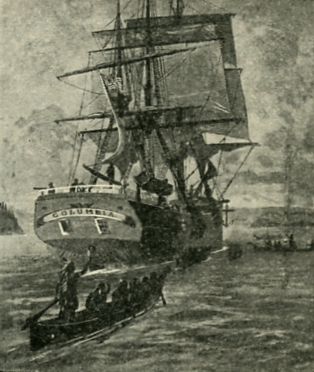
In fact the first American of European origin to sail a boat on the Columbia River was a native of Tiverton, Rhode Island - Captain Robert Gray.


Robert Gray was a merchant sea captain who undertook two trading voyages to the northern Pacific coast of North America, between 1787 and 1793, and pioneered the American maritime fur trade in that region.

He also completed the first American circumnavigation of the world in 1790.

Not many people know that.


During his 1792 journey, Gray noticed muddy waters flowing into the Pacific from the shore and decided to investigate whether he might have encountered the "Great River of the West."

On May 11 1792, he ordered a small sailboat launched to attempt to find a safe passage across the sand bars at the mouth of the river. On the evening of that day, his men found a safe channel, so he sailed his ship into the estuary of the Columbia River. Once there, they sailed upriver and Gray named this large river Columbia after his ship.


So that's why the Columbia River is called the Columbia River.

It's also why British Columbia is called British Columbia.

All down to some sailor from Tiverton.


Many years later, Woody Guthrie wrote a song about the Columbia River


And that's all I have to say about that.


Related posts
Down Down Down
Blowout of the Blowout
The Graveyard of the Pacific


Monday, June 01, 2015

First RS Aero Regatta in USA East of the Continental Divide


And so the big day arrived.

The first RS Aero regatta on the east coast of the US. (The Seattle fleet beat us by a couple of weeks to stage the first ever RS Aero Regatta in North America.)

Saturday was a perfect day for racing on Lake Massapoag, sunny, 80 degrees, wind from the SW in the mid-teens gusting into the 20s. Champagne sailing conditions.

I think that counting my days in an Aero in Minorca last year, the days in the demo RS Aero in Newport and Bristol in March and April, and the days on Lake Massapoag more recently in my own boat, this would be my 12th day sailing an Aero.

But I had never raced it before.


The race committee gave us 6 races with windward-leeward courses, usually 2 laps with a downwind finish, except for the last races of the morning and the afternoon when we had upwind finishes near the windward mark - and nearer to the club for post-race refreshments. As well as the 3 RS Aeros, there were 18 Sunfish and 8 Lasers at the regatta too.  The RS Aeros started with the Lasers, as we will for club racing. It seems to work out well and means less waiting around than if all the fleets had separate starts.


The short video gives you a good impression of what the sailing was like. But the caption "Tillerman Wins in an Aero" is totally wrong.  The blog reader who posted this video to YouTube exaggerated slightly. One Aero had already crossed the line so I was actually second Aero in that race, which is where I finished in the regatta too.

Not that I was too much worried about the result. My objectives for the day were basically…

1. Have fun.

2. Don't break anything on the boat.

3. Don't break anything on me.

4. Finish every race.

5. Have fun.

With a couple of minor exceptions to objective #3 (more in another post perhaps) all objectives were achieved.

Especially #1 and #5.


I can't remember the last time I had so much fun at a regatta.

I think I'll watch the video again now.