Photos shamelessly stolen from Sailing Anarchy
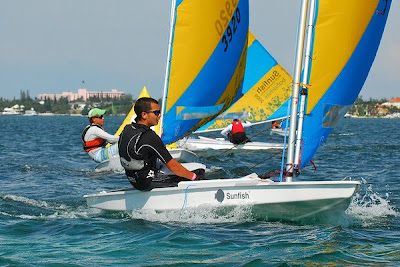 Welcome to the world of sailing blogging to new blogger, and my Blogger of the Week, SailFast13©.
SailFast13© is written by 16-year-old Brent J. Burrows (aka BJ) who is fortunate enough to live in the Bahamas. This past week he has been competing in the Sunfish Worlds in the Bahamas and blogging about it every day... in both text and video formats. In his profile he says, "I will discuss various regattas I have taken part in, as well as my sailing in general, and also how sailing is affecting my life. Videos and photos of my sailing campaign will also be posted." So it sounds like he is going to keep the blog going now the Worlds are over. He should.
I hope you enjoy BJ's accounts of his racing at the Worlds as much as I did. It sounds like it was a windy, fun regatta. I must admit that reading his stories made me a little nostalgic for my former life as a Sunfish sailor, and part of me wished I was out there with him thrashing around in the bottom half of a Sunfish Worlds fleet just like the good old days in Cartagena and Santo Domingo.
But it was an aside in Thursday's post that made me realize how much BJ and I are alike (even if we are separated by 45 years in age). He confessed, "The more I sail Sunfish, the more I can't wait to get into Lasers ."
Yes dude. I know exactly what you mean.
By the way is BJ the first blogger to include that little copyright symbol © in the name of his blog? Damn. Why didn't I think of that?
 Anal-retentive people (such as me) like numbers.
We like to use numbers to analyze things and measure things in order to make decisions that ordinary folk would just make on "gut-feel". This satisfies our preoccupation with details and organization. It feels good to us.
One example...
How do you decide whether to go to a particular regatta? You probably take into account such factors as the likely weather, how attractive the sailing venue is, who else is going, how much fun it will be... and then just go.
Not me. Not anal-retentive people. We need to work the numbers first.
It all started after that invitation I received to sail in the Asia-Pacific Laser Masters in Thailand next year. I wrote about it in the ironically titled Small World. "Ironic" because as I wrote the post I was actually thinking, "It's not a small world at all. Thailand is a hell of a long way to travel to go Laser sailing. How many hours would I have to spend cramped up in an airplane?"
Ahah. I had asked myself a question with a number as an answer. I could put a number on the "to go or not to go" question. And for that matter I could work out how many hours of traveling vs how many hours of sailing are involved for any regatta I might be considering.
Ahah. A ratio. Even better than a number. Anal-retentive people love ratios.
So I built myself a spreadsheet to calculate the hours sailing divided by hours travelling for all the potential sailing practices, clinics and regattas that I could conceivably attend.
Ahah. A spreadsheet. Even better than a ratio. Anal-retentive people love spreadsheets.
So now I can read off the S/T ratios and decide which sailing trips I really want to do. Here are a few examples. (A higher S/T means more sailing and less travelling and is a "good thing").
As a baseline I calculated the S/T for two sailing activities I have really enjoyed in the past...
- frostbiting at Cedar Point YC in Connecticut travelling from my former home in New Jersey
- Saturday afternoon practice at Lake Massapoag in Massachusetts travelling from my current home in Rhode Island
They both came out with S/Ts of approximately 1.000. (Anal-retentive people absolutely love meaningless decimal places.)
So then I looked at a couple of other options for sailing locally...
- solo practice for a couple of hours somewhere very local
- one day regatta at one of the relatively nearby locations around southern New England
These both came out with S/Ts of approximately 4.000. Woo hoo. That's very good.
What about driving longer distances to regattas?
- One-day regatta in Vermont or New Hampshire. S/T=0.667
- Drive to Florida for Laser Masters Week. S/T=0.640
Wow. That's bad. What a shame. I really wanted to go and sail in some of those other New England locations, and that Florida Masters Week sure sounded like fun. But the numbers do not lie.
How about overseas travel to regattas? (For the sake of simplicity, in this calculation I counted airplane hours and car hours as equally painful and monotonous, and just added them together.)
- Caribbean Midwinters and pre-regatta clinic in Cabarete. S/T=1.050
- 2010 Laser Masters Worlds in UK. S/T=1.500
Hmmm. Interesting. Not bad. But not as good as doing local regattas or local practice. Perhaps less is more?
And what about the regatta that started all this anal-retentive obsessive-compulsive decision making by the numbers orgy?
- 2010 Asia Pacific Laser Masters in Thailand. S/T=0.420
Ouch!!
Of course this way of looking at the issue will only make sense to other anal-retentive people. I'm sure this post is going to attract lots of comments from so-called "normal" people who think I'm crazy to analyze things this way, and who will urge me to seize the opportunity to travel all over the world to see exciting places and meet all kinds of new people, and who will tell me how the actual physical travel is all part of the experience and not to be seen as something to be balanced against the sailing, and who will chide me that if I took my analysis to its logical conclusion I would never travel outside of my tiny little state of Rhode Island.
Of course you are right. You are normal. I am not.
My name is Tillerman and I am an anal-retentive.
Another couple of posts came in before the deadline for this month's group writing project Less is More.
Earwigoagin has really entered into the spirit of the theme by writing more 'Less is More' posts than anyone else. (Or perhaps he is trying to prove the counter-argument?) Anyway, his third post harks back to his Boy Scout days: Less is More.... or Less; Anyway, It Beats Paddling! tells the tale of how he (re)invented a very minimalist style of sailing.
And Manfred writes about a 'Less is More' subject that is dear to my own heart: how sometimes a very small regatta can be a more special experience than a huge one.
Update: Oops, missed another one because of an email snafu. The delightfully named Emily Fabpants dreams of warm summer days on the Norfolk Broads.
Full wrap-up on 'Less is More' coming shortly. Thanks to everyone who participated. Once again you guys have exceeded my expectations.
Continuing my series of posts of Tillerman's Top Five Tips For Making Sure I Don't Die on my Laser, my third tip is... if you fall out of the boat for any reason, Hang on to the Mainsheet.
I guess this piece of advice is really just a means to following that instruction given to all beginning dinghy sailors: Stay With the Boat. I used to drum that into my little Opti students right from the first day on the water. If the boat capsizes or you fall out of the boat, stay with the boat. Do not under any circumstances try and swim to the shore. From my coach boat I can see an Optimist in trouble a mile away. I may not see a little head in the water 50 yards away if it's choppy. Also your boat floats so hang on to it.
Where was I? Oh yes, how to stay alive on a Laser. Or rather off a Laser.
In most capsizes it's not too difficult to maintain contact with the boat...
The best of all is the so-called "dry" capsize. The boat goes over to leeward; you step over the windward rail on the daggerboard; you right the boat and step back into the cockpit without ever getting your feet wet. The youngsters do this on about 90% of capsizes; with my slow reactions I do this on about 0.05% of capsizes.
Next best is when the boat goes over and you fall in the water next to the boat. You can swim round to the daggerboard while still in contact with the hull. No problem.
But there will be times when the boat decides to eject you in a way that will initially leave you some distance from the boat.
One method the boat uses to achieve this is when you have just completed a perfect tack to lee-bow "that guy" and as you hike out on the new windward side you realize (too late) that the boat has tricked you into not putting either of your feet under the hiking strap and so you fall backwards headfirst out of the boat and everyone around including "that guy" laughs their socks off.
Another favorite way for your Laser to eject you is the famous "death roll". This is a windward capsize when heading downwind which can happen so fast that you don't even know it's happened until you notice that you are totally underwater and the boat is sailing off without you.
It's occasions like these that you need to hang on to the mainsheet. Your Laser probably won't sail very far away without you in it, but some days it can go even faster without your 200+lbs of weight slowing it down. In particular, a Laser that has done one of those pretty death rolls where the boom stays sticking up in the air can sail surprisingly quickly downwind in a good blow.
So it's important to hang on to something that connects you to the boat. Now, of course you are already holding two things that connect you to the boat: the mainsheet and the tiller extension. For many beginners the instinct is to hang on to the tiller extension. Do not follow this instinct. When your body weight levers the tiller extension against the gunwhale of the boat as you fall in the water, only two things can happen, both of them bad: the tiller extension can bend (if made of aluminum) or it can break (if you have one of those fancy schmancy ones made of carbon fiber.) Either way it's going to be expensive, and either way you probably aren't going to be able to sail very well with it in its altered form. Worst case you are suddenly floating around on your own holding half of an expensive carbon-fiber tiller extension with a nasty jagged end while your boat runs away downwind on its own at a rate of knots.
So hang on to the frigging mainsheet. Say this mantra to yourself ten times every night before you go to bed.
Even if you do hang on to the mainsheet your troubles may not be entirely over. Nine times out of ten the boat will round up, capsize if hasn't done so already, or just generally behave itself while you reel it in and regain contact with the hull. I do recall one day though when I fell out of the boat (don't ask how -- some stupid mistake or other) and as I hung on to the mainsheet the boat carried on sailing downwind at great speed... dragging me along underwater as it did so. That was a fun ride I can tell you. It wasn't so much fun when I surfaced and realised that my involuntary underwater speed swim was so fast it had sucked my expensive prescription sunglasses (which were of course secured by a croakie) right off my head and they were now sinking into the depths of Lake Ontario and I was now as blind as a bat. There are days when I wish I wore contact lenses.
Anyway hang on to the mainsheet. I do pretty much all the time these days... except when I forget to, or when I am too busy using both hands to try and disentangle myself from the mainsheet of some other dude who is trying to strangle me.
And still they come. Yet more contributions for this month's Less is More jamboree.
First time participant in one of my writing projects, Antolin, has written a real gem. He remembers how his love for the water started... riding on his father's back and Hanging on to a line of buoys. I'm hoping we will see more articles from him in future group writing projects.
Then Andrew pushes the envelope of minimalist blogging saying Less is...
And Captain JP offers us some random thoughts on the topic of Less is more (more or less) and hints at more to come (if he can decipher what he wrote on his iPhone.)
Update: Oops I missed one. Pat has an excellent suggestion for how to enjoy more boating for less money and less hassle - the OPB gambit.
I'm going to extend the deadline until Wednesday midnight as a couple of folk have told me they are still hoping to present an offering at the altar of minimalism in boating. Full details of how to participate at Less is More.
Thanks to Antolin for this contribution to our Less is More group writing project...
I have always loved water. Being in the water swimming, body surfing, jumping waves, relaxing; just the feel of the ocean moving you about in one global watery embrace. We start our lives surrounded by water in the most loving environment we will ever have.
Now as a grown man, I still love the water with passion! Race and cruise her body on all sorts of sailboats. From very complicated ocean going fractional rigged racing machines to the sublime uncomplicated Laser (my beloved mid-life crisis solution). How it all started has to be the apex of the "less is more" equation.
As a young boy, dad always took me to the beach. Long walks on the beach holding hands with dad or running ahead "exploring" on my own always included entering the ocean realm. An avid swimmer, dad would always take me into the water way beyond mother's tolerance....as deep as I could be, the assurance of his presence always made me feel safe. I would climb on his back and he would ferry me about as he powerfully swam towards the buoy lined edge of the swimmers area, beyond it, the rest of the world.
Dad would then leave me "hanging" holding the rope that tied all the buoys together in a sine wave parallel to the beach and swim away for his part of the swim. There, clinging to the buoys' line I would see my dad disappear below the waves. Every now and then our bodies would be lifted by the swell at the same time and I could see him speeding away from the top of a cresting wave, splash all about him. The rest of the time, I would be isolated from every sight of land as the troughs between waves only allowed me to see blue water, blue sky.
At those times all there was in my world was the sea holding me. What a pleasure, me in that embrace. With on shore winds, the waves crashing about, the troughs shielding me from any sights or sounds but water and sky, total isolation, total immersion. My only connection to any outside world experience would be the feeling of the rough buoy line in my hands and that barnacle population clinging to the bottom of the buoy. The passing of time vanished.
Eventually, dad's smiling face would appear back from the deep ocean. We would hang together to the buoy line while he caught his breath and rest. The things we spoke about, the silences we shared just bobbing about hanging to the buoy line. Time to go back he would say. I would again climb on his back and he would swim me in. I now could wave hellos to mom waiting for us on the shore.
Proudly riding the ocean on dad's back I was king of the world. Dad was my first boat and if less is more, then I can say a finer vessel has yet to be found.