 My granddaughter likes to draw. She likes to draw in chalk on her drive. To be more truthful she likes grownups to draw things for her that she can "color in" a.k.a "scribble approximately between the lines". She is only two.
If you ask her what she would like you to draw for her she will answer 99% of the time, "Fish." I don't know why. Maybe her mind has been warped by exposure at too early an age to Joe Rouse's Fish on Fridays feature. Maybe it is a sign that she will grow up to be the world champion bass angler. Or maybe she just wants a design for a fish decal to stick on her campaign boat for the 2028 Olympics.
Or maybe the kid just likes fish. Whatever.
Anyway, in our family it has been a tradition for almost 30 years now that when a child has a birthday my wife, Tillerwoman, will make a birthday cake with a theme. I'm sure both my sons had boat cakes some years, there was definitely a Hickory Dickory Dock The Mouse Ran Up The Clock nursery rhyme cake one year, there was a train cake another year, and last year for her first birthday Emily had an Elmo cake.
You can guess where this is heading. This year, Mrs T just had to make a fishcake.

No, wait. That's not right. Not a fishcake. A birthday cake with a fishy theme. A fish cake.
So on the day before Emily's birthday party four of us, including master cake chef Mrs T, assembled to decorate Emily's cake.
 What do you think? Did we do well?
We all made something. Uncle Mike contributed a whale, a lobster and a seahorse. Aimee made the puffer fish and the octopus.

Even I, the only member of the group with no culinary or artistic skills whatsoever, made one fish. You can probably guess which one.
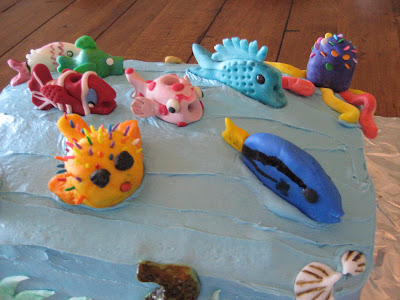 Tonight, Tillerwoman is promising to cook Fish and Chips for dinner. She is currently out shopping for malt vinegar and mushy peas. I am a lucky man.
Thanks to everyone who responded to my request for nominations for my list of Top Ten Sailing Blogs of 2007. There sure are a lot of fine sailing blogs out there so, thanks to your help, I'll be publishing the selection of my own favorites before the end of the year.
In the comments to that post, Edward of EVK4 SuperBlog came up with an excellent suggestion for "a complementary piece on the top ten sailing posts of the year. This would allow those blogs that post infrequently but brilliantly to have a voice."
What a great idea. There are some blogs that aren't really sailing blogs but that do occasionally come up with some superb posts about sailing. And as Edward says there are some blogs that probably wouldn't make the Top Ten Sailing Blogs list because they haven't posted consistently over the year, but there are still gems of posts tucked away in those blogs.
Edward's comment was a bit ambiguous about whether he was going to produce the list of Top Ten Sailing Posts of 2007 himself or whether he wanted me to do it. Edward, I fully concede that you thought of it first so, if you have the time what with your Laser Olympic campaign and all, you are certainly welcome to pull this one together.
But as a first step let's please have some suggestions and nominations for the list of Top Ten Sailing Posts of 2007. Individual posts not whole blogs please. Which posts inspired you, informed you, made you laugh out loud?
No suggestions of posts from Proper Course please. Much as I enjoy the obsequious flattery that some of you purvey, it's not going to win you a coveted Top Ten placing for your blog. On the other hand if you will send me the details of your PayPal account I'm sure we can come to some arrangement for a modest four figure sum.
The second in a series of articles discussing Stuart Walker's article in Sailing World on Unlocking the Mysterious Lake Winds with help from a "translation" of part of the article provided by Tom Donlan.
In Part 1 of this series, we set the scene by talking about "gradient" and "thermal winds" and why local thermal winds are often the dominant factor in lake sailing.
In the second part of the second paragraph of his article, Dr Walker discusses the kinds of wind to expect on a lake on a clear day when the sun is shining. This is classic Walker.... one sentence running on for nearly 70 words... technical words explained in phrases in parentheses... text galloping madly on and and on.
So let's take it slowly and find out about each kind of wind one by one. I've split Walker's words of wisdom into numbered bullet points, one for each type of wind, to make it somewhat easier to follow.
Cold lakes can only expect a sailing wind on clear days in the presence of insolation (surface heating by the sun), and the winds that are then most likely are
- a morning offshore downslope wind,
- an afternoon onshore lake breeze,
- or an afternoon offshore expansion differential wind (created when the pressure levels above an elevated lake fail to rise as much as those above the surrounding heated lowlands).
- Then thermal turbulence (heated air rising and expanding and cooler air sinking above the near-shore heated land) brings the cool air on the upper mountain slopes down to the lake
- or brings the cool marine air onshore in a lake breeze
- and brings upper, higher velocity airflow in an overflowing gradient or expansion differential wind offshore onto the lake surface.
The first two winds seem fairly straightforward. Expect air flowing over the land on to the lake in the morning. And then as the land warms up in the sun, expect a thermal breeze blowing towards the land in the afternoon.
Or as Donlan puts it (with my bullet points added again)...
On a clear, sunny day, a lake sailor may experience
- a morning offshore wind coming down the slope from surrounding hills and then
- an afternoon thermal lake breeze blowing toward the warm shore.
So far so good. If only life were so simple.
Another option according to Walker is an offshore breeze in the afternoon, or as he puts it, "an afternoon offshore expansion differential wind (created when the pressure levels above an elevated lake fail to rise as much as those above the surrounding heated lowlands.)"
You see, this is why I find Walker hard to read. I trust his information is correct because of his reputation but I don't find that last idea very helpful. I sort of understand the physics of why the situation he describes would cause an offshore wind. But I want to know when that condition would occur. And why. And how I can predict when it will happen. It's not much use to be told in effect, "in the afternoon the wind may blow offshore; then again it may not."
Let's see if Donlan conveys that thought any more clearly...
A lake high in the mountains, however, may generate an afternoon wind blowing off the shore if there is a great deal of temperature difference between the water and the surrounding land.
Aha. I think I get it now. If the water is warm and the land is cold, then the land may not warm enough to generate a thermal onshore breeze, so you get an offshore breeze in the afternoon instead. At least I think that's what he means. And at least there's some information in the Donlan version that I can use to predict what will happen in the afternoon.
And if the thermal onshore breeze doesn't kick in, Walker says you can get any or all of winds 4, 5 and 6 which basically means
- it could be offshore
- it could be onshore
- it could be the gradient wind.
Thanks Doctor. I feel like one of your patients and you have just described that I have some awful medical condition and when I ask you what it means you tell me, "Well you could go blind, or impotent, or you might die tomorrow." Thanks Doctor.
Let's see how Donlan delivers the prognosis...
Heated air rising and expanding above the warm land near shore and cooler air sinking above the water near shore can create turbulence. This disruption can do almost anything.
It can bring the cool air on upper mountain slopes down to the lake, like the morning breeze. It can bring the cool moist air over the lake onshore in a lake breeze. It can even bring strong breezes from the overhead gradient wind onto the lake surface, in whatever direction the gradient wind happens to be blowing. Sometimes it can do all of these things simultaneously within short distances.
lol as they say on the forums. lmao even. I love that phrase, "This disruption can do almost anything." And then having described the three kinds of winds you might see, he delivers the coup de grace, "Sometimes it can do all of these things simultaneously within short distances."
Ah. That's the lake sailing I know. Anything can happen anywhere. Some wind. No wind. Wind from almost any direction. I'm sailing a beat and that boat on the same leg 50 yards away is on a run. Yes, that's lake sailing.
So, to sum up, what have we learned today? On a sunny day on a lake, expect an offshore breeze in the morning that might be replaced by a thermal onshore breeze in the afternoon if the land warms up enough in the sun. If not, anything can happen and probably will.
Comments welcomed. Especially if I have misinterpreted what the experts say. Does this explanation so far align with your experience of lake sailing?
Tacticat the online sailing tactical simulator just keeps improving. In the last week or so tides have been added to the program introducing all sorts of fun new realistic effects such as being swept on to the windward mark by the current.
There's also an action replay feature which I suggest you try if you want to gain a feel for the simulator. Go to the American Gold regatta from last night and click on where it says #6 REPLAY [SKIFF]. (You will see why I suggest this race shortly.)
I hope this works on your computer. For some reasons I have to click on the link, wait a few seconds, and then click on it again to get the Java applet to load properly. (Hey, I never said it was perfect.)
Once the applet starts you can click on F1 to see the full list of commands some of which you will need to control the view in the replay. Z and X zoom in and out. W controls different displays of wind. U controls display of current. You can left-click on the display to re-center what part of the race course you are viewing.
The race countdown clock is in the top left-hand corner. There are controls at top center to pause or slow the action, and a slide to fast forward at top right.
You will see the sailors chatting to each other before the start and during the race. The exchanges about ICISC relate to my Small World post from a few days ago. You will see some dude called Litoralis foul himself on my transom just before the start and then see him complaining at other boats that he thought were too slow at the start.
But note how that yellow boat aces the start, picks the correct side of the course, nails the layline (well almost) and leaves the fleet in his wake. As they say, "Even a blind nut can find a squirrel occasionally." Or something like that.
So you've read on some blog or other about Laser sailing and decided it sounds like fun. You went down to watch your local Laser fleet racing and saw people of all ages, sizes and genders out racing Lasers, and now you're certain that Laser sailing is for you. But you're nor sure whether you need to buy a Standard Rig or a Radial Rig... or even something called a 4.7 whatever that is.
Well let me try and explain. Basically it all depends on your weight.
When the Laser was first launched over 35 years ago it came with one size of sail. It quickly became very popular, but over the years it became apparent that for lighter people, especially smaller women and younger teenagers, it was more than they could handle in a real blow. It was clear that a smaller, less powerful rig was needed for the boat to become popular with lighter people.
One attempt to solve this problem was called the M-rig. It never really caught on. If you see one for sale I don't recommend you buy it. There are very few of them around and you won't find any other M-rigs to race against.
The real breakthrough in solving the issue of making the boat more manageable for lightweight sailors was the Laser Radial. This uses a shorter more flexible bottom mast section and a radial cut sail with 18% less area than the standard rig. The Radial is now immensely popular for youth and women's racing. Indeed the Radial is the single-handed boat for women in the Olympic games.
It was then discovered that many kids who learned to sail in Optimists and aspired to sail Lasers had a problem. There was a weight range when they were really too heavy for an Optimist but not quite heavy enough for a Laser Radial. So the Laser 4.7 Rig was introduced. This uses a shorter pre-bent mast section and a sail with an area of 4.7 square meters, smaller again than the Radial sail.
So now we have the Laser range....
The Laser 4.7 which suits sailors who weigh roughly 75 to 120 lbs.
The Laser Radial for sailors who weigh 120 to 155 lbs.
The Standard Laser for sailors who weigh over 150 lbs.
Of course these are not hard and fast rules. Any sailor, however light they are, can sail a Standard Rig Laser in very light winds. But as the wind picks up a lightweight will find it harder to keep the boat flat and when it gets very windy they will be so overpowered that they will be capsizing way too often for it to be fun any more.
Also skill level and fitness make a huge difference. A young fit expert sailor of 130 lbs would probably be faster than a heavy, clumsy old doofus like me in a Standard Rig, even in heavy weather.
Some sailors own Radial and Standard Rigs and switch according to the conditions. In light winds they sail the Standard Rig; then on a day with a real blow they sail the Radial. The hull and almost all the equipment is the same. All you need to change is the sail and the bottom half of the mast.
One caveat. At least in North America, the 4.7 rig has been positioned as being for kids transitioning from Optimists to the Laser. The major regattas for 4.7 rigs are for juniors only. So if you are an adult weighing 110 or 115 lbs say, I would advise going with the Radial, not the 4.7. You won't find other adults to race against in the 4.7. (Of course you could always buy a 4.7 rig as well so you can go out and practice and have fun when it's blowing dogs off chains if you want.)
Sailing is a small world. It's amazing how you run into the same people at different times in different parts of the world. There's probably one of those weird "degrees of connection" rules in sailing. And I would hazard a guess that, in sailing, we're all connected to each other by three or fewer degrees of separation.
I've written once or twice here already about running into people I knew at sailing clubs or regattas that I never expected to meet in that context. But last night I had the most unusual "small world" moment yet.
I was sitting at home in Rhode Island feeling sorry for myself (still no sailing as my back injury heals slowly) and playing Tacticat. I like to check the profiles of my fellow competitors to see who they are and where they are from. I noticed that a couple of the other sailors in the race had the same last name, a rather unusual name, and I remembered that some guy in my first sailing club in England whom I hadn't seen for about 25 years had the same last name. A quick instant message (being careful not to be typing at the same time that I might need to make a sudden steering change in the race) as to whether there was some connection to the guy from last century, and I received the reply, "Yes, that's the old man."
So I'm playing a virtual sailing game with two young guys who are the sons of the ace from my first sailing club. A connection that spans three thousand miles and a quarter of a century. Small world indeed.
Do you have any "It's a Small World" sailing stories?
"I split with the leaders, find a little booster shot on the left, and nip Bethwaite at the finish line for the bullet. Life is good."
No, I didn't write that. It's a quote from Spanish Lessons, an account of the 2007 Laser Masters Worlds in Roses written by Bill Symes. Bill was sailing in the same fleet as me at Roses, but he's a much better sailor than me, and a much better writer.
So enjoy his story, the story I wish I could have written about the regatta I wish I could have had.


